Posted on

Why Becoming a Software Engineer or Enterprise Software Consultant Is Often Easier Than Selling B2B Software

Many people assume that selling software must be easier than building it. The logic seems simple at first glance. Software engineers and consultants must understand complex systems, write code, and solve technical problems, while salespeople only need to explain the product and convince someone to buy it. In reality, the situation is often the opposite. In many cases, becoming a software engineer or enterprise software consultant is actually easier than becoming successful at selling B2B software.

The main reason lies in how predictable the learning path is. Software engineering and enterprise consulting have relatively structured skill development. A person can study programming languages, practice building applications, and gradually develop the ability to solve technical problems. The same is true for enterprise software consulting. Someone can learn how systems like SAP, Salesforce, or other business platforms work, study how companies use them, and steadily build expertise over time. Progress in these fields is largely based on knowledge and experience, which can be accumulated in a fairly consistent way.

B2B software sales, on the other hand, is much less predictable. Selling enterprise software requires convincing companies to spend significant amounts of money on a product that may affect their operations for years. These decisions often involve multiple stakeholders, long evaluation processes, and a high level of skepticism from buyers. Even a highly skilled salesperson may face months of conversations, demonstrations, negotiations, and internal reviews before a deal closes.

Another challenge is that B2B sales outcomes are heavily influenced by factors outside the salesperson’s control. A prospect may initially show strong interest but suddenly postpone the purchase because of budget changes, internal politics, or shifting priorities. Deals that seemed almost certain can disappear without warning. This level of uncertainty makes success in enterprise sales extremely difficult to master.In contrast, technical roles reward persistence and competence more consistently. A programmer who learns how to build reliable software can usually find opportunities to apply those skills. An enterprise consultant who understands how to configure complex systems can become valuable to companies that rely on those tools. The work may be intellectually demanding, but the relationship between effort and progress is generally clearer.

Sales also requires a particular temperament that not everyone possesses. Successful B2B salespeople must tolerate rejection regularly and remain motivated despite frequent setbacks. Many conversations lead nowhere, and a large portion of prospects never become customers. The ability to stay confident and persistent through these experiences is a rare trait.

Technical professionals face challenges as well, but the nature of those challenges is different. When an engineer encounters a difficult problem, the solution usually exists somewhere in documentation, experience, or experimentation. When a salesperson loses a deal, the outcome may have little to do with their effort or preparation. External circumstances often play a decisive role.

Another factor is the level of competition for attention in B2B sales. Many companies selling enterprise software are targeting the same pool of potential customers. Decision-makers receive countless sales emails, calls, and demonstrations every week. Breaking through that noise requires not only skill but also timing and persistence.

None of this means that B2B software sales is impossible or unappealing. In fact, the people who succeed in this field can earn extremely high incomes because their role directly generates revenue for the company. However, the path to success is often much less straightforward than the path to becoming a technical expert.

For individuals deciding between technical and sales careers in the software industry, it is worth understanding this difference. Learning to build or configure enterprise software requires discipline and technical curiosity, but the progression is relatively clear. Mastering B2B sales requires navigating human psychology, organizational complexity, and unpredictable market conditions.

In the end, both paths demand effort and dedication. The difference is that technical careers usually follow a more structured learning curve, while success in enterprise software sales often depends on a combination of skill, resilience, and timing that can be much harder to control.

Posted on

How a Strong Content Website Can Become a Valuable Asset for Outside Investors

Many people think of websites primarily as platforms for publishing information or sharing ideas. While that is certainly true, a well-built content website can also become something much more significant. Over time, a successful site can develop into a valuable digital asset that outside investors may be willing to purchase.

A content website becomes valuable when it consistently attracts visitors and generates reliable revenue. This revenue may come from advertising, affiliate partnerships, sponsorships, digital products, or services promoted through the site. As the audience grows and the income becomes predictable, the website begins to resemble a small media business rather than simply a collection of articles.Investors are often interested in businesses that generate stable cash flow. A content website with strong traffic and diversified revenue streams can fit this description surprisingly well. Once a site ranks in search engines and develops an established audience, it may continue attracting visitors for years with relatively modest ongoing maintenance. This makes the revenue from the site appear attractive to buyers who want predictable income.

The value of a content website often depends on its financial performance. Buyers frequently evaluate websites based on how much profit they produce each month or each year. A site that earns steady income can sometimes be sold for a multiple of its annual profit, similar to how other small businesses are valued. In some cases, the sale price may represent several years of expected earnings.

Another factor that increases the value of a website is its authority and reputation. Websites that rank well in search engines and attract loyal readers are difficult to replicate quickly. Building that authority often requires years of publishing high-quality content and earning trust within a particular niche. Because this process takes time, investors may prefer to acquire an existing website rather than starting one from scratch.

Content websites are particularly attractive to investors when they operate in industries where businesses are already spending money to reach customers. When a website focuses on topics such as software, finance, education, or professional services, it often becomes a gateway to high-value audiences. Companies in these industries frequently advertise or form partnerships with websites that can connect them to potential customers.

As a result, a successful content website can eventually be viewed not just as a creative project but as a marketable asset. Private investors, digital media companies, and online business aggregators sometimes acquire websites specifically because they generate traffic and revenue. These buyers may expand the site, improve its monetization strategies, or integrate it into a larger portfolio of digital properties.For the person who originally built the website, selling to outside investors can represent a significant financial opportunity. Years of writing articles, building an audience, and optimizing the site for search engines can ultimately translate into a lump-sum payment when the website changes hands.

The broader lesson is that content on the internet can create more than just influence or visibility. When a website consistently delivers useful information and attracts a loyal audience, it can evolve into a real business with measurable financial value. In the right circumstances, that business can eventually be sold to investors who recognize the long-term potential of a well-established online platform.

Posted on

High Domain Authority Blogs Can Charge for Guest Posts

As the internet has grown more competitive, visibility in search engines has become one of the most valuable assets a website can possess. Businesses, entrepreneurs, and marketers all compete for attention online because strong search rankings can generate consistent traffic and customers. In this environment, blogs that have built strong domain authority often discover that their websites themselves become valuable platforms. One way they monetize that value is by charging for guest posts.

Domain authority is essentially a measure of how trusted and influential a website appears to search engines. When a blog consistently publishes high-quality content, earns links from other reputable sites, and attracts steady traffic, it gradually develops a reputation within search algorithms. This reputation increases the likelihood that its pages will rank well in search results. As that authority grows, links coming from the blog become more valuable to other websites that want to improve their own visibility.

Guest posting originally emerged as a collaborative practice between writers and bloggers. Someone with expertise on a topic would contribute an article to another blog in order to share knowledge and reach a new audience. In return, the writer usually received a link back to their own website or business. Over time, however, marketers realized that guest posts could also serve another purpose. The link within the article could help improve the search engine ranking of the writer’s website.

Because of this, businesses began actively seeking opportunities to publish guest articles on authoritative blogs. A single link from a respected website can sometimes help a company’s pages rank higher in search results. When enough businesses start competing for those opportunities, the blog hosting the content begins to control a valuable resource.

Blogs with strong domain authority often receive large numbers of guest post requests from marketers, agencies, and companies looking to promote their websites. Reviewing, editing, and publishing these submissions takes time and effort. Many blog owners also recognize that publishing external content involves risk, since low-quality articles could damage the site’s reputation. Charging for guest posts becomes a way to compensate the blog owner for the time spent reviewing submissions and maintaining the quality of the site.

From the perspective of the business purchasing the guest post, the payment can still make sense. If a company earns a valuable backlink from a trusted website, the long-term improvement in search rankings can generate traffic and potential customers for years. In that context, paying for a guest post can be viewed as a form of marketing investment rather than simply a publishing fee.

For the blog owner, charging for guest posts becomes another revenue stream that complements advertising, affiliate marketing, and product sales. A blog that has spent years building authority through consistent publishing may find that other businesses are willing to pay meaningful amounts for the opportunity to appear on the platform. The stronger the site’s reputation, the more valuable those opportunities become.

Of course, maintaining quality is essential. Blogs that allow too many low-quality guest posts can quickly lose the authority that made them valuable in the first place. Responsible blog owners carefully review submissions and ensure that the content still provides value to readers. When done correctly, paid guest posts can become a sustainable business model that rewards blogs for the credibility they have built over time.

In the end, charging for guest posts reflects a simple economic principle. When a website earns strong domain authority, it gains influence within search engines and within its niche. That influence becomes a scarce and valuable resource, and businesses seeking visibility are often willing to pay for the opportunity to be associated with it.

Posted on

Why Making Money Online Is Mostly About Choosing the Right Niche

Many people believe that making money online is mainly about working harder, producing more content, or mastering complicated marketing tactics. While effort and skill certainly matter, the single most important factor is often much simpler: choosing the right niche.

A niche determines who your audience is, what problems they are trying to solve, and how much money they are willing to spend on those solutions. When someone builds an online business in a niche where customers already spend significant amounts of money, almost every part of the business becomes easier. Traffic converts better, partnerships are more valuable, and each customer interaction has greater economic potential.

The opposite is also true. If someone builds a website, social media account, or digital product around a niche where people rarely spend money, it becomes extremely difficult to generate meaningful income. Even if the content attracts a large audience, the underlying economics may simply be too weak. Millions of visitors can still translate into very little revenue if the audience has no strong reason to buy anything.

This is why some niches consistently produce profitable online businesses while others struggle to generate revenue. Industries such as business software, financial services, education, health, and professional tools involve problems that people are willing to pay significant money to solve. When an audience is actively searching for solutions in these areas, a creator who introduces the right product or service can generate meaningful income from a relatively small number of customers.

In contrast, many online creators choose niches that revolve primarily around entertainment or casual interest. These topics can attract large audiences, but the financial opportunities are often limited. When people are browsing content simply for enjoyment, they are far less likely to spend money compared to someone searching for a solution to a costly problem.

Choosing the right niche also determines the type of products and partnerships available. In high-value niches, companies offer affiliate programs, consulting opportunities, software partnerships, and premium services that can generate substantial commissions. When the niche involves expensive products or services, even a small number of conversions can produce significant income.

Another advantage of selecting the right niche is that it attracts a more focused audience. Instead of trying to appeal to everyone, successful online businesses often serve a specific group of people with a clear problem. This focus makes it easier to produce relevant content, build trust, and position products as meaningful solutions rather than generic promotions.

Many people who struggle to make money online assume that they simply need more traffic or better marketing tactics. In reality, the underlying niche may be the problem. If the audience is not financially motivated or the available products are inexpensive, even excellent marketing will struggle to produce large results.

This is why experienced online entrepreneurs often spend a great deal of time analyzing markets before launching a project. They look for niches where people already spend money and where businesses are competing to acquire customers. These signals indicate that the market contains real economic value rather than just attention.

In the end, making money online is rarely about clever tricks or secret strategies. It is mostly about aligning your work with a market where solving problems creates real financial value. When the niche is right, the entire business model becomes stronger. When the niche is wrong, even the most dedicated effort may struggle to produce meaningful results.

The difference between a profitable online business and an unprofitable one often comes down to a single decision made at the beginning: choosing a niche where people are already willing to pay for solutions.

Posted on

Why Learning by Trial and Error Often Leads to a Roundabout Path to Success

Many people imagine success as a straight line. In this idealized version of progress, someone decides what they want to accomplish, follows a clear plan, and steadily moves forward until they reach their goal. In reality, very few people experience progress in such a clean and predictable way. For those who learn primarily through trial and error, the path to success is usually far more indirect.

Trial and error is one of the oldest and most powerful forms of learning. Instead of following a precise blueprint, a person experiments, observes the results, adjusts their approach, and tries again. Each attempt provides new information, even when the outcome is disappointing. Over time, this process gradually builds experience and understanding that cannot easily be gained from theory alone.

However, the downside of this approach is that progress often looks messy. When someone learns by experimentation, they inevitably spend time exploring ideas that do not work. They pursue strategies that fail, invest energy in projects that stall, and occasionally move in directions that later prove unproductive. From the outside, this can make their journey appear inefficient or disorganized.

In truth, these detours are not wasted effort. Each unsuccessful attempt eliminates one more possibility and brings the learner closer to understanding what actually works. The knowledge gained through mistakes often becomes the foundation for future breakthroughs. What looks like wandering is often the process of mapping unfamiliar territory

.This pattern is especially common in fields like entrepreneurship, sales, creative work, and technology. In these areas, there are rarely clear instructions that guarantee success. Markets change, customer behavior evolves, and new tools appear constantly. People operating in these environments must often rely on experimentation to discover which strategies produce results.

Because of this, individuals who rely on trial and error must develop patience with the process. The early stages of learning may feel slow or uncertain because the person is gathering information rather than executing a perfected plan. It can take time for patterns to emerge and for the lessons from past experiments to accumulate into real expertise.

Over the long run, however, this form of learning often produces deep practical knowledge. Someone who has tested many different approaches tends to understand a field more thoroughly than someone who has only followed instructions. They know not only what works, but also why certain strategies fail and under what conditions different tactics become effective.

When success finally arrives, it often appears sudden to outsiders. People may assume that the individual simply discovered the right formula or had a stroke of good luck. What they rarely see is the long series of experiments, setbacks, and adjustments that gradually led to that moment.

Understanding this dynamic can help people remain motivated during the uncertain stages of learning. A roundabout path does not mean a person is lost. It often means they are exploring, testing ideas, and collecting the experience necessary to navigate the terrain more confidently later on.

In many cases, the indirect route is not a flaw in the process. It is the process itself. Those who learn by trial and error are not following a straight road, but they are steadily building the knowledge that eventually makes success possible.

Posted on

Why Being a Realtor Doesn’t Work Financially for Most People

Real estate is often marketed as one of the easiest ways to build a lucrative career. Many people are drawn to the profession by stories of large commissions, flexible schedules, and the possibility of making six figures without spending many years in school. While these success stories are real, they hide a much harsher truth about the industry. For most people who attempt to build a career as a realtor, the financial results are far less impressive.

The core challenge is that real estate sales is a commission-based business. Realtors are only paid when a transaction closes, and those transactions can take months to complete. During that time, the realtor may spend significant effort showing homes, meeting clients, marketing listings, and negotiating deals without earning anything. If the deal falls apart, all of that time and effort produces no income.

Another major difficulty is the number of people competing in the field. In many cities there are far more licensed real estate agents than there are homes being sold. Because the barriers to entry are relatively low, thousands of people enter the industry each year hoping to take advantage of the large commissions that successful agents earn. The result is a highly competitive environment where a small percentage of agents close the majority of transactions while many others struggle to find consistent clients.

Expenses also play a role in reducing the financial viability of the career. Realtors often have to pay for licensing fees, brokerage fees, marketing materials, professional photography, advertising, and transportation. Many agents also spend money on lead generation services or online platforms designed to connect them with potential buyers and sellers. These costs can add up quickly, especially for agents who are still trying to establish themselves.

The income volatility of the profession can also make it difficult to rely on real estate as a stable career. Even successful agents may experience periods where deals are slow or markets become less active. Housing markets move in cycles, and when interest rates rise or economic conditions weaken, the number of transactions can decline significantly. Because realtors depend entirely on closed sales, their income often fluctuates with the broader real estate market.

There is also a strong network effect within the industry. Experienced agents who have been working in a city for many years often dominate the market because they have built large referral networks. Past clients recommend them to friends and family, which creates a steady stream of new business. New agents entering the industry usually do not have these relationships, which means they must spend a great deal of time prospecting for leads before they can build a reliable pipeline of transactions.

This dynamic leads to a situation where a relatively small group of top performers earns a large share of the commissions, while many agents close only a handful of deals each year. For those agents, the income often does not justify the time, expenses, and uncertainty involved in trying to maintain the career.

None of this means that success in real estate is impossible. Many realtors build extremely profitable businesses by developing strong networks, specializing in certain types of properties, or becoming experts in specific neighborhoods. However, these results typically come after years of persistence and relationship building rather than quick success.

The key reality is that the profession is much closer to entrepreneurship than traditional employment. Realtors are essentially running their own small sales businesses, and like most businesses, many do not produce large profits. The stories of agents earning huge commissions are real, but they represent a small segment of a much larger industry where many participants find the financial rewards much harder to achieve than they initially expected.

Posted on

What an SAP Consultant Is and Why It Can Be a Powerful Career Path

Modern corporations rely on complex software systems to manage everything from accounting to manufacturing to supply chains. One of the most important of these systems is SAP, a type of enterprise software used by many of the world’s largest companies. Behind every successful SAP implementation are professionals known as SAP consultants, specialists who understand both the software itself and the business processes it supports.

An SAP consultant is a professional who helps organizations implement, customize, and maintain SAP software. SAP systems are designed to manage core business functions such as finance, logistics, procurement, human resources, and production. Because these systems sit at the center of a company’s operations, implementing them correctly requires a deep understanding of both technology and business workflows. SAP consultants act as the bridge between these two worlds. They work with company leaders and employees to understand how the organization operates, and then configure the software so that it supports those processes efficiently.

The work often involves translating real business needs into technical solutions. For example, a manufacturing company may need to track raw materials, manage production schedules, and monitor inventory across multiple warehouses. An SAP consultant would design the system so that all of these functions are integrated and visible within the software. In many cases the consultant also trains employees, helps migrate data from older systems, and ensures that the software continues running smoothly after it goes live.

One reason SAP consulting can be such an attractive career path is the scale and importance of the systems involved. Many of the world’s largest corporations depend on SAP to run their operations. When a system manages billions of dollars in transactions, the companies using it are willing to pay very well for experts who understand how to configure and maintain it properly. Because of this, experienced SAP consultants are often highly compensated and in strong demand.

Another advantage of this career path is that it combines technical knowledge with business understanding. Some SAP consultants focus on the technical side, working with programming tools and system architecture. Others specialize in particular business areas such as finance, supply chain management, or human resources. Over time, consultants often develop deep expertise in a specific module of the software and become valuable advisors to companies implementing those systems.

The path to becoming an SAP consultant usually begins with learning how large organizations operate. Many consultants start their careers in fields like accounting, logistics, or information technology. Understanding real business processes makes it much easier to configure enterprise software effectively. Once someone has that foundation, they begin learning the SAP platform itself. This often involves formal training, certification programs, or working for a company that already uses SAP internally.

Experience is extremely important in this field. Many consultants first gain exposure to SAP by working inside a company that runs the software. Others join consulting firms that specialize in enterprise software implementations and learn by assisting on projects. Over time they become more familiar with the system, the terminology, and the typical challenges companies face when deploying enterprise software.

As consultants gain experience, their value often increases significantly. Organizations implementing SAP frequently require guidance from professionals who have worked on multiple projects and understand how to avoid costly mistakes. Consultants who develop a strong reputation can eventually move into senior advisory roles, lead large implementation teams, or even start their own consulting firms.

For people interested in technology, business operations, and high-value enterprise systems, SAP consulting offers a career path that can be both intellectually challenging and financially rewarding. It sits at the intersection of software and real-world business operations, allowing professionals to play a direct role in helping large organizations function more efficiently.

In a world where companies rely heavily on complex software to run their operations, professionals who understand how those systems work will continue to be valuable. SAP consultants are a clear example of how technical expertise combined with business insight can create a powerful and durable career.

Posted on

The Early Adopter’s Dilemma: Why SaaS Companies Chase Scale Through Constant Reinvention

There is an enormous amount of capital flowing into the SaaS ecosystem right now, and for good reason. Software-as-a-Service businesses represent some of the most attractive investment opportunities in the modern economy. Their recurring revenue models create predictable cash flows that investors love, their gross margins tend to be exceptionally high once they achieve product-market fit, and their potential for exponential growth makes them the darlings of venture capital firms and growth equity funds alike. Walk into any pitch meeting on Sand Hill Road or in London’s Tech City and you will find partners eager to write checks that help these companies scale from promising startups to category-defining giants.But there is a fascinating tension at the heart of this dynamic that often goes unexamined. The very same SaaS companies that attract these massive investments in scaling infrastructure are also the businesses most likely to abandon that infrastructure for something newer, shinier, and theoretically more efficient. They are the quintessential early adopters, perpetually restless, always convinced that the next technology wave will be the one that finally unlocks their true potential.

This restlessness is not merely a personality trait of SaaS founders, though many do fit the stereotype of the perpetually unsatisfied technologist. It is structural to the business model itself. SaaS companies sell software that promises to make their customers more efficient, more agile, more capable of responding to market changes. To maintain credibility in this sales motion, they must demonstrate that they themselves are operating at the technological frontier. A SaaS company running on five-year-old infrastructure is like a fitness coach who does not exercise. The misalignment between promise and practice becomes obvious to anyone paying attention.

The implications of this early adopter tendency ripple throughout the organization and fundamentally shape how these companies consume capital. When a SaaS business raises a Series B or C round to scale its operations, a significant portion of that funding often goes toward technology migration rather than pure expansion. The company might have built its initial product on a monolithic architecture that made sense when speed to market was the only priority, but now faces pressure to re-platform onto microservices to support enterprise customers. It might have written its application in a programming language that was popular three years ago but is now seen as limiting for hiring top engineering talent. Its data infrastructure, sufficient for thousands of users, suddenly requires complete overhaul to handle millions.

Investors understand this dynamic intellectually but often underestimate its costs in practice. The pitch decks they review show clear paths to scale with assumptions about customer acquisition costs and lifetime value ratios. They rarely include line items for the technical debt that must be paid down through platform migrations, or the productivity loss that occurs when engineering teams spend quarters rebuilding functionality that already worked rather than developing new features. The capital allocated for growth gets diverted into reinvention, and the timeline to profitability stretches further into the future.What makes this particularly challenging is that the early adopter impulse is often correct in the long run even when it is painful in the short term. The SaaS companies that dominate their categories typically are those that made bold technology bets before their competitors. They moved to cloud infrastructure while others maintained on-premise data centers. They adopted containerization and orchestration early, giving them operational advantages that compounded over time. They experimented with machine learning integration before it became table stakes, creating product differentiation that was difficult to replicate.

The reward for being early is market leadership, but the cost is constant instability. Engineering teams at scaling SaaS companies live with a permanent sense of transition. The tools they master today may be deprecated tomorrow. The architectural patterns they implement this year will be labeled legacy code within eighteen months. This creates a unique culture of continuous learning that attracts certain personality types and repels others. It favors engineers who are intellectually curious and emotionally comfortable with ambiguity, while those who prefer deep expertise in stable systems often find themselves frustrated and eventually depart for industries with longer technology cycles.

From a capital allocation perspective, this creates interesting questions about what it means to invest in “scaling” a SaaS business. Traditional industrial scaling meant buying more machinery, hiring more workers, opening more facilities. The marginal cost of each additional unit of production decreased as volume increased. In SaaS, scaling often involves rebuilding the factory while simultaneously trying to increase output. The economics are different, the risk profiles are different, and the management challenges are substantially more complex.

The early adopter tendency also affects how SaaS companies hire and retain talent. They must compete for engineers who have their own early adopter instincts, professionals who want to work with the latest frameworks and tools rather than maintaining mature systems. This creates a talent market where experience with emerging technologies commands premium compensation, and where companies feel pressure to adopt new tools partly to maintain their employer brand. The decision to migrate to a new frontend framework or database technology is rarely purely technical. It is also a human resources strategy, a way of signaling to potential hires that this is a place where they will not stagnate.

Customers feel the effects of this restlessness too, sometimes positively and sometimes negatively. On the positive side, SaaS early adopters often pass along the benefits of technological advancement to their users in the form of better performance, new capabilities, and improved security. The customer who subscribed to a marketing automation platform five years ago likely has access to far more sophisticated features today than they did at signup, often without significant price increases. On the negative side, they must cope with interfaces that change without warning, integrations that break when underlying technologies shift, and occasionally the complete discontinuation of products that were acquired or deprecated as part of platform consolidation.

The most sophisticated SaaS buyers have learned to account for this instability in their vendor evaluation processes. They look beyond current feature checklists to assess a vendor’s architectural flexibility and technical decision-making culture. They ask hard questions about data portability and API stability. They negotiate contract terms that protect them from the disruption that inevitably follows when their vendor decides to replatform yet again. These buyers understand that they are not just purchasing software but entering into a relationship with an organization that will look technologically different in two years than it does today.

For the SaaS companies themselves, the challenge is to balance early adopter enthusiasm with the discipline required to actually scale. There is a difference between being strategically early on technologies that create competitive advantage and being distractingly early on every new tool that emerges from the startup ecosystem. The most successful scaling SaaS businesses develop frameworks for technology evaluation that help them distinguish between genuine inflection points and passing fads. They create architectural principles that provide stability even as individual components evolve. They maintain engineering cultures that value craftsmanship and maintainability alongside innovation and experimentation.

This balance is difficult to achieve because the incentives often push in the opposite direction. Founders who have raised capital on promises of rapid growth feel pressure to demonstrate progress through visible technological change. Engineering leaders want to build resumes that show experience with the latest technologies. Board members read industry publications and ask why the company has not yet adopted whatever approach is currently being celebrated in the tech press. Against these pressures, the case for stability and incremental improvement can be hard to make.

Yet those SaaS companies that do achieve this balance often become the most valuable. They scale efficiently because they are not constantly rebuilding. They serve customers reliably because their platforms are mature and well-understood. They generate profits rather than just revenue because their engineering resources are focused on customer value rather than internal reinvention. They prove that it is possible to be technologically sophisticated without being perpetually restless, to innovate in customer-facing ways while maintaining stable foundations.

The money will continue to flow into SaaS because the underlying economics remain compelling. But investors and operators alike would benefit from more honest conversations about what scaling actually requires in this sector. It is not simply a matter of pouring capital into proven playbooks and watching businesses grow. It is a complex exercise in managing technological change, in knowing when to lead and when to follow, in building organizations that can simultaneously execute for today and prepare for tomorrow. The SaaS companies that master this duality will capture the value that others leave on the table, converting early adopter energy into sustainable competitive advantage rather than permanent transition.


Posted on

Why SaaS Founders Shouldn’t Be Afraid to Cold Email Venture Capitalists

Many founders assume that venture capital is a closed network where introductions are mandatory and only the well-connected can get through the door. This belief discourages many software builders from even attempting to contact investors directly. In reality, venture capitalists are constantly searching for new opportunities, and many of the best conversations begin with something far simpler than a warm introduction: a thoughtful cold email or a well-timed cold call.

Venture capitalists make their money by discovering companies with the potential to grow rapidly. Their entire business depends on finding founders who are building something valuable before the rest of the market fully notices. Because of this, investors spend an enormous amount of time looking for new ideas and teams. A SaaS founder reaching out directly is not an annoyance when the message is clear, professional, and relevant. In fact, many investors expect founders to contact them directly because the flow of new startups is the lifeblood of the venture capital industry.

For a SaaS builder, the advantage of direct outreach is speed. Instead of spending months trying to engineer introductions through networks, events, or mutual acquaintances, a founder can immediately begin conversations with investors who specialize in their market. If you are building software for logistics companies, fintech platforms, healthcare infrastructure, or developer tools, there are venture firms whose entire investment strategy revolves around those categories. Reaching out directly allows you to put your product in front of someone who is already looking for opportunities exactly like yours.

Cold outreach also forces founders to communicate clearly. When you write a cold email to an investor, you must explain what your software does, why it matters, and why it has the potential to grow quickly. This exercise often improves the clarity of your pitch. If you cannot summarize your company in a few strong sentences, investors will struggle to understand it during a meeting as well. The discipline of crafting direct outreach messages helps refine the narrative around your product.

Many founders are surprised to learn that venture capitalists read far more cold emails than people assume. Investors constantly evaluate potential deals, and a large percentage of them come from direct outreach. While not every message will receive a response, the cost of sending an email or making a call is extremely low compared to the potential upside of securing funding, mentorship, and connections that can accelerate a company’s growth.

Cold calling can also work when done thoughtfully. While email is the most common method of outreach, calling a firm and asking whether a partner is open to hearing about a new SaaS product is not unreasonable. Venture firms are small organizations, and partners are often accessible. A short, respectful conversation that quickly explains the opportunity can sometimes lead to a request for more information or a follow-up meeting.

Of course, success with cold outreach requires professionalism and preparation. Investors receive many messages, so founders need to demonstrate that they understand the firm’s investment focus and that their product fits within that strategy. A generic pitch sent to hundreds of funds is unlikely to succeed. A targeted message that explains why the investor’s portfolio, thesis, or past investments make them a good match is far more compelling.

For SaaS founders, the broader lesson is simple. Building software already requires initiative, persistence, and the willingness to solve difficult problems. Reaching out to investors directly is simply another extension of that mindset. Venture capital may appear exclusive from the outside, but at its core it is an industry built on discovering ambitious founders.

Sometimes the conversation that leads to funding, partnership, or long-term mentorship begins with something surprisingly simple: a single email or phone call sent by a builder who decided not to wait for permission to introduce themselves.

Posted on

What Enterprise Resource Planning Software Actually Does

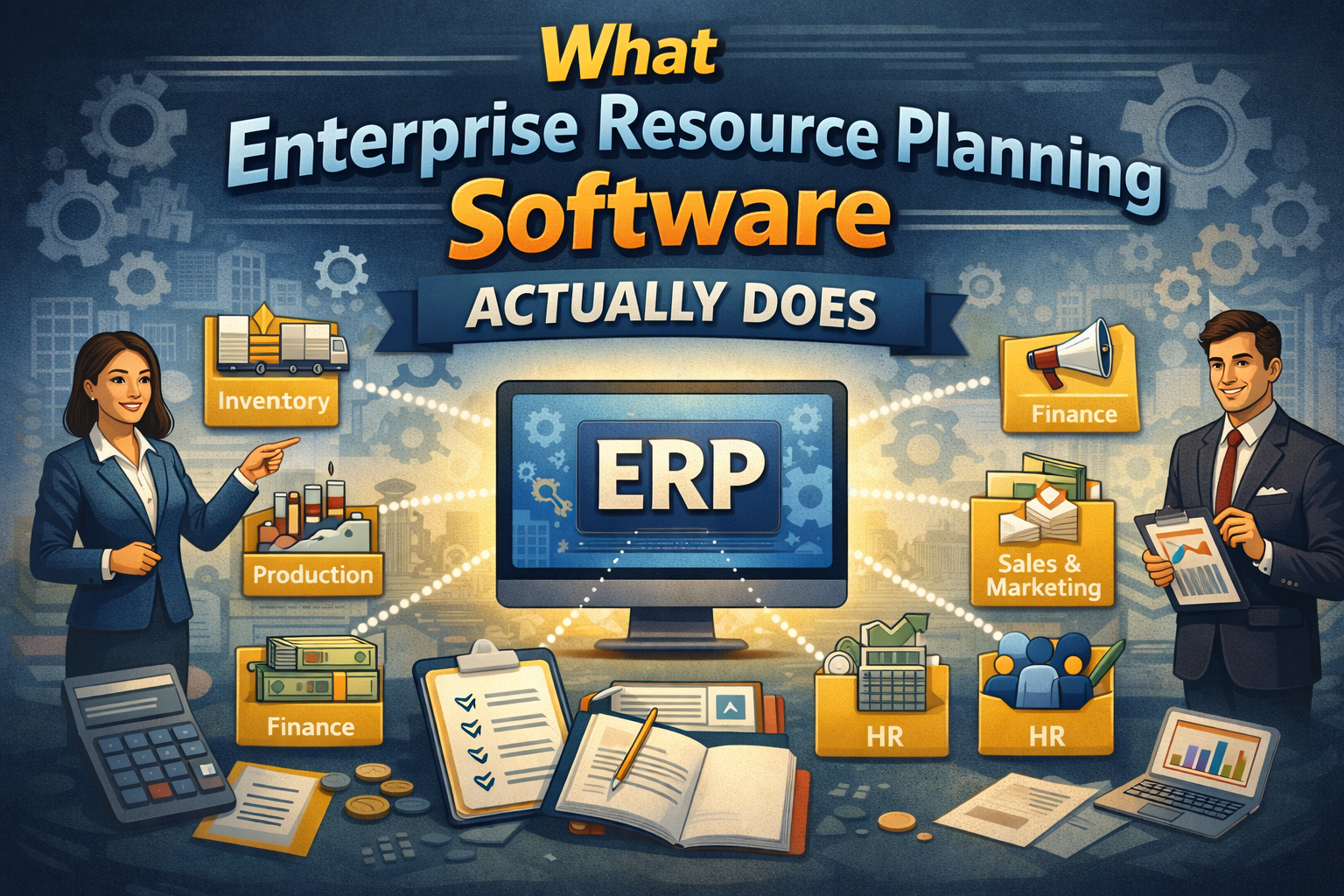
Enterprise Resource Planning software, often shortened to ERP, is one of the most important types of software used inside modern businesses. While it rarely receives the same public attention as consumer apps or flashy technology products, ERP systems quietly run the internal operations of many of the world’s largest companies. At its core, ERP software exists to bring together all of the major functions of a business into a single unified system.

Most organizations operate through several departments that each handle a different responsibility. Accounting manages finances, human resources manages employees, operations oversees production or service delivery, and sales tracks revenue and customers. In smaller companies these functions may be handled through spreadsheets, separate software tools, or manual processes. As a business grows, however, these disconnected systems begin to create problems. Information becomes fragmented, data is duplicated, and decision makers struggle to see what is actually happening inside the company.

Enterprise Resource Planning software solves this problem by integrating these functions into one centralized platform. Instead of having financial data in one system, employee information in another system, and inventory data somewhere else, an ERP system connects everything together. The result is that information flows through the company in a coordinated way rather than being trapped inside isolated departments.

A typical ERP system contains modules that represent different parts of the business. These modules allow companies to manage financial accounting, track inventory, process orders, handle payroll, manage procurement, and monitor operations. Because the modules share the same underlying database, a change made in one part of the system immediately updates the rest of the organization. When a sales order is created, inventory levels update automatically. When payroll is processed, financial records update without manual entry.

This integration dramatically reduces the amount of administrative work required to run a company. Instead of employees manually copying information between systems, the software handles the flow of data automatically. The reduction in duplication and errors allows companies to operate more efficiently and with far greater accuracy.

Another major benefit of ERP software is visibility. Business leaders rely on accurate information in order to make decisions. When data is scattered across different tools and departments, it becomes difficult to understand the true financial health of the company or the status of operations. ERP systems solve this by providing a single source of truth. Managers can see revenue, expenses, inventory levels, production output, and workforce information in one place.

This visibility becomes especially important as companies grow larger and more complex. A small business might be able to manage its operations informally, but a global organization with thousands of employees cannot rely on disconnected spreadsheets. ERP systems allow these organizations to coordinate their activities across multiple offices, countries, and divisions while maintaining consistent processes.

Large technology companies have built enormous businesses around ERP software. Companies such as SAP, Oracle, and Microsoft have developed platforms that serve enterprises across manufacturing, logistics, finance, retail, healthcare, and many other industries. Implementing one of these systems can take months or even years because the software often becomes the central nervous system of the entire organization.

Despite the complexity of these systems, the underlying idea behind ERP software is simple. Businesses run more efficiently when their information is organized, connected, and accessible. Instead of every department operating independently, the entire organization works from the same data and the same processes.

In many ways, ERP software represents the digital infrastructure of modern business. Just as roads and power grids allow cities to function, ERP systems allow large organizations to coordinate their internal operations. They may not be visible to the public, but they quietly power the everyday activities that keep companies running.