Posted on

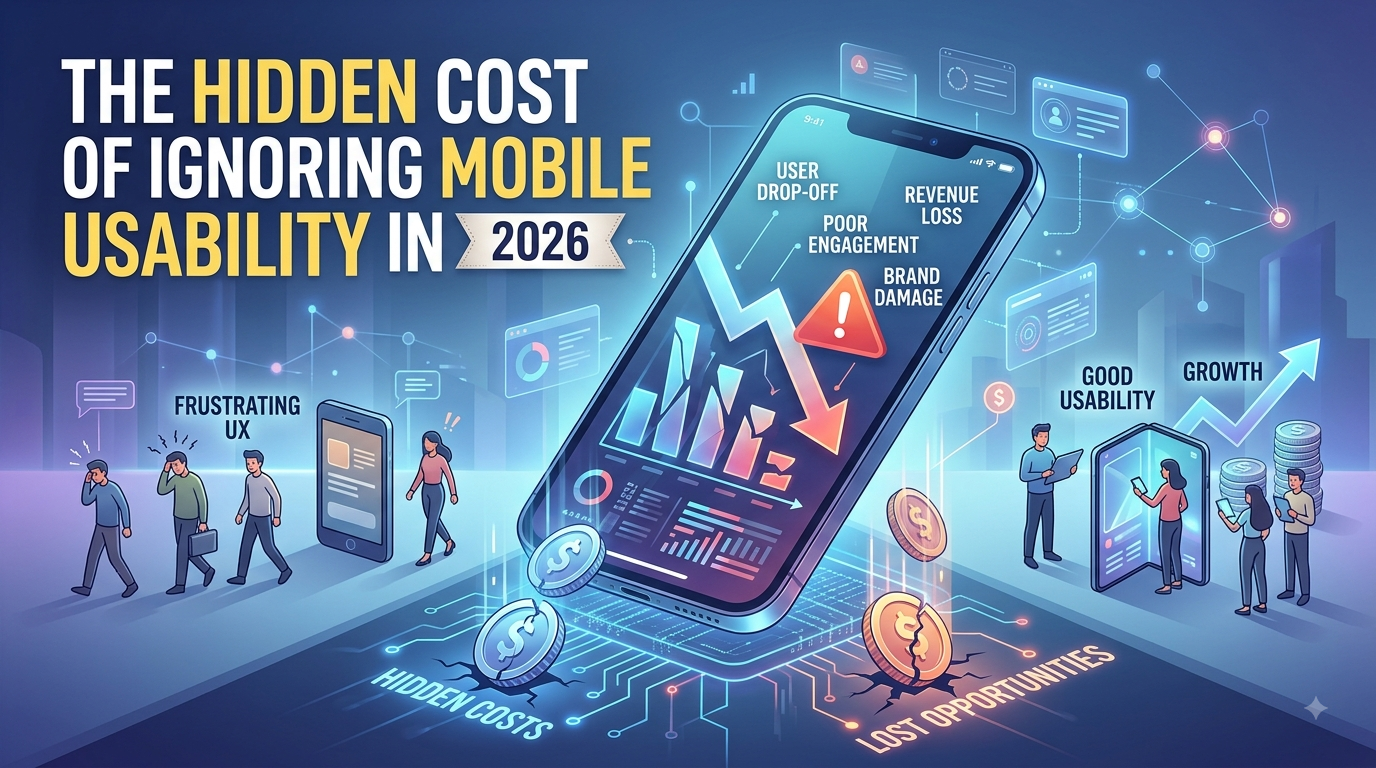
The Hidden Cost of Ignoring Mobile Usability in 2026

If you run a SaaS product or a small local business, there’s a good chance more than half your visitors are already arriving on a phone. And there’s a good chance you’ve never actually tested your site the way they experience it: one thumb, a cracked screen, spotty wifi, and zero patience for anything that doesn’t work on the first tap.

Mobile usability isn’t a design nicety anymore. It’s a revenue line item, and most businesses are bleeding money from it without ever seeing the number.

Mobile Isn’t the Future Anymore. It’s Already the Majority.

For years, “mobile-friendly” was treated as an add-on to the “real” desktop site. That thinking is now backwards. Across most industries, mobile devices account for well over half of all web traffic, and for many small businesses and SaaS landing pages, it’s closer to two-thirds. Your homepage, your pricing page, your signup form, your checkout flow: all of it is being judged primarily on a six-inch screen, whether you designed it that way or not.

When a business still tests only on desktop and treats mobile as an afterthought, it’s optimizing for the minority of its own visitors.

For SaaS Businesses, Mobile Friction Kills Trials Before They Start

SaaS companies live and die by signup conversion rates, and mobile usability problems hit that funnel especially hard because the stakes are so front-loaded. A prospective user who lands on your site from a LinkedIn ad or a Google search is making a split-second judgment about whether your product is worth their time. If the signup form is broken on mobile, if a dropdown menu doesn’t render properly, if the “Start Free Trial” button is hidden below a slow-loading hero video, that prospect doesn’t file a bug report. They just leave.

The damage compounds because SaaS trials are often the entire top of the funnel. A single broken mobile input field isn’t a small UX issue, it’s a leak at the very top of the pipeline that quietly reduces every number below it: trial signups, activation, and eventually paid conversions. Founders often spend heavily to drive traffic to that page and never realize a meaningful percentage of it never had a real chance to convert.

For Local and Small Businesses, It’s Even More Direct

A SaaS company loses a trial signup. A local business loses a phone call, a table reservation, or a walk-in customer who gave up trying to find your hours. Small business searches skew even more heavily mobile than SaaS searches do, because people are usually looking for something nearby, right now: a restaurant to book, a plumber to call, a store that’s still open. That’s an intent-heavy, impatient moment, and it has zero tolerance for a site that’s slow to load or hard to tap through.

A tiny “Call Now” button that’s nearly impossible to hit accurately, a menu page that requires pinching and zooming to read, a booking form that times out on a spotty connection: these aren’t cosmetic flaws. They are the exact moment a ready-to-buy customer decides to call the next business on the list instead.

The Cost Is Invisible Because It Never Shows Up as an Error

This is what makes mobile usability problems so dangerous: they rarely throw an error message or show up in an obvious way. Nobody gets an alert saying “23 potential customers gave up on your mobile checkout today.” The visitor simply leaves, and from the business owner’s side, it just looks like traffic that didn’t convert. Most people assume that’s a marketing problem, so they spend more on ads to drive more traffic into the same broken funnel, which only scales the loss.This is exactly the kind of issue a site audit is built to catch, because it requires actually testing the experience the way a real visitor would encounter it, rather than assuming the desktop version “basically” works everywhere.

What Good Mobile Usability Actually Looks Like in 2026

Good mobile usability isn’t about a page technically rendering on a small screen. It’s about whether someone can accomplish their goal with one thumb, on a real connection, without frustration. That means buttons and links sized for a fingertip rather than a mouse cursor, forms that use the right input types so a phone’s keyboard adapts automatically, pages that load quickly even on a weaker connection, and critical actions like “buy,” “book,” “call,” or “start trial” placed where they’re immediately visible rather than buried under a slow hero image.

For SaaS products specifically, it also means testing the actual signup and onboarding flow on a phone, not just the marketing homepage. That flow is often where the most expensive mobile usability failures hide, because it’s the part of the site most likely to have been designed and tested on a desktop screen by the product team.

Whether you’re running a SaaS platform trying to fill the top of your funnel or a local business trying to convert nearby searches into customers walking through the door, mobile usability failures cost you the same way: silently, continuously, and without ever showing up as a line item you can easily point to. The businesses that treat mobile as the primary experience rather than an afterthought are the ones keeping the customers everyone else is quietly losing. A proper site audit is often the only way to see exactly where that loss is happening, because it’s the one exercise built specifically to catch what a normal desktop review never will.


Posted on

The Real Way to Land Enterprise Clients: Become the Authority They Already Trust

Most people trying to land enterprise clients approach the problem backwards. They build a sales deck, hire a business development person, start cold emailing procurement departments, and wonder why nothing moves. Enterprise buyers are risk averse by nature. They are spending someone else’s budget, they will be judged on the outcome, and they cannot afford to bet on a vendor nobody has heard of. The fastest and most durable way to become the obvious choice is not to chase these buyers directly. It is to build enough traffic and enough visible authority that they come looking for you already convinced.

Enterprise Buying Is a Trust Problem Before It Is a Product Problem

When a large company evaluates a new vendor, the actual product comparison often happens late in the process. What happens first is a kind of quiet vetting. Someone on the buying committee searches your name, reads what you have written, checks whether you show up in industry conversations, and forms an impression before a single sales call takes place. If that search turns up a thin website and no independent evidence that you know what you are talking about, you are already fighting an uphill battle no matter how good the product is. If instead it turns up a body of substantial, well distributed content that consistently ranks and gets shared, you walk into that first call already partially sold.

Traffic Is a Proxy for Credibility, and Enterprise Buyers Read It That Way

Nobody on a buying committee says out loud that they are impressed by your monthly visitor count, but the underlying signal still reaches them. High traffic means other people, often their peers or competitors, have already found your content valuable enough to read, share, and link to. That accumulated attention functions as social proof at scale. A single glowing testimonial is nice, but ranking for the terms an entire industry searches, or being the piece that keeps getting referenced in conversations and forwarded internally, tells a buyer that the market has already vetted you before they ever spoke with you.

Becoming a High Authority Figure Changes Which Conversations You Get Invited Into

There is a meaningful difference between reaching out to a company and having someone at that company already familiar with your work before you reach out. Once you are recognized as an authority in a space, whether through consistent publishing, speaking, or simply showing up wherever your buyers already pay attention, the dynamic shifts. Inbound interest starts to replace outbound effort. People forward your content to the decision maker. A procurement manager researching vendors finds your name attached to the ideas that shaped how they think about the category in the first place. At that point you are no longer pitching a stranger, you are confirming what they already suspected, that you understand the problem better than anyone else they could hire.

Content and Traffic Compound in a Way Sales Outreach Never Does

A cold email campaign produces results for as long as you keep sending emails, and the moment you stop, the pipeline dries up. Content built to earn traffic and reinforce authority behaves differently. An article that ranks well, a resource that becomes the reference point for a topic, or a body of work that consistently shows up in searches keeps working long after it was published. Each new piece adds to the credibility of everything that came before it, and the traffic it earns continues introducing you to new enterprise buyers with no additional effort. Over time this builds a kind of gravitational pull where the right prospects find their way to you instead of the other way around.

Authority Also Shortens the Sales Cycle Once the Conversation Starts

Even after a lead comes in, the effect of established authority does not stop working. Enterprise sales cycles are often long specifically because internal stakeholders need convincing at every level, and each of those stakeholders will independently look you up. If they consistently find evidence that you are a serious, credible voice in the space, objections dissolve faster and the internal case for choosing you gets easier for your champion to make. You are effectively doing part of the selling before the deal team ever gets involved, simply by having built a reputation that precedes you.

Landing enterprise clients is rarely won through outreach alone, because outreach cannot manufacture the trust that large organizations require before committing real budget to a vendor. That trust is built through visibility and credibility earned over time, through traffic that proves the market already values what you have to say and authority that proves you understand the problem at a deeper level than the competition. Companies chasing enterprise clients would do well to spend less energy trying to get in front of buyers and more energy becoming the figure those buyers are already looking for when the search begins.

Posted on

Why the Best Blogs in 2026 and Beyond Will Live on YouTube Too

For twenty years, blogging and video lived in separate worlds. You either wrote or you filmed. That separation is now gone, and the blogs that keep pretending otherwise are going to fade into irrelevance. The reason is simple and structural: Google owns YouTube, and Google’s search results increasingly favor content that comes from, or connects to, its own video platform. A written blog that ignores this reality is competing with one hand tied behind its back.

The Search Landscape Has Quietly Changed

Google has spent years blending video directly into search results. Type almost any how-to question, product comparison, or explainer topic into Google, and you’ll see video thumbnails sitting above or alongside the traditional blue links. Those thumbnails almost always pull from YouTube. This isn’t an accident or a side experiment. It reflects how Google’s ranking systems have evolved to reward multimedia relevance, and YouTube is the single largest source of video content Google can draw from with full confidence in its metadata, watch time, and engagement signals. A blogger who never touches video is voluntarily giving up one of the most visible slots on the search results page.

Google and YouTube Are Not Two Companies Working Together, They Are One System

It helps to stop thinking of YouTube as a separate platform that happens to be Google-owned and start thinking of it as an extension of Google’s search infrastructure. Watch history, search history, click behavior, and channel authority all feed into a shared understanding of what a creator or brand is about. When a blog and a YouTube channel are linked, consistently branded, and reinforcing the same expertise, Google can build a much richer picture of that creator’s authority than it can from text alone. This matters enormously for topical authority, which has become one of the more durable ranking factors as Google’s algorithms have grown better at understanding entities rather than just keywords.

Video Solves the Trust Problem That Text Alone Cannot

Readers today, especially younger ones, are more skeptical of pure text than they were a decade ago. Anyone can generate a wall of confident-sounding prose in seconds now, and audiences know it. A face on camera, a real voice, a demonstration that clearly happened in real time, these are much harder to fake convincingly and much easier for a reader to trust. A blog paired with a YouTube channel gives the audience a way to verify that a real, knowledgeable person is behind the content. That trust signal translates into loyalty, return visits, and the kind of engagement that both readers and search algorithms reward.

Repurposing Content Multiplies Its Reach Without Multiplying the Work

The smartest blogs in 2026 are not treating YouTube as an entirely separate content operation requiring double the effort. They are treating it as a second format for the same underlying research and expertise. An article becomes a script outline. A tutorial becomes a screen recording. A roundup becomes a talking-head video with the same points delivered conversationally. This repurposing lets a single piece of research or expertise show up in two different discovery channels, the traditional web search results and YouTube’s own massive internal search engine, which is itself one of the largest search engines in the world independent of Google.com.

Embedded Video Improves the Blog Itself

There is also a direct, practical benefit that has nothing to do with algorithms. A blog post with an embedded video tends to keep visitors on the page longer, and dwell time remains a meaningful quality signal. A written guide paired with a short video walkthrough serves readers who prefer to watch and readers who prefer to read, without forcing a choice. This dual-format approach respects that people consume information differently, and it turns a single blog post into a more complete resource than either format could be alone.

Building the Channel Does Not Require a Film Studio

The barrier here is lower than most writers assume. A blogger does not need professional lighting, an expensive camera, or a scripted production pipeline to start building a connected YouTube presence. A phone, decent audio, and the same expertise that already goes into the writing is enough to begin. What matters more than production value is consistency and clear alignment between what the blog covers and what the channel covers, so that Google’s systems and human readers alike see one coherent body of expertise rather than two disconnected projects.

Blogging has not been replaced by video, and it will not be. But the blogs that thrive from here forward will be the ones that stop treating text and video as competitors and start treating them as two expressions of the same authority. Because Google and YouTube are fundamentally one connected system, a blog with no video footprint is invisible in an entire layer of search results that increasingly matters. The blogs that adapt now, by building even a modest, consistent YouTube presence alongside their writing, will be the ones still growing in 2026 and beyond.

Posted on

You Can’t Afford a Marketing Team. You Can Afford a Blog Post

If you run a small business, you already know the drill. Marketing agencies want a monthly retainer. Ad platforms want a daily budget that never stops. Social media wants fresh content every single day, forever, or the algorithm forgets you exist.It’s exhausting, and for most small businesses, it’s simply not affordable. So a lot of owners give up on marketing altogether and hope word of mouth does the job.But there’s a category of marketing that doesn’t work like the rest — and it’s easy to overlook because it doesn’t come with a subscription. A blog post.

Rented Attention vs. Owned Attention

Most marketing is rented. You pay for an ad, it runs, it stops. You pay for a boosted post, it shows up in feeds for a day or two, then it’s gone. The moment you stop paying, the visibility disappears with it. You’re renting attention, and the lease is very short.

A blog post is different. You write it once, publish it, and it sits on your website indefinitely. Someone can find it through a search engine six months from now, two years from now, and it still does its job — introducing your business, answering a question, building trust — without you spending another dollar to keep it there.

That’s the core difference: rented marketing disappears the second you stop paying. Owned marketing keeps working after you’ve moved on to something else.

Why This Matters for a Tight Budget

If you can only afford a handful of marketing dollars a month, where you put them matters enormously. Spending on something that evaporates in 48 hours means you’re starting from zero next month. Spending on something that compounds means next month you’re building on top of what you already have.A well-written blog post can:

Keep showing up in search results long after it’s publishedAnswer the exact questions your potential customers are typing into Google

Give you something to link to from social media, email, and other content instead of creating from scratch every time

Build a body of work that makes your business look established and credible

None of that happens with a single ad campaign, no matter how well it performs while it’s live.

So When Is It Worth Paying Someone?

Not every blog post needs a professional. But there are moments where paying for good writing and strategy pays for itself many times over:Cornerstone content — the handful of posts that explain what you do, who you serve, and why you’re different. These get linked to and referenced for years.High-intent topics — posts answering the specific questions people ask right before they’re ready to buy.

Anything you plan to reuse — a post that becomes the basis for social captions, email content, or a sales page pays for itself several times over.

You’re not paying for 30 days of visibility. You’re paying for an asset that keeps earning long after the invoice is settled.

You may not be able to justify a retainer for ongoing digital marketing, and that’s a reasonable call for a lot of small businesses. But don’t let that stop you from investing, occasionally and deliberately, in content that doesn’t expire. A blog post you own outlasts an ad campaign you rent — and over time, that difference adds up to real, compounding value.

Posted on

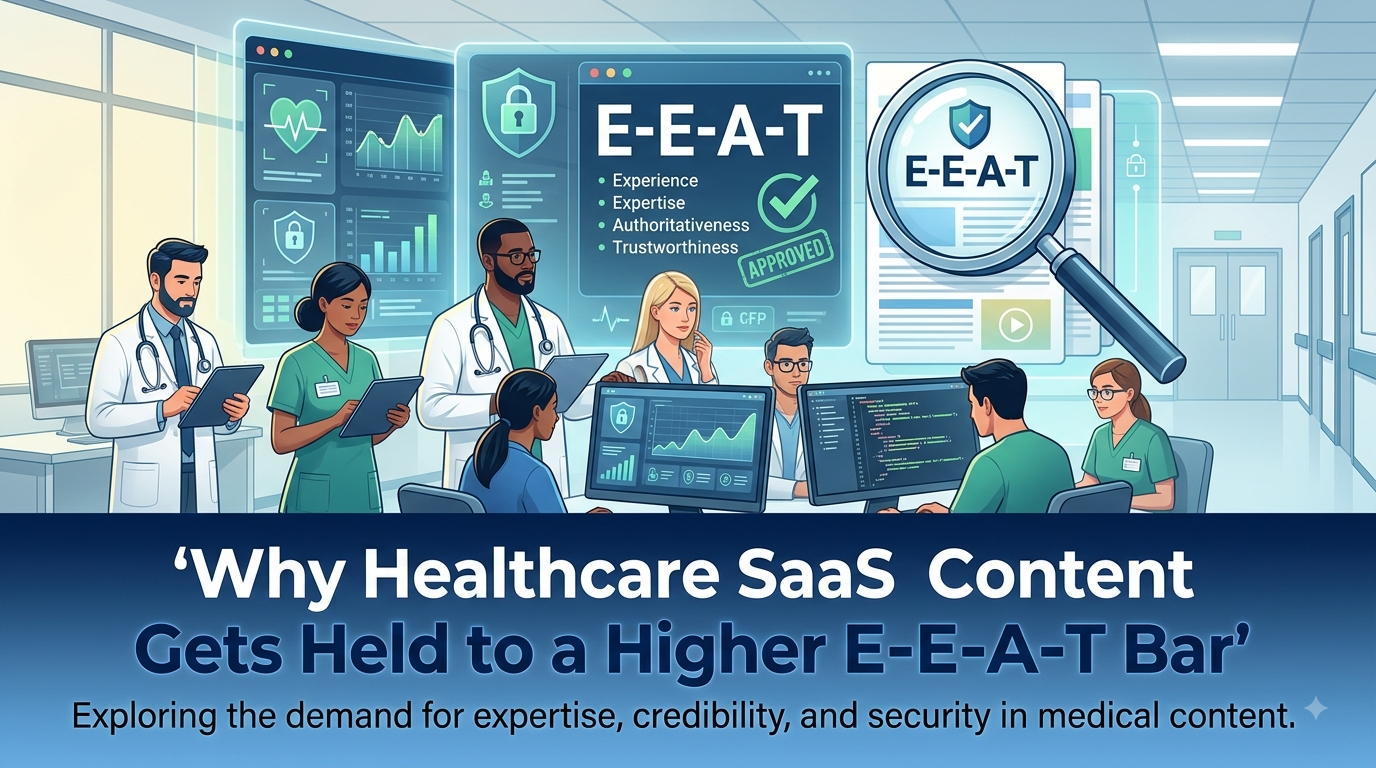
Why Healthcare SaaS Content Gets Held to a Higher E-E-A-T Bar

Write a blog post about the best productivity apps and Google will evaluate it on the same general terms as most other content: is it useful, well-organized, reasonably credible. Write a blog post that touches on patient safety, clinical workflows, or health data, even tangentially, and you’re suddenly operating under a different and much stricter set of rules. Google classifies this territory as Your Money or Your Life content, and healthcare SaaS marketing teams who don’t understand what that classification actually triggers tend to be baffled by why their well-written, keyword-optimized content still doesn’t rank.

YMYL Isn’t About Your Product, It’s About the Topic

The YMYL designation doesn’t care whether you’re selling software or practicing medicine. It cares whether the content could plausibly affect someone’s health, safety, or financial wellbeing if it’s wrong. A blog post explaining how your platform helps reduce medication errors falls squarely into that territory, even though you’re not a pharmacy and you’re not offering medical advice. The moment content brushes up against clinical outcomes, patient safety, or health data handling, Google’s quality systems start asking a harder question than they would of a typical SaaS blog: can this be trusted, and can that trust be verified.

This matters because a lot of healthcare SaaS marketing teams write with the instincts of a general B2B content strategy, optimizing for keyword coverage and search volume, without registering that the topic itself has quietly moved them into a category where credibility signals carry disproportionate weight in how the content gets evaluated and surfaced.

Expertise Has to Be Demonstrable, Not Implied

In most SaaS categories, a confident, well-researched blog post is enough to establish authority. In healthcare, confidence isn’t a substitute for demonstrable expertise, and Google’s guidelines are explicit that YMYL content should be produced or reviewed by someone with relevant subject matter expertise. A generalist content writer, however skilled, explaining the clinical implications of a workflow change is a weaker signal than the same content reviewed and attributed, even briefly, to a clinician or someone with a relevant credential.

This is why a lot of healthcare SaaS companies that take content seriously build a light clinical review step into their editorial process, not because every post needs a physician co-author, but because a visible reviewer credential changes how both search engines and human readers assess the content’s trustworthiness. It’s a real cost, in time and sometimes in fees paid to a clinical reviewer, and it’s one of the clearest ways this space diverges from standard SaaS content production.

Authorship and Bios Do More Work Here Than Elsewhere

A generic “written by the marketing team” byline is unremarkable on most B2B blogs. On a healthcare SaaS site, the absence of a named, credentialed author on clinically adjacent content is a missed opportunity at best and a credibility gap at worst. Author bios that specify relevant background, whether that’s a nursing credential, a health IT certification, or years spent in clinical operations, give both readers and search algorithms something concrete to evaluate rather than an anonymous voice making claims about patient care.

This doesn’t mean every piece of content needs an elaborate bio. Content about integration architecture or pricing doesn’t carry the same YMYL weight as content about reducing diagnostic errors. But teams that apply the same authorship treatment to everything, either over-crediting low-stakes content or under-crediting high-stakes content, are missing where the actual scrutiny falls.

Claims Need Citations, Not Just Confidence

General SaaS marketing can get away with unsupported claims about efficiency or satisfaction because the stakes of being wrong are low. In healthcare content, an unsupported claim about clinical outcomes is a bigger liability, both for search visibility and for the compliance reasons covered elsewhere in this space. A statement like “reduces documentation errors” reads very differently depending on whether it’s followed by a citation to a study, a specific customer result, or nothing at all. Google’s guidelines increasingly reward content that shows its work, linking to primary research or providing verifiable data, over content that simply asserts a benefit and moves on.

This creates a genuine tension for marketing teams who are used to writing punchy, declarative copy. Softening a claim to make it defensible can feel like it weakens the pitch. In practice, a specific, sourced claim tends to outperform a vague, confident one anyway, both with skeptical buyers and with the ranking systems evaluating the content’s trustworthiness.

Trust Signals Compound Across the Whole Site

E-E-A-T isn’t evaluated purely at the level of a single blog post. Google’s guidelines look at signals across an entire site and even the reputation of the organization publishing it. A healthcare SaaS company with a clear About page detailing real leadership, visible security and compliance documentation, transparent contact information, and a track record of consistent, accurate content builds a cumulative trust profile that makes each individual piece of content more credible by association. A site with an anonymous team page and no clear indication of who’s behind the product starts every new piece of content from a credibility deficit, regardless of how well that individual post is written.

What This Means Practically

None of this means healthcare SaaS content needs to read like a clinical journal. It means the editorial process has to account for scrutiny that other SaaS categories simply don’t face. That includes deciding which topics genuinely touch YMYL territory and deserve a review step, building real author credentials into the site rather than treating bylines as an afterthought, and getting comfortable citing sources even when it makes the copy a little less punchy. The healthcare SaaS companies that internalize this tend to see it pay off twice, first in search visibility that’s harder for competitors to catch up to, and second in the same kind of buyer trust that matters everywhere else in a sales process built on skepticism.

Posted on

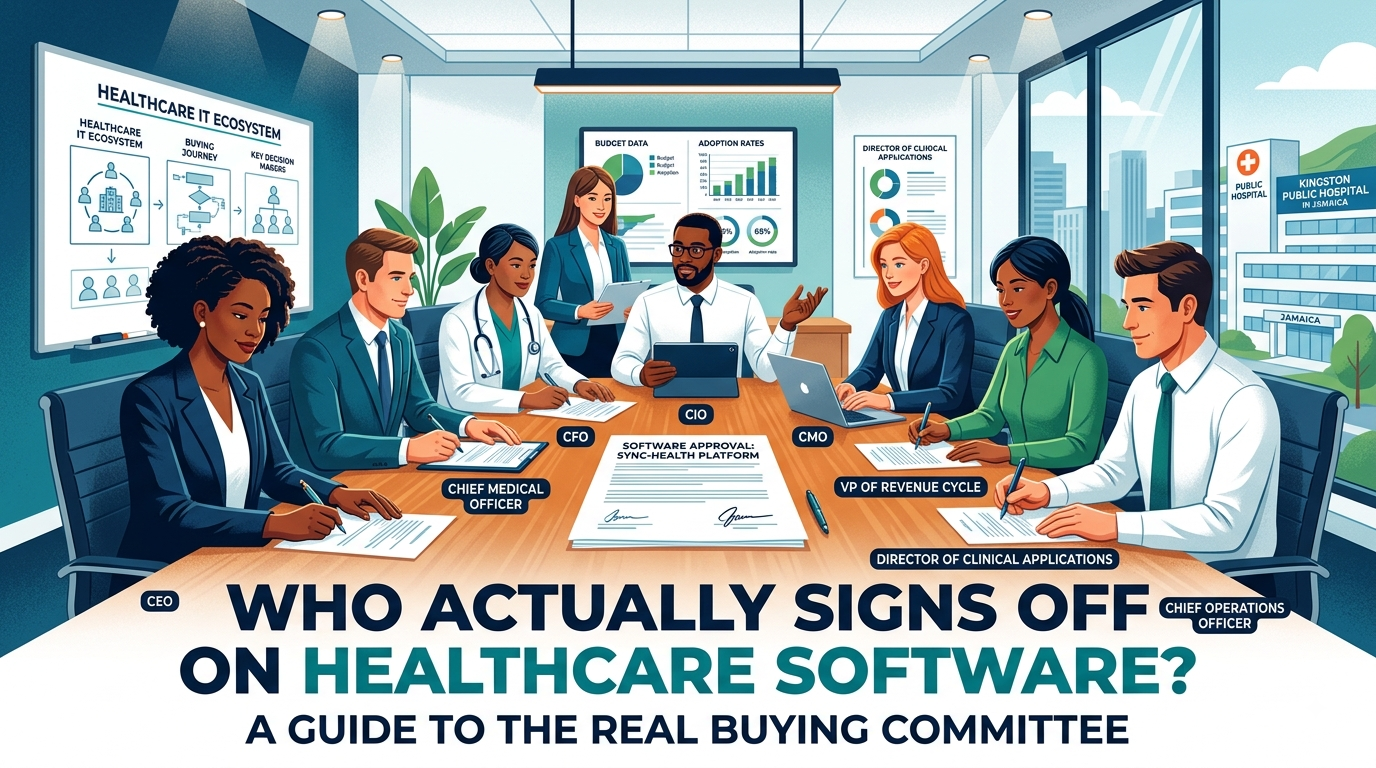
Who Actually Signs Off on Healthcare Software? A Guide to the Real Buying Committee

Ask a healthcare SaaS marketing team who their buyer is, and you’ll often get a single job title back. VP of Clinical Operations, maybe, or Director of IT. That answer isn’t wrong, exactly, but it’s dangerously incomplete. Healthcare software is rarely purchased by one person. It’s approved by a committee, and every member of that committee is evaluating the product against a different set of fears, and if your marketing only speaks to one of them, you’re relying on a single champion to translate your pitch to everyone else in the room, which is a fragile way to close a deal.

The Champion Is Not the Decision-Maker

In most healthcare organizations, the person who finds your product and gets excited about it is not the person with final authority to sign the contract. A department director might discover your tool, sit through the demo, and become genuinely convinced it solves a real problem. But that enthusiasm has to survive contact with procurement, compliance, IT security, and often finance, none of whom were in the room for the demo and none of whom share the department director’s sense of urgency. Marketing that only equips the champion with excitement, and not with the specific answers those other stakeholders will demand, puts the entire deal on that one person’s shoulders.

This is why the most effective healthcare SaaS content doesn’t just sell the product. It arms the champion. A one-pager that anticipates the security questionnaire, a technical brief that answers the interoperability question before IT has to ask it, a plain-language summary of the compliance posture that a department director can forward without having to translate it themselves. The champion’s job gets dramatically easier when your marketing has already done the work of speaking to people who aren’t in the room yet.

The Compliance Officer Is Reading for What You Didn’t Say

Compliance and privacy officers approach vendor marketing differently than almost anyone else in the buying process. They aren’t looking for reasons to be impressed. They’re looking for gaps, vague language, and claims that don’t hold up under a security questionnaire. A confident, specific description of your data handling practices reads as competence to this stakeholder. A page full of adjectives like “secure” and “trusted” without any specifics reads as a red flag, because it suggests either the vendor doesn’t understand the regulatory environment or is hoping nobody looks closely.

The practical implication is that content aimed at this stakeholder needs to exist somewhere, even if it’s not on the main landing page. A security and compliance overview, written plainly enough that a non-technical department head can still follow it, does double duty: it satisfies the compliance officer’s scrutiny and gives the internal champion something concrete to hand off when the question inevitably comes up.

Clinicians Are Evaluating a Completely Different Question

Somewhere in the process, usually after the demo but before the contract, the software reaches the people who will actually use it every day, and their evaluation has almost nothing to do with the criteria everyone else applied. A nurse or physician isn’t weighing security architecture or total cost of ownership. They’re asking whether this tool will make their next twelve-hour shift easier or harder, and they’ve likely been burned before by software that was sold to administration as transformative and turned out to add clicks instead of removing them.

This is often the stage where deals quietly die, not because the contract fell through, but because adoption never happened and the renewal conversation a year later reflects that. Marketing rarely reaches this stakeholder directly, since they’re not the ones reading landing pages, but the language used earlier in the sales process shapes how the tool gets introduced to them. A rollout framed around administrative metrics alone tends to land as one more mandate from people who don’t do the actual clinical work. A rollout that can point to a specific, credible claim about time saved or friction removed gives the internal champion something to say in the room that isn’t just “corporate wants us to use this.”

Finance and Procurement Want a Different Kind of Proof

By the time a deal reaches finance and procurement, the emotional case has usually already been made elsewhere. What these stakeholders want is a defensible number: total cost of ownership over a multi-year period, a clear picture of implementation costs beyond the subscription price, and ideally a benchmark against whatever the organization is currently doing, whether that’s a competitor’s tool or a manual process. Marketing content aimed at this audience benefits from being unusually plain and quantitative, resisting the temptation to lean on the same persuasive language used for clinical or executive audiences.

Why This Changes How Content Should Be Built

Once it’s clear that a single sale involves this many distinct evaluators, the flaw in a one-size-fits-all marketing approach becomes obvious. A single landing page cannot simultaneously excite a department head, satisfy a compliance officer, reassure a clinician, and justify a budget line to finance, at least not without becoming so generic that it fails to fully convince any of them. The stronger approach treats the buying committee as an actual audience map, producing distinct pieces of content, even short ones, that speak directly to each stakeholder’s real question, and trusting the internal champion to assemble those pieces into the case they need to make internally.

That’s ultimately what strong healthcare SaaS marketing does that generic SaaS marketing often doesn’t. It acknowledges that the sale isn’t won in a single conversation with a single buyer, but in a series of quieter conversations happening across a committee, most of which the vendor will never be present for.

Posted on

HIPAA Compliance for SaaS: What Actually Changes in Your Marketing Copy

Most healthcare SaaS marketing teams treat HIPAA as a legal problem, something that lives in a compliance checklist and gets a single mention in the footer. That’s a mistake. HIPAA doesn’t just constrain what your product can do. It constrains what you’re allowed to say about it, how you can prove your claims, and even what data you can use to write a case study. If your marketing team hasn’t had a real conversation with legal about this, your copy is probably making promises the compliance team would wince at.

The Difference Between Being Compliant and Talking About It

A product can be fully HIPAA compliant and still be marketed in a way that creates liability. This happens more often than people expect. A landing page that says “we keep your patient data completely safe” is making an absolute claim that no security professional would ever sign off on internally, because no system is completely anything. A blog post that walks through a customer’s workflow in enough detail could inadvertently describe protected health information, even if every name has been changed, if the combination of details makes a patient identifiable to someone who already knows the case.

The point isn’t that healthcare marketing has to be vague or lifeless. It’s that specificity has to be paired with precision. There’s a real difference between “we help you stay compliant” and “our audit logging meets the technical safeguard requirements under the HIPAA Security Rule,” and buyers who actually make purchasing decisions in this space can tell which one came from someone who understands the regulation and which one is a marketing team guessing.

Case Studies Are Where Most of the Risk Lives

Case studies are the most persuasive content a healthcare SaaS company can produce, and they’re also where compliance mistakes happen most often. A case study built around a specific patient encounter, even anonymized, needs a business associate agreement covering that use of data, sign-off from the covered entity’s compliance office, and often a formal de-identification review under the Safe Harbor or Expert Determination method. Skipping that process because the marketing deadline is tight is exactly how a great case study turns into a legal problem for both the vendor and the client featured in it.

The safer and, honestly, more scalable approach is to build case studies around operational metrics rather than clinical narratives. A story about reducing average documentation time across a department doesn’t require touching PHI at all. A story that opens with “picture a 68-year-old patient arriving at 2 a.m. with chest pain” almost certainly does, even if the patient is fictional, because it invites the reader to assume it’s real and sets a tone the rest of your marketing has to live up to.

The Words That Get Copy Teams in Trouble

Certain phrases show up constantly in healthcare SaaS marketing and deserve more scrutiny than they get. Claiming a product is “HIPAA certified” is a common one, and it’s inaccurate, because there is no official government certification for HIPAA compliance. Vendors can be compliant, can undergo third-party audits, and can sign business associate agreements, but “certified” implies a credentialing body that doesn’t exist for this regulation. A buyer’s compliance officer will notice that phrase immediately, and it tends to undercut credibility rather than build it, since it signals the marketing team didn’t do their homework.

Similarly, phrases like “bank-level encryption” or “military-grade security” sound impressive but are vague enough to be meaningless, and they don’t map to anything a security reviewer can actually verify. Specific claims, like naming the encryption standard in use or referencing which safeguards under the Security Rule the product addresses, do far more to build trust with the technical and compliance stakeholders who are quietly deciding whether the deal moves forward.

Testimonials Need the Same Scrutiny as Case Studies

A glowing quote from a satisfied nurse or administrator feels harmless, but if that quote references specific patient outcomes, specific volumes tied to an identifiable facility, or details that could be cross-referenced with public information, it can raise the same de-identification concerns as a full case study. The safest testimonials focus on the reviewer’s own experience using the software rather than describing what happened to patients as a result. That distinction is subtle in the writing but significant in terms of risk.

Why Getting This Right Is a Brand Advantage

Healthcare buyers, especially the compliance officers and CMIOs who often have veto power over a purchase, read marketing copy differently than buyers in other industries. They are actively looking for signs that a vendor understands the regulatory environment, because a vendor that gets the marketing wrong raises real doubts about whether they got the underlying product wrong too. Careful, accurate language about HIPAA isn’t just risk mitigation. It’s one of the fastest ways to signal to a skeptical buyer that this vendor has actually done this before.

The freelance writers and marketing teams who take the time to understand what HIPAA actually requires, rather than treating it as boilerplate to paste into a footer, end up producing copy that survives legal review on the first pass and reads as more credible to the people who matter most in the buying process.

Posted on

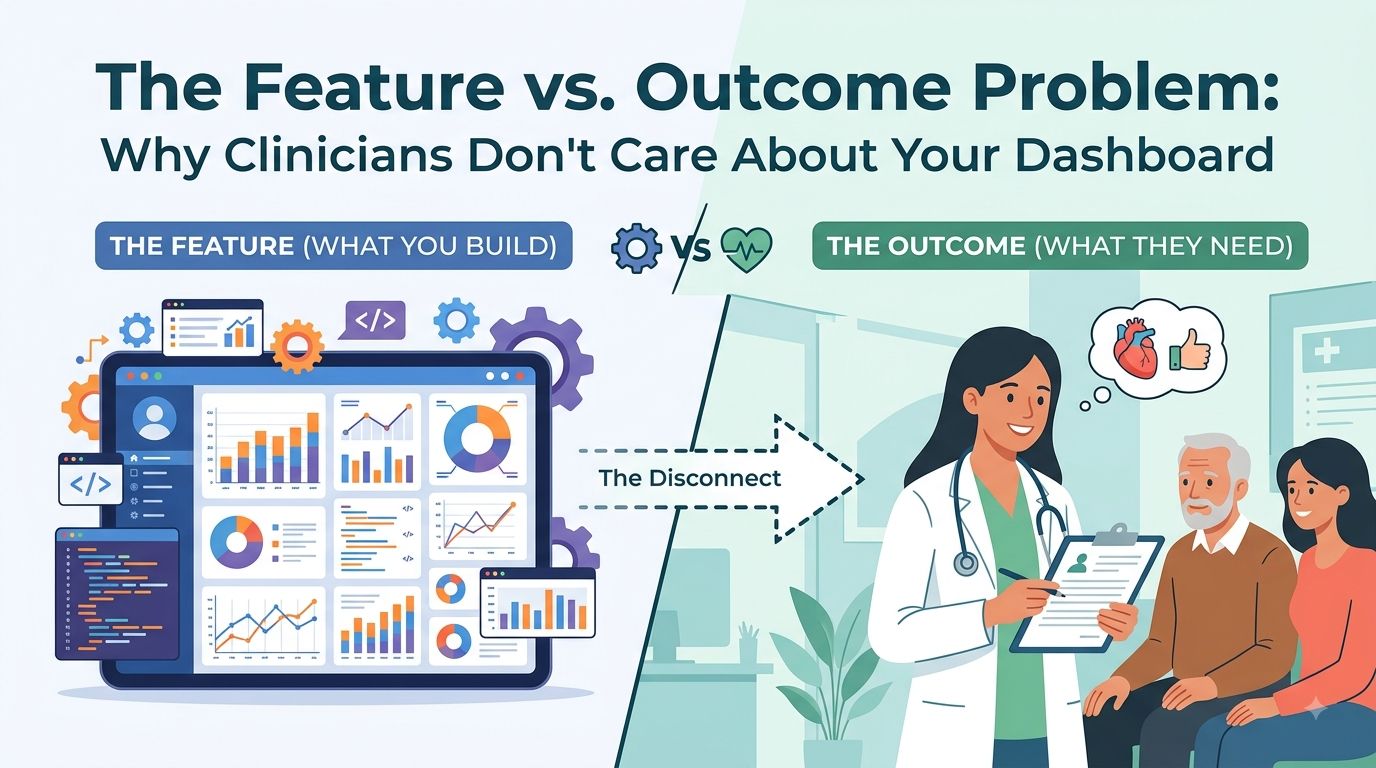
The Feature vs. Outcome Problem: Why Clinicians Don’t Care About Your Dashboard

Open almost any healthcare SaaS homepage and you’ll find the same pitch. Real-time analytics. Customizable dashboards. Seamless EHR integration. A clean UI with a screenshot to prove it. It reads like a spec sheet, and that’s exactly the problem.

Clinicians are not evaluating your software the way a typical SaaS buyer does. They are not weighing features against a checklist of nice-to-haves. They are asking a much narrower question: does this make a specific, recurring problem in my day go away? If the answer isn’t obvious within a few seconds of reading your copy, you’ve lost them, no matter how impressive the feature actually is.

The Disconnect Starts With Who’s Writing the Copy

Most SaaS marketing inherits its instincts from software categories where the buyer and the user are the same person, and where the value of a feature is self-evident. A better dashboard is a better dashboard. But healthcare software is usually sold to one person, approved by several others, and used by someone with none of the same incentives as the buyer. A hospital administrator cares about cost per encounter and audit readiness. A nurse cares about not clicking through six screens to chart a single vital sign. A feature that thrills the administrator can be actively resented by the person actually logging in every day.When marketing copy leads with features, it’s implicitly writing to the buyer’s spec sheet and ignoring the user’s actual experience. That gap is where trust erodes, and it’s often where deals stall after the demo, when the software finally reaches the people who have to live inside it.

Outcomes Are a Different Kind of Claim

Talking about outcomes instead of features isn’t a rebranding exercise. It requires making a claim that can be tested against reality: this reduced documentation time by an average of eleven minutes per shift, or this cut prior authorization turnaround from four days to same-day in a rollout across a twelve-clinic network. That kind of specificity is uncomfortable for a lot of marketing teams because it requires real data, a willingness to be pinned down, and often a case study that took months to produce properly.

But that discomfort is exactly why outcome-driven copy works. Clinicians and administrators alike have been pitched a thousand tools promising to “streamline workflows.” Almost none of them define what streamline means in a measurable way. The rare vendor who does immediately reads as more credible, not because the claim is flashier, but because it’s falsifiable. You can ask them how they measured it, and a serious vendor has an answer.

The Feature Still Matters, Just Not First

None of this means features are irrelevant. Integration depth, security architecture, and interface design are often the reason an outcome is achievable at all. The mistake is sequencing them first, as though the mechanism is what earns attention. A better structure reverses the order: state the outcome, let the reader feel the relief of the problem being solved, and only then explain the feature as the reason it’s possible. The feature becomes evidence for the claim rather than the claim itself.

This reordering sounds simple, but it changes almost every piece of content a healthcare SaaS company produces. Landing pages stop opening with product screenshots and start opening with a sentence a clinician would actually say out loud about their own frustration. Case studies stop narrating the implementation timeline and start with the number that changed. Sales decks stop with an architecture diagram on slide two and save it for slide eight, once the buyer already understands what they’re getting.

Why This Is Harder Than It Sounds

Writing this way requires something a lot of marketing teams don’t have readily available: a real, specific understanding of the workflow being disrupted. You can’t credibly describe the outcome of reducing charting time if you don’t know what charting actually looks like at 2 a.m. on a short-staffed unit. This is usually where the writing has to slow down, involve actual conversations with clinical staff or customer success teams, and resist the temptation to default to industry-standard phrases like “improve patient outcomes” that sound authoritative but say nothing specific at all.

The healthcare SaaS companies that get this right aren’t necessarily the ones with the best product. They’re the ones willing to do the unglamorous work of finding out exactly what changed for exactly which person, and saying it plainly instead of hiding behind the dashboard.

Posted on

More Content, More Problems: Why Good Information Is Harder to Find Than Ever

There has never been more content in the world. Every minute, millions of words are published, thousands of videos go live, and countless posts flood every platform we scroll through. By any measure, we are drowning in information.And yet, ask anyone trying to research a health decision, understand a policy debate, or simply learn how to fix their dishwasher, and you’ll hear the same complaint: it’s harder to find good information now, not easier.This isn’t a contradiction. It’s the whole story.

Abundance Isn’t the Same as Access

When content was scarce, the bottleneck was production. Publishing was expensive, editorial standards acted as gatekeepers, and if something made it into print or on air, it had usually cleared some bar of scrutiny.

That bottleneck is gone. Anyone can publish anything, instantly, to a global audience. This is genuinely good in many ways; it has democratized voices that used to be shut out entirely. But it also means the gatekeeping function has vanished, and nothing has fully replaced it.The result: quality and quantity have decoupled. There’s more expert-level analysis available today than at any point in history, and more misinformation, filler, and AI-generated noise sitting right next to it, often indistinguishable at a glance.

The New Bottleneck Is Discernment

If production used to be the hard part, now it’s filtering. The scarce resource isn’t content anymore. It’s trustworthy, well-sourced, genuinely useful content that answers your actual question.This shows up everywhere:

Search results increasingly surface SEO-optimized content built to rank, not to inform.Social feeds reward what’s engaging over what’s accurate.AI-generated text can now produce plausible-sounding material at a scale no human editorial team can review.

None of this means the good stuff disappeared. It means it’s buried deeper, surrounded by more noise than ever, and harder to distinguish without real effort.

Why Demand for Quality Is Rising, Not Falling

You might expect that as content multiplies, people would care less about quality; there’s just too much to sort through, so why bother. The opposite has happened.As trust in default sources erodes, people actively seek out signals of credibility: original reporting, named experts, primary sources, transparent methodology. Newsletters from individual journalists, niche communities with strict moderation, and paid subscriptions to publications with editorial standards have all grown, not despite the flood of free content, but because of it.In other words, scarcity of trust has created its own market. When everything is available, the willingness to pay (in money, time, or attention) for something verified goes up.

What This Means Going Forward

The lesson isn’t that more content is bad. It’s that content volume and content value are no longer correlated, and treating them as if they are is a mistake anyone can make when scrolling on autopilot.The skills that matter now aren’t about finding information. They’re about evaluating it: knowing how to check a source, recognizing when something is optimized for clicks rather than accuracy, and being willing to slow down before sharing or acting on something that sounds right.The amount of content will keep growing. So will the premium on the kind that’s actually worth your time.

Posted on

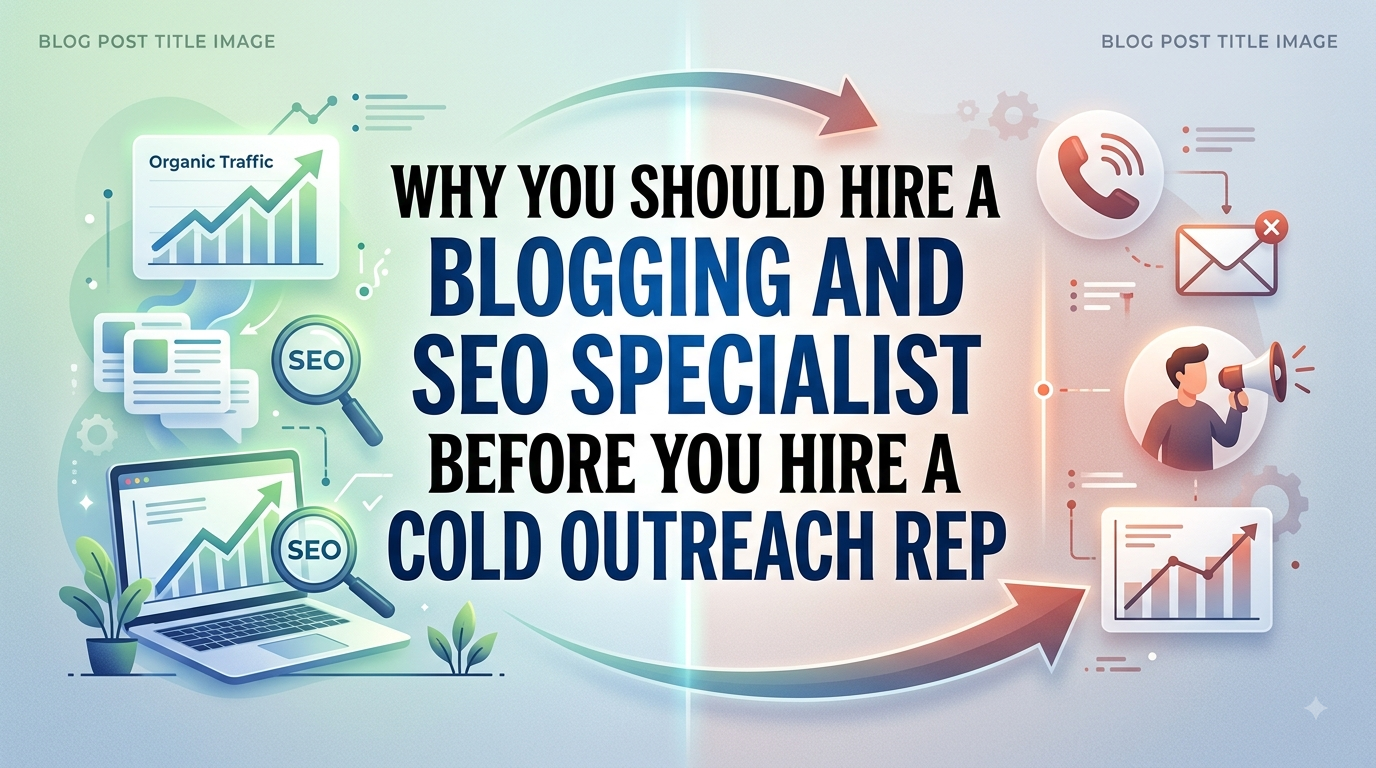
Why You Should Hire a Blogging and SEO Specialist Before You Hire a Cold Outreach Rep

Every growing business eventually faces the same question: where do we put our limited time and money to generate more leads? Two answers tend to dominate the conversation. One is cold outreach — emails, calls, and LinkedIn messages sent directly to prospects. The other is content and SEO — building a blog and a search presence that pulls people in over time. Most founders assume these are interchangeable growth levers, and that whichever one gets staffed first is mostly a matter of preference. It isn’t. The smarter move, in almost every case, is to hire out the blogging and SEO work while keeping cold outreach as something your own team learns to do.

The reasoning comes down to a simple truth about skill acquisition: cold outreach has a short learning curve, and SEO has a long one. Anyone reasonably articulate and willing to take rejection can become competent at cold outreach within a few weeks. You learn to write a decent subject line, personalize an opener, follow up without being annoying, and track replies. The feedback loop is immediate — you send a message today and know by tomorrow whether it worked. That fast feedback is exactly what makes a skill learnable on the job. A motivated salesperson, or even a founder, can go from mediocre to genuinely good at outreach in a single quarter, just by sending volume and paying attention to what lands.

SEO and content marketing don’t work that way. The feedback loop is slow and noisy. You might publish a well-researched article and not see any movement in rankings for two or three months, and when movement finally happens, it’s hard to know whether it was your keyword research, your internal linking, a Google algorithm update, or a competitor’s content decay that caused it. Getting good at SEO means understanding search intent, technical site health, content structure, backlink dynamics, and how all of that interacts with an algorithm that changes constantly and never explains itself. It is a discipline built on pattern recognition across hundreds of published pieces and years of watching what actually moves rankings versus what merely sounds like it should. That kind of judgment is exactly what’s expensive to build in-house and cheap to rent from someone who already has it.

There’s also an opportunity cost hiding in the decision to have your own team “figure out SEO as they go.” Every month spent learning through trial and error on your own site is a month where your competitors, who already hired someone experienced, are compounding their advantage. SEO is fundamentally a compounding asset — old posts keep earning traffic, domain authority keeps building, and rankings get harder to displace the longer they’ve been held. A slow, fumbling start doesn’t just cost you time; it costs you the compounding you would have had if the work had been done well from month one. Cold outreach has no such compounding penalty. A rep who was mediocre in January and good by June hasn’t lost much — each outreach campaign mostly stands on its own, unconnected to the ones before it.

None of this means cold outreach is unimportant. It’s often the faster path to a first sale, and it deserves real investment. But precisely because it’s fast to learn and fast to see results from, it’s a reasonable thing to build internally, iterate on, and improve through repetition. SEO and blogging reward a different kind of investment: hiring someone who has already climbed the learning curve on someone else’s dime, so your business starts compounding from day one instead of spending a year figuring out what already-established practitioners know cold.

The practical takeaway is simple. Put your internal energy into outreach, where a smart person with some coaching can get good fast and where the cost of a slow start is low. Put your money into an experienced content and SEO hire or agency, where expertise takes years to build, mistakes are expensive because they compound, and the return on getting it right early is enormous. Treating these two channels as equally learnable is where most growth strategies quietly go wrong.