Want to know what your competitors are writing? Use our browser extension.
Most of this series has focused on structural questions: how posts relate to each other, whether they’re linked properly, whether a cluster is the right size. This post looks at a different but related question: whether the content itself matches what a reader actually needs at the specific point they’re at in their relationship with your topic. A perfectly structured cluster can still underperform if every post in it is written for the same kind of reader, while ignoring several other kinds of readers who are searching for the same broad topic with very different needs.
The Three Broad Stages a Reader Moves Through
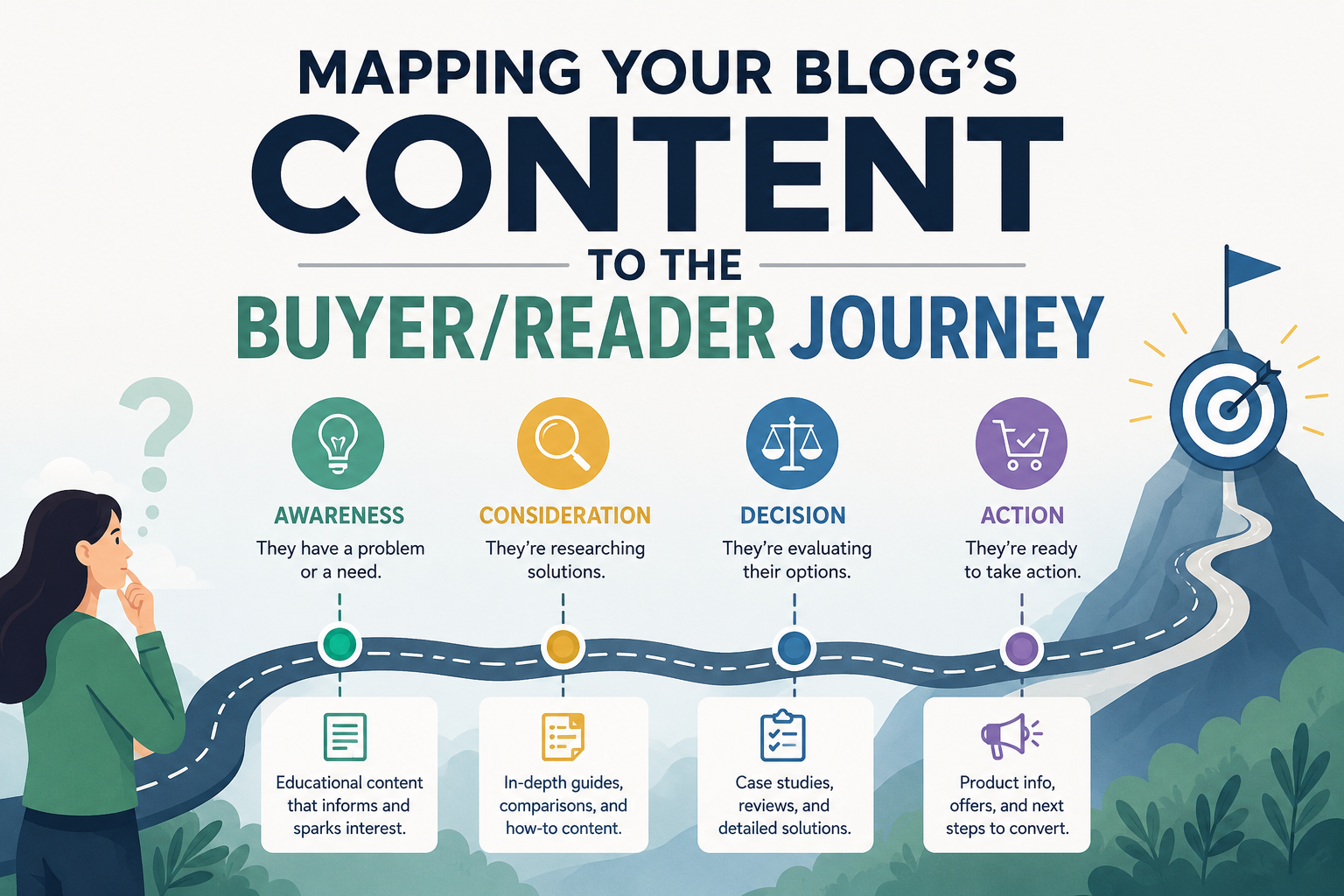
For almost any topic, readers tend to fall into three broad stages, even outside of an explicitly commercial context. The first stage is awareness, where a reader is just starting to explore a topic and often doesn’t yet have the vocabulary or framework to ask a more specific question. Someone new to home coffee brewing searching “why does my coffee taste bad” is in this stage. The second stage is consideration, where a reader understands the topic reasonably well and is now comparing specific approaches or options against each other. The same reader, a few weeks later, searching “pour-over versus French press” has moved into this stage. The third stage is decision or application, where a reader has settled on an approach and needs specific, actionable guidance to execute it well, such as searching “best grind size for a specific pour-over dripper.”
Even for a blog that isn’t selling anything directly, this framework is useful, because it maps cleanly onto search intent. A cluster that only has posts written for the decision stage, full of specific product or method recommendations, will struggle to capture readers who are still in the awareness stage and haven’t yet formed the more specific question your existing content answers.
Auditing a Cluster Against the JourneyTake any existing cluster and, post by post, identify which stage each piece of content is really written for. It’s common to find clusters heavily skewed toward one stage, usually consideration or decision, since those tend to be the more concrete, easier-to-write topics, while awareness-stage content requires explaining fundamentals that feel almost too basic to the person writing them, despite being exactly what a genuinely new reader needs.A cluster that’s missing awareness-stage content is invisible to readers who haven’t yet learned enough to ask a more specific question, even if the cluster is comprehensive for anyone who’s already past that point. This is a common and fixable gap, and often one of the highest-value additions to an existing cluster, since awareness-stage queries are frequently higher volume than the more specific queries a cluster’s existing content already covers.
Why This Differs From the Distinct-Question Test
The cluster sizing post earlier in this series covered checking whether a cluster has posts for every distinct reader question. This is a related but different lens: even a cluster with a full set of distinct-question posts can be skewed if every one of those questions happens to be asked by a reader at the same stage. A cluster can have ten genuinely distinct posts and still fail a new reader if none of them explain the topic from first principles, because the writer, being deep in the topic themselves, unconsciously wrote every post assuming a baseline of knowledge only a consideration or decision-stage reader would already have.
Both checks are worth running on the same cluster, since they catch different kinds of gaps. The distinct-question test catches missing subtopics. The journey-stage test catches missing depth levels within topics you’ve already covered.
Linking Across Stages Deliberately
Once a cluster has content spanning multiple stages, the internal linking between them matters more than usual. An awareness-stage post should naturally link forward to the more specific consideration-stage content a reader is likely to want next, once they’ve absorbed the basics. A decision-stage post can link back to the more foundational content for any reader who arrived at a specific, advanced query without the background it assumes, giving them a path to fill that gap without leaving your site.
This kind of stage-aware linking, layered on top of the general internal linking principles from earlier in this series, effectively creates a guided path through a topic, rather than a flat set of equally-weighted posts a reader has to sort through on their own.
Applying This to Non-Commercial Blogs
It’s worth being clear this framework isn’t only useful for blogs selling something. A hobby blog, a personal interest site, or a blog that monetizes purely through ads still benefits from thinking in these terms, because the underlying pattern, readers arriving at different levels of existing knowledge and needing different things from the same broad topic, exists regardless of whether a purchase decision is involved anywhere in the picture. Substituting “decision” for something like “ready to try this myself” works just as well as a mental model for a strictly informational blog.
A Practical Starting Exercise
For any cluster you consider important, list out the actual search queries or reader questions you already know are relevant to the topic, then sort them by which stage they represent. If one stage has noticeably fewer entries than the others, that’s your next content priority for the cluster, likely more valuable than adding another post at a stage that’s already well covered. This exercise is quick to do once per cluster and tends to surface gaps that a purely structural audit, focused on links and duplication rather than reader intent, would miss entirely.
The next post in this series pulls this thread together with everything covered so far, describing the general warning signs that indicate a blog has a content organization problem worth addressing, whether that’s structural, stage-related, or both.