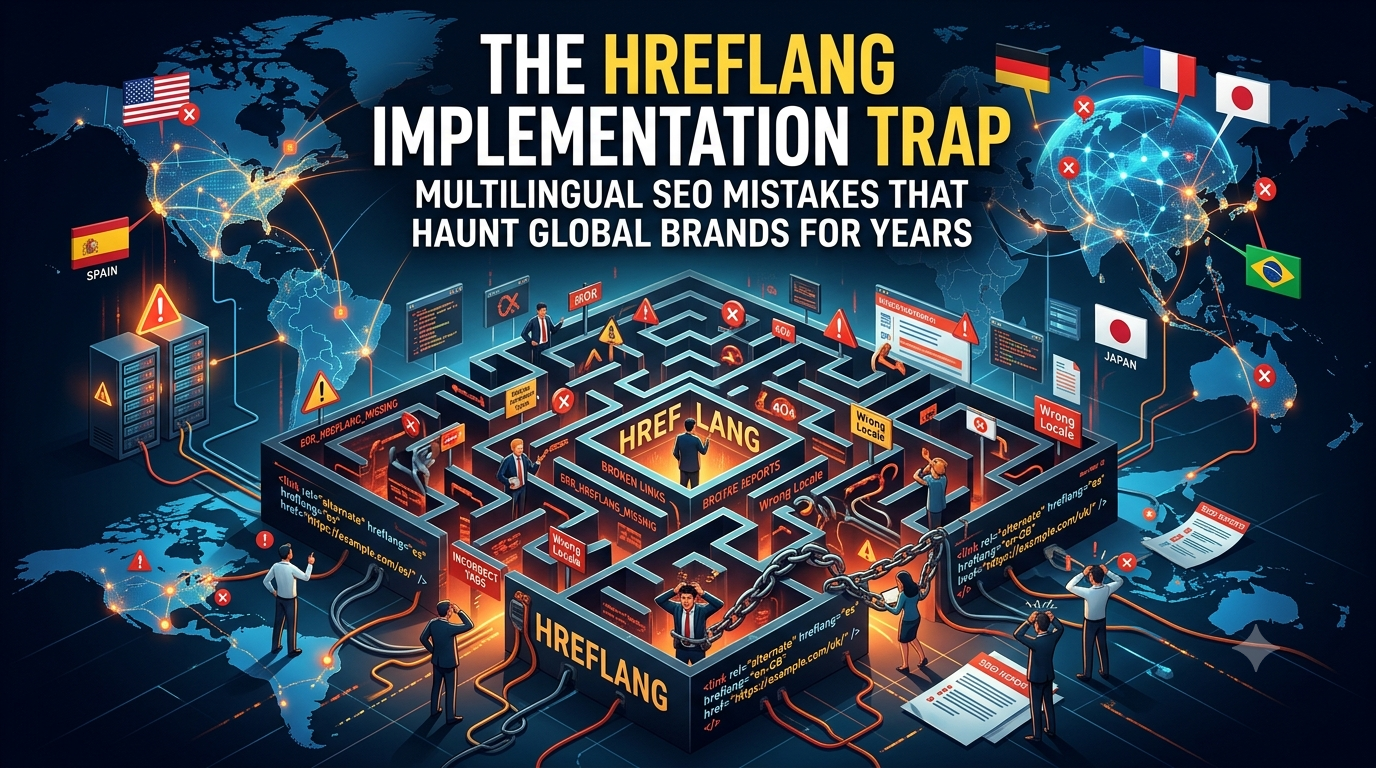
There is a particular arrogance that creeps into the expansion plans of successful brands. They have conquered one market, built a site that ranks, converts, and earns trust, and they assume that replicating that success in a new language is simply a matter of translation. They hire agencies to localize their content, deploy subdirectories or subdomains for each new region, and then someone on the technical team mentions hreflang tags as the final step to connect all these versions. The tags are implemented, the project is checked off, and the brand waits for international traffic to pour in. Months later, the traffic is flat, the wrong pages are ranking in the wrong countries, and search results show a jumble of languages that confuse users more than they help. The brand has fallen into the hreflang implementation trap, and like most traps, it is far easier to stumble into than to escape.
Hreflang was conceived as an elegant solution to a genuine problem. The internet is not monolingual, and users in different regions often prefer content in their own language, or in a specific regional variant of a language, or even in a shared language with region-specific pricing and availability. A user in Spain should not land on a page intended for Mexico. A user in the United Kingdom should not see prices in US dollars. A French speaker in Canada should not be pushed toward content meant for France. Hreflang tags were designed to tell search engines which version of a page is intended for which language and region, so that the right user sees the right content. In theory, it is perfect. In practice, it is one of the most consistently botched technical SEO implementations in existence, and the mistakes made during initial deployment can linger for years, silently undermining global performance.
The first and most fundamental misunderstanding is that hreflang is a ranking signal. It is not. Hreflang does not make your French page rank higher in France. It does not give your German content a boost in Berlin. What hreflang does is help search engines understand the relationship between equivalent pages so that when a French page does rank, it is shown to French users rather than to Spanish users. If your French page has no authority, no relevance, and no competitive content, hreflang will not save it. It will simply ensure that the failure is localized correctly. Brands often implement hreflang expecting it to unlock international rankings, and when those rankings do not materialize, they blame the tags rather than recognizing that their content or link building in the new market is simply not strong enough.
The technical implementation itself is where most nightmares begin. Hreflang requires reciprocity. If your English page points to your German page with a hreflang tag, your German page must point back to your English page with the corresponding tag. If the connection is one-way, search engines may ignore the directive entirely. This sounds simple until you realize that a site with twenty language versions and five thousand pages is managing one hundred thousand reciprocal relationships. One missing tag on one page breaks the chain for that entire cluster. One incorrect URL, perhaps a typo or a link to a staging domain, poisons the signal. One page that exists in English but has not yet been translated into Italian creates an incomplete set that leaves search engines guessing. The complexity scales exponentially with the size of the site, and most implementations are simply not rigorous enough to maintain perfect reciprocity across thousands of pages.
The return tag error is the most common and maddening symptom of broken reciprocity. Search Console will dutifully report that your hreflang tags lack return tags, meaning somewhere in your vast web of language versions, a page is pointing to another page that does not point back. Finding the culprit is like searching for a single faulty wire in a skyscraper. It could be a page that was accidentally excluded from the hreflang cluster during a content update. It could be a redirect that was implemented on one version but not reflected in the hreflang annotations of its counterparts. It could be a page that was deleted in one language but still referenced by all the others. These errors accumulate like dust, and unless you have a systematic process for validating your hreflang structure after every site change, they will accumulate until your international targeting is effectively broken.
Language and region codes are another minefield. The code for English is en. The code for English in the United States is en-us. The code for English in the United Kingdom is en-gb. These distinctions matter. A user in London searching for a product does not want to land on a page with American spelling, American pricing, and American shipping policies. Yet brands frequently use generic language codes without regional specification, or they use incorrect codes like uk instead of gb, or they mix language-only tags with language-region tags in ways that create conflicts. A page tagged with both en and en-us sends a conflicting signal. Which one takes precedence? Search engines have rules for resolving these conflicts, but the resolution may not match your business intent. The result is that your carefully crafted UK landing page is shown to American users, or your generic Spanish page outranks your Mexican-specific page in Mexico City because the signals are muddled.
The self-referencing tag is a detail that seems unnecessary until it is missing. Every page in a hreflang cluster should include a tag pointing to itself, along with tags pointing to all its equivalent pages. Without the self-reference, search engines may struggle to understand the full scope of the cluster. It is like attending a meeting where everyone introduces each other but no one confirms their own identity. The omission is subtle, the documentation does not always emphasize it, and many implementations skip it entirely. Then they wonder why search engines are not honoring their language targeting, never realizing that a missing self-referential tag has left the page orphaned from its own cluster.
Canonical tags and hreflang tags must work in concert, and when they conflict, the result is chaos. A page that canonicalizes to a different URL while also declaring itself as a hreflang equivalent is sending contradictory instructions. The canonical tag says this is not the primary version, send authority elsewhere. The hreflang tag says this is a valid version for this specific audience, show it in search results. Search engines must reconcile these conflicting directives, and they often do so by ignoring one or both. Brands frequently implement hreflang without auditing their existing canonical structure, or they add canonical tags later without considering the hreflang implications. The pages become tangled in their own metadata, and the intended targeting collapses under the weight of internal contradiction.
The method of implementation introduces its own risks. Hreflang can be deployed in three ways: as link elements in the HTML head, as HTTP headers, or in an XML sitemap. Each method has valid use cases, but mixing methods is a recipe for confusion. If you declare hreflang in your HTML and also in your sitemap, the two sources must be perfectly synchronized. A discrepancy between them creates uncertainty about which signal to trust. HTML implementation is the most common and the most fragile, as it places the burden on every page template to render the correct tags. Sitemap implementation is cleaner for large sites but requires rigorous sitemap maintenance. HTTP headers are rarely used for standard pages but are sometimes necessary for non-HTML files. The trap is choosing a method without fully committing to its maintenance, or worse, allowing different teams to implement hreflang differently across different sections of the site until no one knows which source of truth to believe.
Perhaps the most insidious mistake is implementing hreflang without actually having equivalent content. A brand translates its homepage and a handful of product pages into German, then slaps hreflang tags across the entire site pointing to those German pages as equivalents for every English URL. The German user searching for a specific service lands on a generic German homepage because there is no translated equivalent for the deep page they actually needed. This is not helpful. It is frustrating. Hreflang should only connect pages that are genuinely equivalent in content and purpose. If a page does not exist in a given language, it should not be forced into a hreflang cluster. The absence of a tag is better than a tag that lies.
The maintenance burden is where global brands truly suffer. A website is not a static monument. It changes daily. New products launch, old ones retire, blog posts publish, campaigns begin and end. Every change in one language version must be reflected in the hreflang structure of all related versions. Most organizations do not have this level of coordination. The English team updates a URL structure without informing the French team. The Spanish team launches a new landing page that has no Italian equivalent yet. The German team removes a product page that is still referenced by hreflang tags on the English and Dutch sites. These small oversights compound over months and years until the hreflang implementation is a cobweb of dead links, missing return tags, and orphaned pages that no longer exist but are still being referenced. The brand that invested heavily in international expansion is now paying a hidden tax in technical debt, and the cost is paid in confused users, diluted authority, and missed opportunities in markets that should have been lucrative.
Fixing a broken hreflang implementation is not a weekend project. It requires a complete inventory of every language version, every URL, and every intended relationship. It requires validation tools that check for reciprocity, correct codes, self-referencing tags, and canonical conflicts. It requires a governance process that ensures any change to one language version triggers a review of all connected versions. It requires the humility to remove hreflang tags from pages that do not have true equivalents rather than pretending that a generic homepage is a satisfactory substitute for a specific deep page. It requires ongoing monitoring in Search Console and log files to catch errors as they emerge rather than discovering them months later when the damage is already done.The brands that get hreflang right treat it as an organizational commitment, not a technical checkbox. They build systems that automate the validation of hreflang clusters. They maintain clear documentation of which pages exist in which languages and what the true equivalents are. They train their content and development teams to understand that international SEO is not a feature that is deployed once and forgotten, but a living structure that demands constant attention. They accept that hreflang will not create demand where none exists, but they ensure that when demand is present, the right user is guided to the right page without friction.
The trap is seductive because it promises an easy path to global reach. Implement a few tags, connect your translations, and watch the world discover your brand. The reality is that hreflang is a precision instrument, and like all precision instruments, it fails catastrophically when handled carelessly. The mistakes you make today will not trigger an immediate penalty. They will simply confuse search engines, frustrate users, and slowly erode the trust you are trying to build in new markets. Years from now, when your international traffic has plateaued and your global expansion feels harder than it should, you may finally trace the problem back to those tags that were implemented in haste and never maintained with care. By then, the technical debt will be vast, the errors will be countless, and the opportunity cost will be measured in markets you never truly had a chance to win.