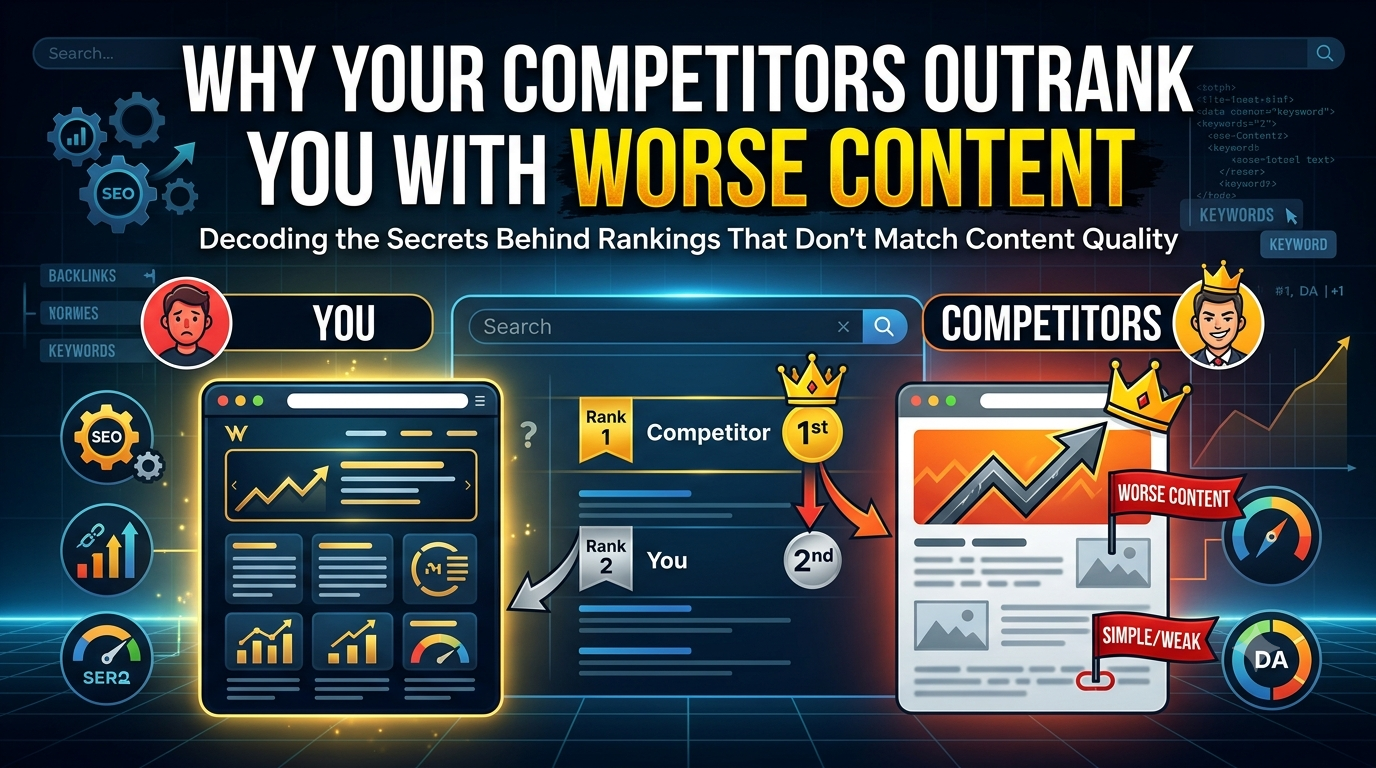
There is a particular kind of frustration that keeps SEO professionals awake at night. You have done the research. Your content is longer, more detailed, more thoroughly sourced, and more genuinely helpful than anything else on the first page of search results. You have included original data, commissioned custom graphics, and written with the kind of authority that comes from years of genuine expertise. Yet when you search the target keyword, there it is: a competitor ranking above you with a page that is shorter, thinner, clearly outdated, and arguably less useful to the user. The natural instinct is to blame the algorithm. You tell yourself that Google is broken, that rankings are rigged by backlinks or brand recognition or some opaque favoritism that has nothing to do with quality. But the truth is usually more humbling, and it lives beneath the surface of the page itself. Your competitor is not winning despite having worse content. They are winning because their worse content lives inside a technically superior website, and that invisible foundation is carrying them to the top.
We have been conditioned to believe that content is king, and in a narrow sense, that is still true. But a king without a castle, without roads, without supply lines, and without an army to enforce his rule, is just a person in expensive clothing. Content needs infrastructure to reach its potential, and most websites are crumbling from within while their owners obsess over word count, keyword density, and semantic richness. The competitor with thinner content has likely built a site that Google can crawl efficiently, render completely, index confidently, and serve to users without friction. Their page loads in under two seconds on a budget Android phone over a slow mobile network. Yours takes six seconds and shifts layout three times before the user can tap a button. Their internal linking structure funnels authority precisely to the pages they want to rank. Yours strands valuable content in orphaned corners that search engines visit rarely and trust less. Their structured data helps Google understand the context, relationships, and entities on the page. Yours forces Google to guess. These are not minor details. They are the difference between a page that search engines can confidently rank and a page that languishes in obscurity no matter how brilliant the prose.
Consider the journey that a page must take before it can rank. First, Google must discover it. This sounds trivial until you realize how many well-written pages are effectively invisible because they sit behind poor site architecture. If your content is buried four levels deep in a navigation structure with no logical internal linking, or if it is published on a subdomain that is not properly connected to your main domain’s authority, or if your XML sitemap is outdated and your robots.txt accidentally discourages crawlers from reaching that section, Google may never find the page at all. The competitor’s thinner content might be linked prominently from their homepage, referenced in their global navigation, and supported by a breadcrumb trail that makes its position in the site hierarchy unmistakable. Googlebot visits it frequently because the site has taught Google that new content there is worth checking. Your masterpiece, meanwhile, is a hidden room in a mansion with no doors. The content quality is irrelevant if the crawler cannot reach it.
Even when discovery happens, rendering is the next gate. Modern websites are increasingly dependent on JavaScript to load content, inject related articles, populate comments, and assemble the final page that a human sees. If your site serves a shell of HTML and expects the browser to build the actual content through complex scripting, you are forcing Google to work harder to see what you see. Google has improved at rendering JavaScript, but it is not instantaneous, and it is not guaranteed to match the capabilities of a modern desktop browser. Your competitor’s simpler page might be fully rendered in the initial HTML response, giving Google immediate access to every word, every heading, and every link. Your beautifully dynamic page might require Google to execute multiple scripts, wait for API calls, and piece together the content like a puzzle. If any step in that chain fails, or times out, or is blocked by a resource that Googlebot cannot access, the crawler sees less than the full picture. It sees a fraction of the content you worked so hard to create, and it ranks that fraction accordingly. The competitor’s page looks complete to Google. Yours looks incomplete, not because it is, but because your technical stack hides the completeness behind rendering complexity.
Speed and stability create another invisible advantage that directly impacts rankings. Google has confirmed that Core Web Vitals are ranking factors, but the impact goes beyond the explicit signal. A fast, stable page encourages longer dwell times, lower bounce rates, and higher engagement. Users do not leave in frustration before the content loads. They do not abandon the page because a late-loading ad pushed the text they were reading off the screen. They stay, they read, they click deeper into the site. Google observes these behavioral signals, and it interprets them as evidence that the page satisfied the searcher’s intent. Your competitor’s thinner content loads instantly, presents itself cleanly, and allows the user to consume it without interruption. Your superior content stutters, shifts, and forces the user to wait. The user leaves before experiencing the quality you invested in, and Google records that departure as a vote of no confidence. The algorithm is not consciously preferring worse content. It is responding to the reality that users are engaging more successfully with the faster, more stable experience.Indexation quality is another arena where technical superiority quietly defeats content excellence. When Google crawls your site, it makes a judgment about whether a page deserves a place in its index. This judgment is influenced by what surrounds the page. If your site is bloated with thin, duplicate, or auto-generated pages, Google may apply a lower overall quality threshold to your entire domain. It may crawl your brilliant article, note that it is well-written, but still hesitate to index it prominently because the surrounding context suggests that your site lacks editorial discipline. The competitor’s thinner content sits on a lean, focused site where every indexed page has a clear purpose. Google has learned to trust that domain. It indexes new pages quickly and ranks them generously because the historical pattern says this site does not waste the indexer’s time. Your site, despite its individual gems, has trained Google to be cautious. The content quality of one page cannot fully overcome the reputational drag of a technically messy domain.
Structured data and semantic clarity provide yet another hidden boost. Your competitor’s page might not be as comprehensive as yours, but it might communicate its purpose to Google with crystal clarity through schema markup. It might explicitly declare the author, the publication date, the review rating, the product availability, or the FAQ content. Google does not have to infer what the page is about or whether it matches a specific search intent. The signals are unambiguous. Your page, richer in narrative and detail, might offer none of this semantic scaffolding. Google has to parse your natural language, interpret your headings, and guess at your entities. In a world where search engines are increasingly driven by structured knowledge graphs, the page that speaks Google’s language often wins over the page that speaks beautifully in human terms but offers no machine-readable translation. The competitor’s content is worse for the user but better for the algorithm, and in the early stages of ranking, algorithmic comprehension matters enormously.Internal linking is perhaps the most underappreciated technical lever in this entire dynamic. Your competitor might have a modest blog post, but it exists within a web of contextual links that pass authority, establish topical clusters, and signal which pages are cornerstone resources. Their navigation, their related posts, their category pages, and their in-content references all point to that page with optimized anchor text and logical relevance. Your superior content, meanwhile, was published as a standalone piece with no strategic connection to the rest of your site. It has no internal links pointing to it from high-authority pages. It does not sit within a clearly defined topic cluster. It is an island, and islands do not rank well no matter how lush their vegetation. The competitor’s page rides a current of distributed authority. Your page drowns in isolation.
Backlinks certainly play a role in competitive rankings, and it is tempting to attribute a competitor’s success entirely to their link profile. But backlinks do not exist in a vacuum. A technically sound site attracts more links because it is more trustworthy, more crawlable, and more likely to remain accessible over time. Journalists and bloggers link to pages that load quickly, that do not break, and that present a professional face. A site that returns server errors, that serves mixed content warnings, or that redirects through chains of broken URLs, earns fewer links over time and loses the value of the links it once had. The competitor’s thinner content might have attracted links precisely because the site as a whole is reliable. Your better content lives on a site that link builders have learned to avoid because the technical experience is flaky. The link gap is not separate from the technical gap. It is a consequence of it.There is also the matter of how Google evaluates expertise, authoritativeness, and trustworthiness at the site level rather than the page level. A technically neglected site sends subtle signals of untrustworthiness. Broken pages suggest abandonment. Slow load times suggest a lack of investment. Missing security certificates suggest indifference to user safety. Outdated markup suggests that no one competent is maintaining the property. These impressions accumulate in Google’s assessment of your domain, and they create a ceiling on how high even your best content can rise. The competitor’s site, even if their individual articles are weaker, projects institutional competence through its technical polish. Google trusts the platform, and that trust flows downhill to every page it hosts. Your content is fighting an uphill battle against the suspicion that your site is not a serious contender.
The most painful realization is that this advantage is largely invisible to the casual observer. When you look at the search results, you see two pages side by side. You read them both, and yours is objectively better. What you do not see is the crawl efficiency, the render completeness, the indexation confidence, the Core Web Vitals distribution, the structured data markup, the internal linking graph, and the domain-level trust signals that Google weighs alongside the visible text. You are comparing apples to apples while Google is comparing entire orchards. The competitor’s page is not an outlier. It is the natural result of a system that rewards technical competence at every stage of the search pipeline.
The path forward is not to abandon content quality. That would be a fatal overcorrection. The path is to recognize that content quality is necessary but not sufficient, and to invest in the technical foundation with the same intensity you bring to research and writing. Audit your site architecture to ensure that every valuable page is discoverable within three clicks from your homepage. Simplify your rendering so that critical content appears in the initial HTML without requiring complex JavaScript execution. Optimize your Core Web Vitals not to chase a perfect Lighthouse score, but to deliver a genuinely stable and fast experience for real users on real devices. Implement structured data that helps search engines understand your content’s context and intent. Build internal linking strategies that distribute authority to your most important pages and establish clear topical clusters. Clean up index bloat so that your domain projects editorial discipline rather than chaotic volume. Fix broken links, server errors, and redirect chains that erode crawl efficiency and user trust.
When you do this work, something remarkable happens. Your great content finally has the infrastructure it deserves. It is discovered quickly, rendered completely, indexed confidently, and served to users without friction. The behavioral signals improve. The authority compounds. The rankings rise. And one day, you look at the search results and realize that your page is not just better in substance. It is better in every way that matters to a search engine. The competitor with thinner content falls behind not because the algorithm suddenly got smarter about quality, but because your technical advantage became too large to ignore. The invisible foundation that once carried them is now carrying you, and this time, the content on top is worthy of the elevation.