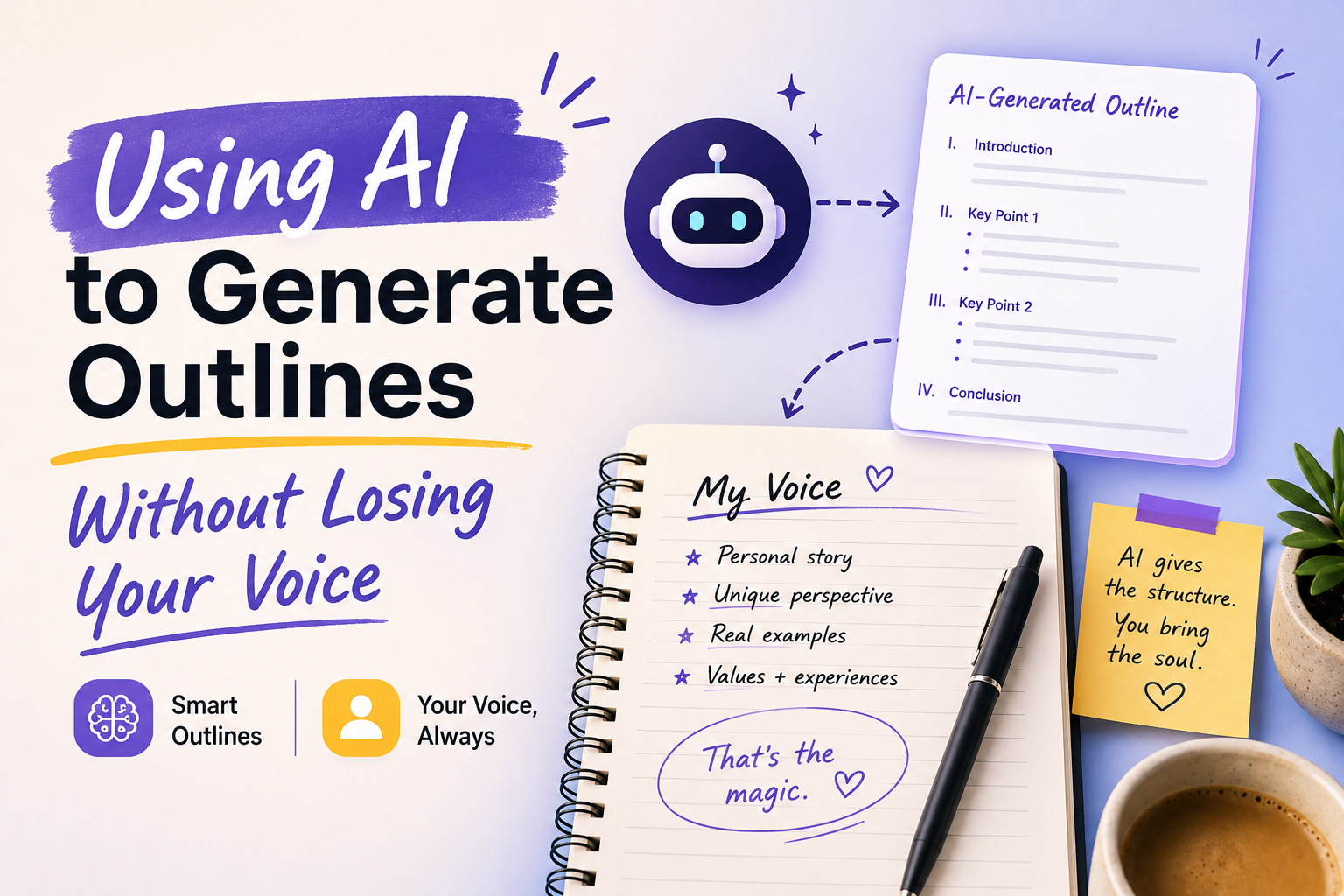
There is a quiet fear that comes with outsourcing the first step of creation. You sit down to write, and instead of facing the blank page, you hand it to a machine. The cursor blinks, the model responds, and suddenly you are staring at a scaffold that feels competent but alien. It is too clean, too balanced, too much like everyone else. This is the trap of the AI outline: it gives you structure, but it does not give you you.
The outline is where voice lives or dies. It is not merely a table of contents. It is the rhythm of your thinking, the weight you place on one idea over another, the moment you decide to linger and the moment you decide to cut. When an AI generates an outline, it is doing something different. It is averaging. It is predicting what should come next based on what has already been written by thousands of other people. The result is often a perfectly reasonable progression that no one would argue with and no one would remember.So the question is not whether to use AI for outlines. The question is how to use it without becoming a passenger in your own work.
Start by treating the AI output as raw material rather than architecture. When the model gives you a sequence of sections, do not accept the hierarchy. Move things. Demote the point that feels overexplained. Elevate the tangent that surprised you. The AI suggested that the historical context come first, but your instinct says to open with the contradiction you noticed yesterday. Follow the instinct. The outline is not a contract. It is a sketch, and you are allowed to redraw it until the proportions feel right.
Voice is also a matter of what you leave out. AI tends toward completeness. It wants to be thorough, to touch every base, to acknowledge every counterargument in measured paragraphs. Your voice, by contrast, is defined by your obsessions. You care about some things more than others, and that care is audible to the reader. When you review an AI outline, look for the sections that make you impatient. Those are the sections that do not belong, or at least not in the form suggested. Cut them, or compress them into a single transitional sentence. The outline should reflect your priorities, not the median priorities of the internet.
Another way to reclaim the outline is to write it twice. The first time, generate it with AI to see the landscape of what is possible. The second time, close the laptop and speak the outline aloud into a voice recorder. Walk around the room and explain the piece as if you were talking to one specific person you know. Transcribe that. Compare the two. The spoken version will be messier, but it will contain your actual syntax, your natural pivots, the places where you slow down for emphasis. Merge the useful structure from the AI version with the living texture of the spoken version. The result will be an outline that holds your shape.
You can also use the AI to sharpen your voice rather than replace it. Feed it a paragraph you have already written in your own style and ask it to outline what comes next, but with a constraint: the outline must mirror your sentence rhythms, your paragraph lengths, your tendency toward short declarative statements or long cumulative ones. Some models can do this with surprising fidelity if you give them enough examples. You are not asking the AI to invent your voice. You are asking it to extend a pattern you have already established.
There is a deeper practice here that goes beyond technique. Before you ever open the AI tool, spend a few minutes writing by hand. Not on the topic. Write about why the topic matters to you. Write the anecdote that made you care. Write the question you cannot answer. This writing will not appear in the final piece, but it will tune your ear to your own frequency. When the AI outline arrives, you will recognize immediately which parts resonate and which parts land with a dull thud, because you have just spent time listening to yourself.
The goal is not to reject the efficiency that AI offers. The goal is to make sure the efficiency serves something human. An outline generated by AI can save you an hour of wandering, but only if you are willing to spend ten minutes wandering in your own mind first. That ten minutes is the difference between a piece that sounds assembled and a piece that sounds discovered.
In the end, your voice is not a style to be preserved like a specimen under glass. It is a habit of attention, a way of moving through ideas that is yours because you practiced it. The AI can hand you the map, but you still have to choose the path, set the pace, and decide what is worth stopping for. The outline is where that journey begins. Make sure it begins in your own direction.