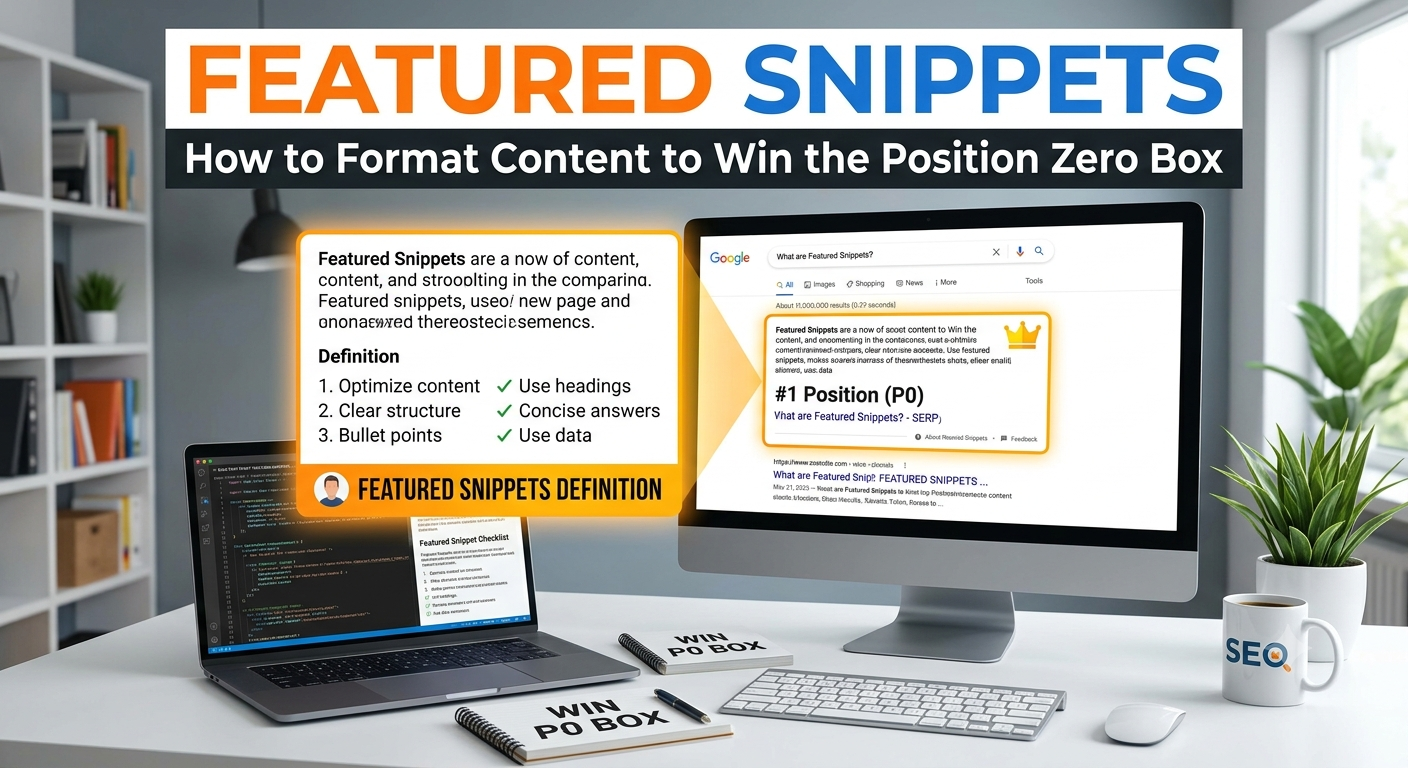
Above the normal search results, sometimes above even the top-ranked page, Google displays a box with a direct answer pulled straight from someone’s content: a definition, a short list of steps, a comparison table. This is a featured snippet, commonly called “position zero,” and it’s one of the few places in modern search where a page that isn’t ranked first can still land the most visible spot on the page. It’s also more winnable than most SEO tactics, because it’s driven by formatting as much as by authority.
What a Featured Snippet Actually Is
A featured snippet is a single page’s content that Google extracts and displays in a highlighted box above the standard organic results, with the source page’s title and URL shown beneath it. Google generally pulls these from pages already ranking on page one for the query, most commonly from positions two through eight, not necessarily the current top result. This matters practically, because a page doesn’t need to be the single top-ranked result to win the snippet. It needs a genuinely well-formatted answer while already ranking reasonably well.
It’s worth knowing directly that featured snippets have persisted even as AI Overviews, Google’s AI-generated answer summaries, have expanded to cover a large share of searches. The two features aren’t fully separate. The same clear, well-structured, directly-answered content that wins a traditional snippet is also the kind of content AI systems tend to pull from and cite. Optimizing for a snippet is, in effect, also optimizing for AI-answer visibility, rather than a separate, competing effort.
The Four Snippet Formats, and Which Queries Trigger Each
Google selects a different snippet format depending on the shape of the query, and matching your content structure to the right format matters more than any other single factor.
Paragraph snippets are the most common format, pulled for definition and explanation queries like “what is X,” “why does X happen,” or short factual questions. Google typically extracts a tight block of text, generally in the range of forty to sixty words, so the winning move is having a genuinely direct answer of roughly that length sitting immediately under a heading that matches the query.
List snippets, whether numbered or bulleted in Google’s display, dominate procedural “how to” queries covering how to configure something, how to fix something, or step-by-step processes. Google pulls the list items directly from the page’s underlying structure, so the content needs an actual ordered or unordered list in the HTML, not a paragraph describing steps in prose.
Table snippets are common for comparison and conversion-style queries, things like “X vs. Y,” unit conversions, or pricing comparisons. These require an actual HTML table rather than a bulleted comparison, since Google extracts the row and column structure directly from the markup.
Video snippets appear for highly visual how-to queries, such as how to tie a specific knot or how to fold something, and are dominated by video content rather than text. These are less relevant for a text-based blog unless you’re also producing video content to go alongside it.
The Formatting Approach That Actually Wins the Box
Winning the box comes down to a consistent set of habits rather than a single trick. Start by matching the query almost verbatim in a heading. If you’re targeting “what is a content cluster,” use that exact phrasing, or something very close to it, as an H2, rather than a cleverer or more creative rewording. Google favors content that clearly maps to the query as typed.
From there, put the direct answer immediately after that heading. Skip the throat-clearing and the “great question, let’s dig in” preamble entirely. The first sentence or two after the heading should be the actual answer, not a lead-up to it.
Keep paragraph answers concise, aiming for roughly forty to sixty words for a definitional answer. That’s long enough to be complete, and short enough for Google to extract as a clean block. For process-based or comparison content, make sure the answer is actually structured as a real list or a real table in the page’s underlying HTML, not simply described in a paragraph. Google can only extract what’s genuinely marked up that way.
Throughout, favor active, declarative language. State plainly what something is, rather than what it might be, and write definitions in the present tense, saying “content marketing is” rather than “content marketing was traditionally considered.” And be selective about which queries you target in the first place. Only pursue snippets for queries where you already rank reasonably well, since Google pulls snippets almost exclusively from page-one results. If a page currently ranks on page two or three, the right fix is improving the underlying ranking first. Reformatting alone won’t win a snippet from far outside page one.
How to Find Your Best Opportunities
Rather than guessing which queries to target, check where you’re already positioned well. In Google Search Console, filter your Performance report for queries where your average position falls somewhere between roughly two and ten. Cross-reference that list against question-shaped queries, ones starting with what, how, why, when, or where, or containing phrases like “vs” or “difference between.” For each one, search the query directly and look at whether a snippet currently exists, what format it uses, and whether your own page’s structure currently matches that format.
This approach turns snippet-hunting into a mechanical process rather than a guessing game. You’re not creating new content from scratch. You’re reformatting pages you already have that are already close to winning.
A Few Things Worth Knowing Before You Invest Time Here
Snippets are a single-winner format. Exactly one URL holds the box per query at a time, and ownership can shift if a competitor reformats their own page more effectively or if Google’s own algorithm re-evaluates the match. It’s worth treating any snippet win as something to periodically re-check, rather than something you win once and forget about.
It’s also worth being honest that not every query is a good target right now. Highly competitive, broad definitional queries increasingly get served by an AI Overview instead of a traditional snippet, and chasing those specific queries with snippet-formatting tactics alone won’t recover a slot that’s been structurally replaced by a different search feature entirely. Procedural “how to” queries and comparison or table-style queries have generally proven more resistant to that substitution than pure definitional ones, which makes them a more reliable place to focus effort at the moment.
Why This Is Worth the Relatively Small Effort
Compared to most SEO work, this is unusually low-cost. You’re not writing new content or building new links. You’re restructuring content you’ve already published to match a format Google is already looking for. For a small site without the backlink profile to compete for position one on a competitive term, winning a snippet from a lower organic position is one of the few ways to claim the most visible spot on the page without first winning the harder authority battle that position one usually requires.
If you’re running a broader content audit, it’s worth adding a check for snippet-format opportunities as its own distinct pass, alongside checking for thin content or broken links. It’s a genuinely different kind of question than the usual audit questions. It’s not asking whether a page is good, but whether it’s structured the way Google actually extracts content, and it’s easy to skip entirely if you’re only looking at traditional ranking metrics.