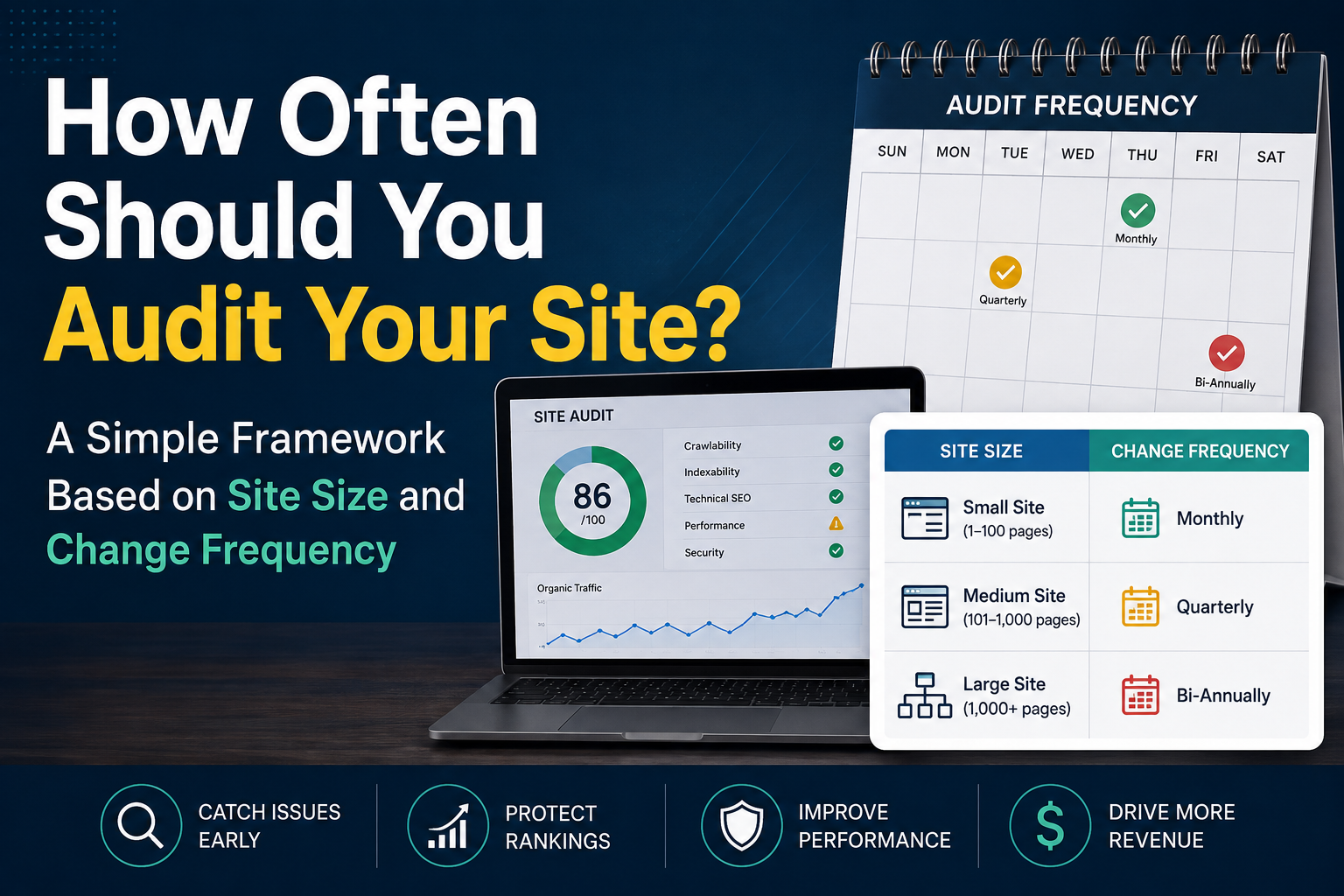
There is a peculiar tension in the world of website management. Everyone agrees that regular audits are essential, yet when you ask ten different professionals how often you should run one, you will get ten different answers. Some insist on quarterly deep dives. Others treat audits like annual physicals, something you endure once a year and try not to think about in between. The truth is that neither rigid schedule works for every site because not every site operates under the same conditions. The frequency with which you should audit your website depends on two primary variables: how large your site is and how often it changes. Understanding the relationship between these factors will save you from both the paralysis of over-auditing and the danger of letting problems fester undetected.
Site size matters because complexity scales with volume. A small business website with fifteen pages, a homepage, an about section, a few service descriptions, and a contact form is a fundamentally different beast from an e-commerce platform with fifty thousand product pages, dynamic filtering, user-generated content, and a blog that publishes daily. On a small site, a single broken link or a missing meta description is easy to spot and quick to fix. On a massive site, the same issues multiply into the thousands, and their cumulative effect on crawl budget, user experience, and search visibility becomes genuinely damaging. Larger sites simply have more moving parts, more opportunities for things to go wrong, and more surface area for search engines to evaluate. They demand more frequent attention not because they are inherently weaker, but because the stakes of a single oversight are magnified across thousands of pages.
Change frequency is equally important, though it is often overlooked. A website that publishes new content weekly, updates product listings daily, runs seasonal promotions, or undergoes regular redesigns is in a constant state of flux. Every change introduces the possibility of new errors. A fresh batch of product pages might carry duplicate titles. A new content management system update could break your structured data. A redesign might inadvertently create redirect chains or orphan previously well-ranking pages. Conversely, a static site that has not changed in six months is unlikely to have sprouted new technical issues unless something external has shifted, such as a search engine algorithm update or a hosting configuration change. The more often you change your site, the more often you need to verify that those changes have not introduced unintended consequences.
With these two variables in mind, a practical framework begins to emerge. For small websites with low change frequency, think of local service businesses, portfolio sites, or informational sites with fewer than fifty pages that update content monthly or less, a comprehensive technical audit once per year is generally sufficient. Between these annual reviews, a lighter monthly check focused on critical metrics such as site uptime, core page speed scores, and any manual actions reported in Google Search Console will keep you aware of major issues without consuming excessive time. These sites are stable by nature, and over-auditing them is a form of productivity theater that yields diminishing returns.For small to medium-sized sites with high change frequency, such as active blogs with several new posts per week, small e-commerce stores with rotating inventory, or businesses running frequent landing page campaigns, the picture shifts. Here, a full technical audit every six months provides a solid baseline, but the real work happens in between. A monthly audit focused specifically on the areas most affected by change becomes essential. If you are publishing content constantly, you need to verify that new pages are being indexed, that internal linking structures remain logical, and that no crawl errors are accumulating. If you are running frequent campaigns, you need to ensure that temporary pages are properly canonicalized or removed once campaigns end, and that no redirect bloat is building up in your architecture. The six-month comprehensive audit catches the deeper structural issues, while the monthly focused reviews prevent the chaos of constant change from degrading your technical foundation.
Medium to large sites with low change frequency occupy an interesting middle ground. Think of established corporate websites, large educational institutions, or enterprise service sites with hundreds or thousands of pages that rarely update their core content. These sites are not changing often, but their sheer size means that existing issues can hide in plain sight for years. A comprehensive audit every six months is advisable to surface problems like broken internal links, outdated structured data, or pages that have slipped out of the index. Additionally, a quarterly review of crawl reports and index coverage data helps ensure that search engines are still accessing and valuing your content correctly. Even when you are not actively changing things, the web around you is evolving. Competitors are improving, search algorithms are shifting, and technical standards are rising. A static large site that is not audited regularly risks gradual obsolescence.
Then there are the heavyweights: large sites with high change frequency. Major e-commerce platforms, large publishers with dozens of daily articles, marketplaces with user-generated listings, and any site with tens of thousands of pages that changes daily or weekly. For these operations, technical SEO is not a periodic task. It is a continuous discipline. A comprehensive audit should be conducted quarterly at minimum, and in many cases monthly deep dives are warranted. Beyond that, automated monitoring becomes non-negotiable. Daily or weekly automated crawls that flag new broken links, sudden drops in index coverage, spikes in server errors, or changes in core page speed metrics act as an early warning system. When your site changes at scale every single day, waiting three months to discover a critical issue could mean thousands of lost rankings and significant revenue damage before you even know something is wrong.
It is worth noting that this framework is not meant to be rigidly prescriptive. External events should always trigger an immediate audit regardless of your scheduled cadence. If you migrate to a new content management system, redesign your site, change your domain, implement a new site architecture, or suffer a sudden traffic drop, you should run a focused audit immediately. These are high-risk moments where the probability of technical issues skyrockets, and catching problems early can mean the difference between a minor hiccup and a months-long recovery.
The tools you use should scale with your audit frequency. For annual or semi-annual comprehensive audits, a deep crawl with a robust technical SEO platform that analyzes every page, images, scripts, and status codes is appropriate. For monthly or quarterly focused audits, targeted crawls of specific sections, combined with dashboard reviews of Google Search Console, page speed tools, and log file analysis, provide the necessary insight without overwhelming your team. For large, high-change sites, investing in automated monitoring tools that integrate with your workflow and alert you to anomalies in real time is one of the smartest technical SEO investments you can make.
Ultimately, the question of how often to audit your site is really a question of risk management. An audit is an insurance policy against the silent decay of technical health. Small, stable sites carry low risk and need minimal coverage. Large, volatile sites carry high risk and need comprehensive, frequent protection. Most businesses fall somewhere in between, and their audit schedule should reflect that reality. The goal is not to audit for the sake of auditing, but to maintain confidence that your site is technically sound enough to support everything else you are building. When you align your audit frequency with the actual size and velocity of your website, you stop guessing and start operating with clarity.