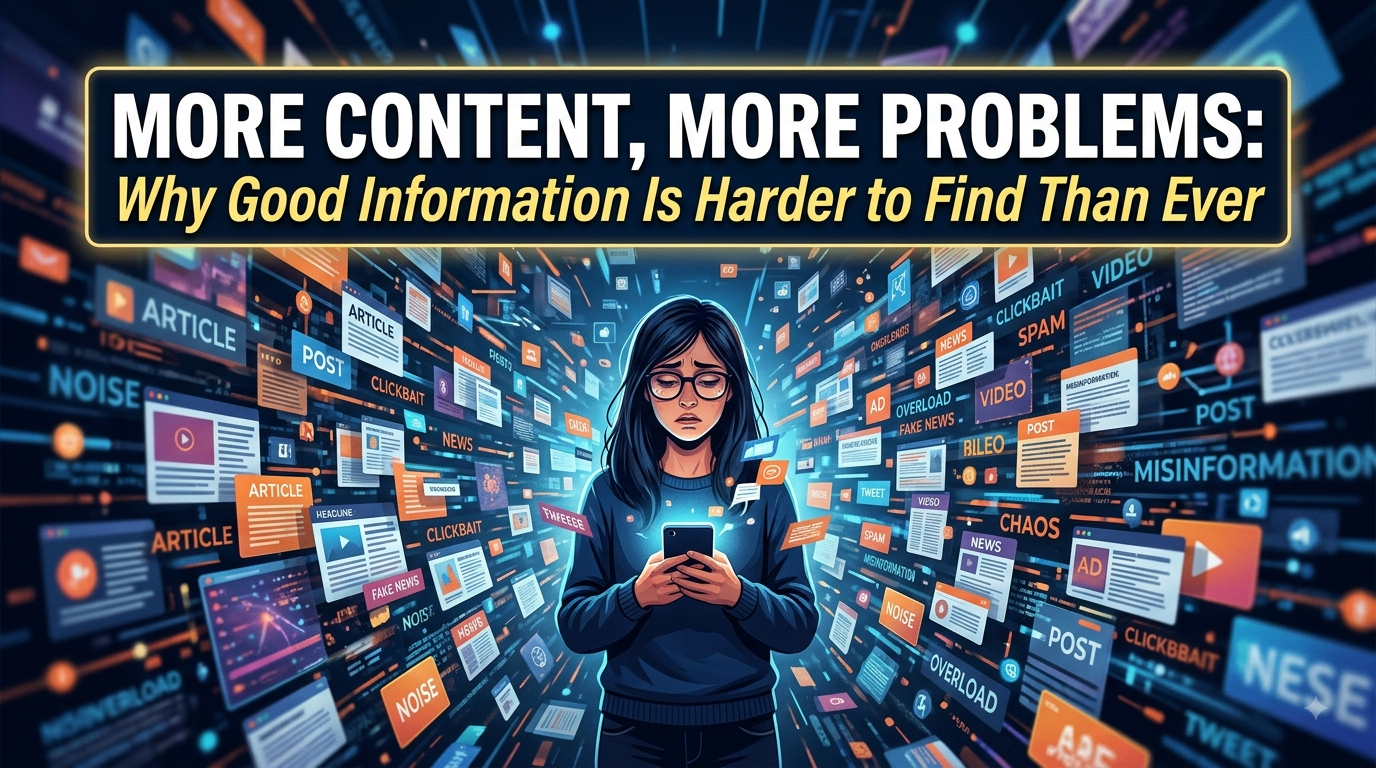
There has never been more content in the world. Every minute, millions of words are published, thousands of videos go live, and countless posts flood every platform we scroll through. By any measure, we are drowning in information.And yet, ask anyone trying to research a health decision, understand a policy debate, or simply learn how to fix their dishwasher, and you’ll hear the same complaint: it’s harder to find good information now, not easier.This isn’t a contradiction. It’s the whole story.
Abundance Isn’t the Same as Access
When content was scarce, the bottleneck was production. Publishing was expensive, editorial standards acted as gatekeepers, and if something made it into print or on air, it had usually cleared some bar of scrutiny.
That bottleneck is gone. Anyone can publish anything, instantly, to a global audience. This is genuinely good in many ways; it has democratized voices that used to be shut out entirely. But it also means the gatekeeping function has vanished, and nothing has fully replaced it.The result: quality and quantity have decoupled. There’s more expert-level analysis available today than at any point in history, and more misinformation, filler, and AI-generated noise sitting right next to it, often indistinguishable at a glance.
The New Bottleneck Is Discernment
If production used to be the hard part, now it’s filtering. The scarce resource isn’t content anymore. It’s trustworthy, well-sourced, genuinely useful content that answers your actual question.This shows up everywhere:
Search results increasingly surface SEO-optimized content built to rank, not to inform.Social feeds reward what’s engaging over what’s accurate.AI-generated text can now produce plausible-sounding material at a scale no human editorial team can review.
None of this means the good stuff disappeared. It means it’s buried deeper, surrounded by more noise than ever, and harder to distinguish without real effort.
Why Demand for Quality Is Rising, Not Falling
You might expect that as content multiplies, people would care less about quality; there’s just too much to sort through, so why bother. The opposite has happened.As trust in default sources erodes, people actively seek out signals of credibility: original reporting, named experts, primary sources, transparent methodology. Newsletters from individual journalists, niche communities with strict moderation, and paid subscriptions to publications with editorial standards have all grown, not despite the flood of free content, but because of it.In other words, scarcity of trust has created its own market. When everything is available, the willingness to pay (in money, time, or attention) for something verified goes up.
What This Means Going Forward
The lesson isn’t that more content is bad. It’s that content volume and content value are no longer correlated, and treating them as if they are is a mistake anyone can make when scrolling on autopilot.The skills that matter now aren’t about finding information. They’re about evaluating it: knowing how to check a source, recognizing when something is optimized for clicks rather than accuracy, and being willing to slow down before sharing or acting on something that sounds right.The amount of content will keep growing. So will the premium on the kind that’s actually worth your time.