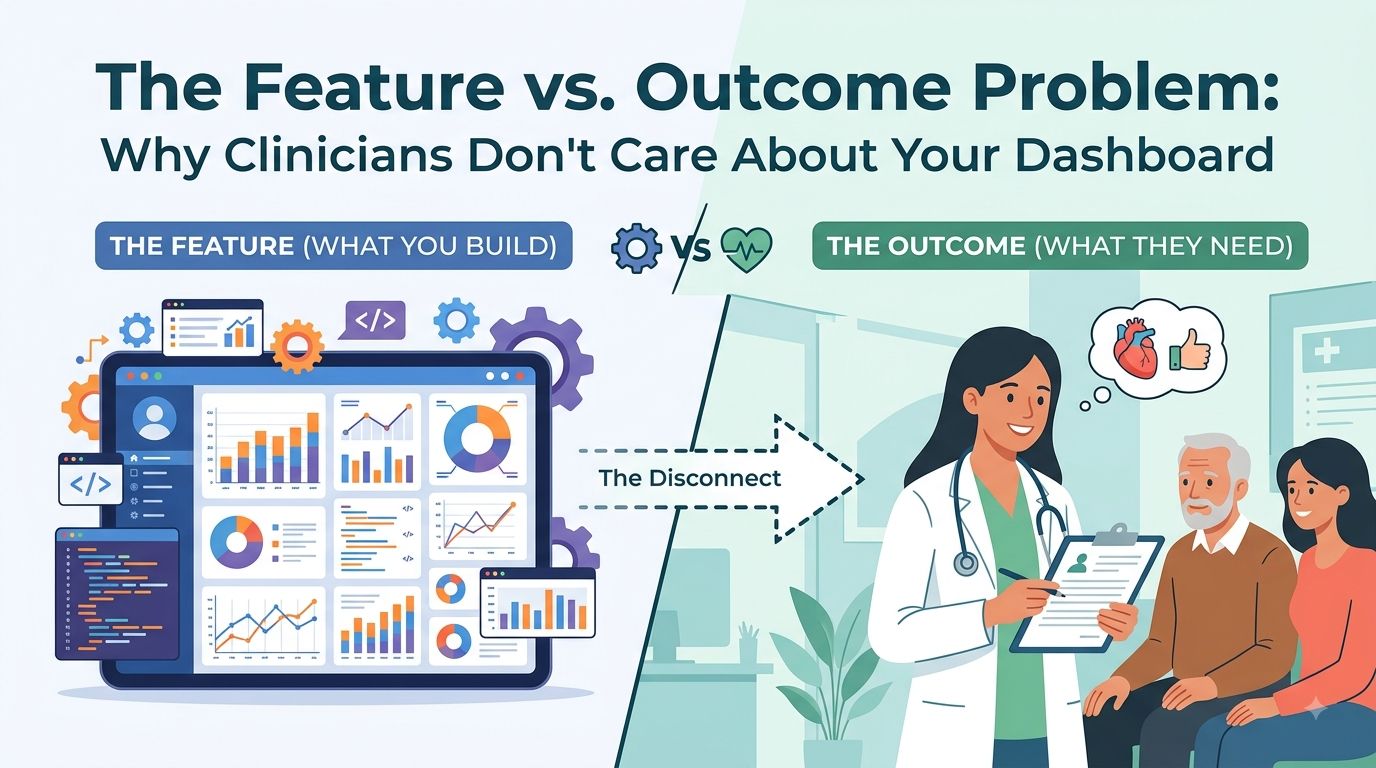
Open almost any healthcare SaaS homepage and you’ll find the same pitch. Real-time analytics. Customizable dashboards. Seamless EHR integration. A clean UI with a screenshot to prove it. It reads like a spec sheet, and that’s exactly the problem.
Clinicians are not evaluating your software the way a typical SaaS buyer does. They are not weighing features against a checklist of nice-to-haves. They are asking a much narrower question: does this make a specific, recurring problem in my day go away? If the answer isn’t obvious within a few seconds of reading your copy, you’ve lost them, no matter how impressive the feature actually is.
The Disconnect Starts With Who’s Writing the Copy
Most SaaS marketing inherits its instincts from software categories where the buyer and the user are the same person, and where the value of a feature is self-evident. A better dashboard is a better dashboard. But healthcare software is usually sold to one person, approved by several others, and used by someone with none of the same incentives as the buyer. A hospital administrator cares about cost per encounter and audit readiness. A nurse cares about not clicking through six screens to chart a single vital sign. A feature that thrills the administrator can be actively resented by the person actually logging in every day.When marketing copy leads with features, it’s implicitly writing to the buyer’s spec sheet and ignoring the user’s actual experience. That gap is where trust erodes, and it’s often where deals stall after the demo, when the software finally reaches the people who have to live inside it.
Outcomes Are a Different Kind of Claim
Talking about outcomes instead of features isn’t a rebranding exercise. It requires making a claim that can be tested against reality: this reduced documentation time by an average of eleven minutes per shift, or this cut prior authorization turnaround from four days to same-day in a rollout across a twelve-clinic network. That kind of specificity is uncomfortable for a lot of marketing teams because it requires real data, a willingness to be pinned down, and often a case study that took months to produce properly.
But that discomfort is exactly why outcome-driven copy works. Clinicians and administrators alike have been pitched a thousand tools promising to “streamline workflows.” Almost none of them define what streamline means in a measurable way. The rare vendor who does immediately reads as more credible, not because the claim is flashier, but because it’s falsifiable. You can ask them how they measured it, and a serious vendor has an answer.
The Feature Still Matters, Just Not First
None of this means features are irrelevant. Integration depth, security architecture, and interface design are often the reason an outcome is achievable at all. The mistake is sequencing them first, as though the mechanism is what earns attention. A better structure reverses the order: state the outcome, let the reader feel the relief of the problem being solved, and only then explain the feature as the reason it’s possible. The feature becomes evidence for the claim rather than the claim itself.
This reordering sounds simple, but it changes almost every piece of content a healthcare SaaS company produces. Landing pages stop opening with product screenshots and start opening with a sentence a clinician would actually say out loud about their own frustration. Case studies stop narrating the implementation timeline and start with the number that changed. Sales decks stop with an architecture diagram on slide two and save it for slide eight, once the buyer already understands what they’re getting.
Why This Is Harder Than It Sounds
Writing this way requires something a lot of marketing teams don’t have readily available: a real, specific understanding of the workflow being disrupted. You can’t credibly describe the outcome of reducing charting time if you don’t know what charting actually looks like at 2 a.m. on a short-staffed unit. This is usually where the writing has to slow down, involve actual conversations with clinical staff or customer success teams, and resist the temptation to default to industry-standard phrases like “improve patient outcomes” that sound authoritative but say nothing specific at all.
The healthcare SaaS companies that get this right aren’t necessarily the ones with the best product. They’re the ones willing to do the unglamorous work of finding out exactly what changed for exactly which person, and saying it plainly instead of hiding behind the dashboard.