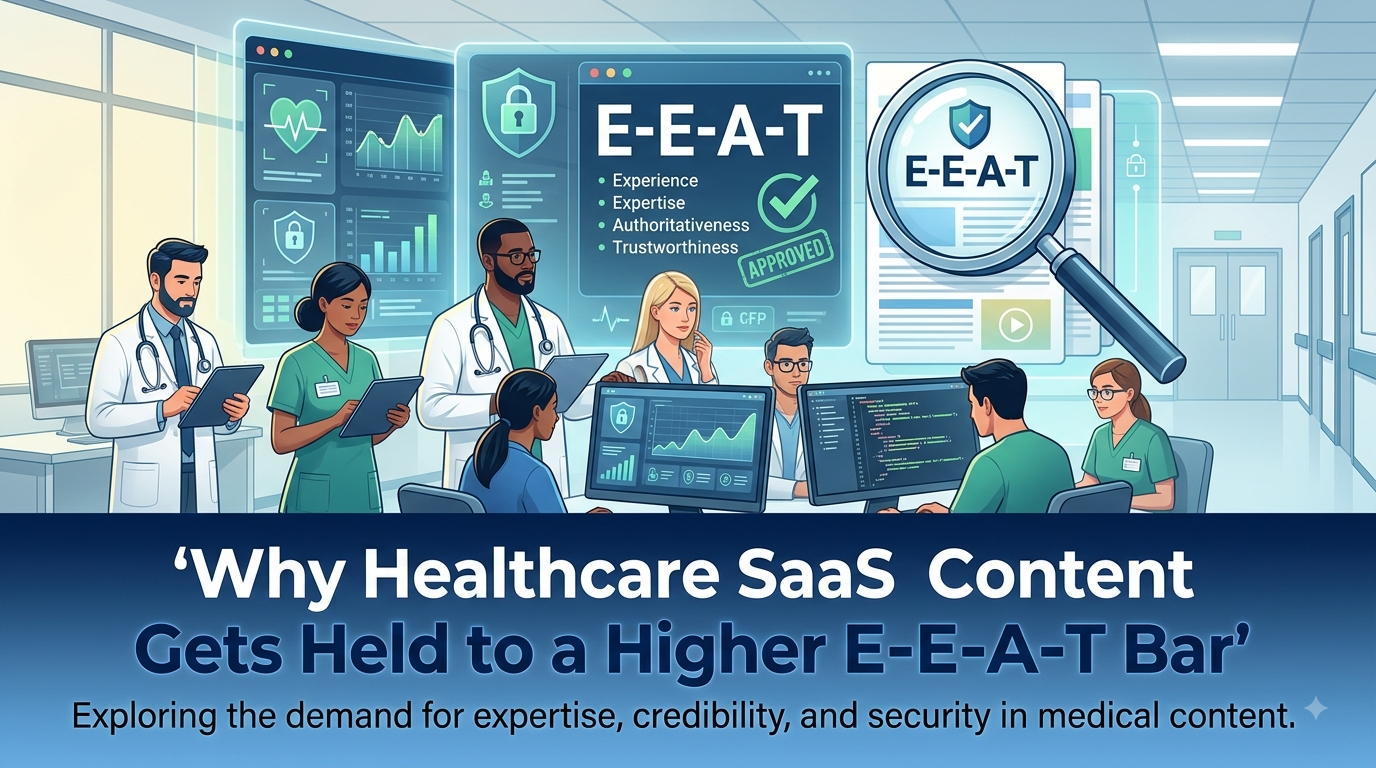
Write a blog post about the best productivity apps and Google will evaluate it on the same general terms as most other content: is it useful, well-organized, reasonably credible. Write a blog post that touches on patient safety, clinical workflows, or health data, even tangentially, and you’re suddenly operating under a different and much stricter set of rules. Google classifies this territory as Your Money or Your Life content, and healthcare SaaS marketing teams who don’t understand what that classification actually triggers tend to be baffled by why their well-written, keyword-optimized content still doesn’t rank.
YMYL Isn’t About Your Product, It’s About the Topic
The YMYL designation doesn’t care whether you’re selling software or practicing medicine. It cares whether the content could plausibly affect someone’s health, safety, or financial wellbeing if it’s wrong. A blog post explaining how your platform helps reduce medication errors falls squarely into that territory, even though you’re not a pharmacy and you’re not offering medical advice. The moment content brushes up against clinical outcomes, patient safety, or health data handling, Google’s quality systems start asking a harder question than they would of a typical SaaS blog: can this be trusted, and can that trust be verified.
This matters because a lot of healthcare SaaS marketing teams write with the instincts of a general B2B content strategy, optimizing for keyword coverage and search volume, without registering that the topic itself has quietly moved them into a category where credibility signals carry disproportionate weight in how the content gets evaluated and surfaced.
Expertise Has to Be Demonstrable, Not Implied
In most SaaS categories, a confident, well-researched blog post is enough to establish authority. In healthcare, confidence isn’t a substitute for demonstrable expertise, and Google’s guidelines are explicit that YMYL content should be produced or reviewed by someone with relevant subject matter expertise. A generalist content writer, however skilled, explaining the clinical implications of a workflow change is a weaker signal than the same content reviewed and attributed, even briefly, to a clinician or someone with a relevant credential.
This is why a lot of healthcare SaaS companies that take content seriously build a light clinical review step into their editorial process, not because every post needs a physician co-author, but because a visible reviewer credential changes how both search engines and human readers assess the content’s trustworthiness. It’s a real cost, in time and sometimes in fees paid to a clinical reviewer, and it’s one of the clearest ways this space diverges from standard SaaS content production.
Authorship and Bios Do More Work Here Than Elsewhere
A generic “written by the marketing team” byline is unremarkable on most B2B blogs. On a healthcare SaaS site, the absence of a named, credentialed author on clinically adjacent content is a missed opportunity at best and a credibility gap at worst. Author bios that specify relevant background, whether that’s a nursing credential, a health IT certification, or years spent in clinical operations, give both readers and search algorithms something concrete to evaluate rather than an anonymous voice making claims about patient care.
This doesn’t mean every piece of content needs an elaborate bio. Content about integration architecture or pricing doesn’t carry the same YMYL weight as content about reducing diagnostic errors. But teams that apply the same authorship treatment to everything, either over-crediting low-stakes content or under-crediting high-stakes content, are missing where the actual scrutiny falls.
Claims Need Citations, Not Just Confidence
General SaaS marketing can get away with unsupported claims about efficiency or satisfaction because the stakes of being wrong are low. In healthcare content, an unsupported claim about clinical outcomes is a bigger liability, both for search visibility and for the compliance reasons covered elsewhere in this space. A statement like “reduces documentation errors” reads very differently depending on whether it’s followed by a citation to a study, a specific customer result, or nothing at all. Google’s guidelines increasingly reward content that shows its work, linking to primary research or providing verifiable data, over content that simply asserts a benefit and moves on.
This creates a genuine tension for marketing teams who are used to writing punchy, declarative copy. Softening a claim to make it defensible can feel like it weakens the pitch. In practice, a specific, sourced claim tends to outperform a vague, confident one anyway, both with skeptical buyers and with the ranking systems evaluating the content’s trustworthiness.
Trust Signals Compound Across the Whole Site
E-E-A-T isn’t evaluated purely at the level of a single blog post. Google’s guidelines look at signals across an entire site and even the reputation of the organization publishing it. A healthcare SaaS company with a clear About page detailing real leadership, visible security and compliance documentation, transparent contact information, and a track record of consistent, accurate content builds a cumulative trust profile that makes each individual piece of content more credible by association. A site with an anonymous team page and no clear indication of who’s behind the product starts every new piece of content from a credibility deficit, regardless of how well that individual post is written.
What This Means Practically
None of this means healthcare SaaS content needs to read like a clinical journal. It means the editorial process has to account for scrutiny that other SaaS categories simply don’t face. That includes deciding which topics genuinely touch YMYL territory and deserve a review step, building real author credentials into the site rather than treating bylines as an afterthought, and getting comfortable citing sources even when it makes the copy a little less punchy. The healthcare SaaS companies that internalize this tend to see it pay off twice, first in search visibility that’s harder for competitors to catch up to, and second in the same kind of buyer trust that matters everywhere else in a sales process built on skepticism.