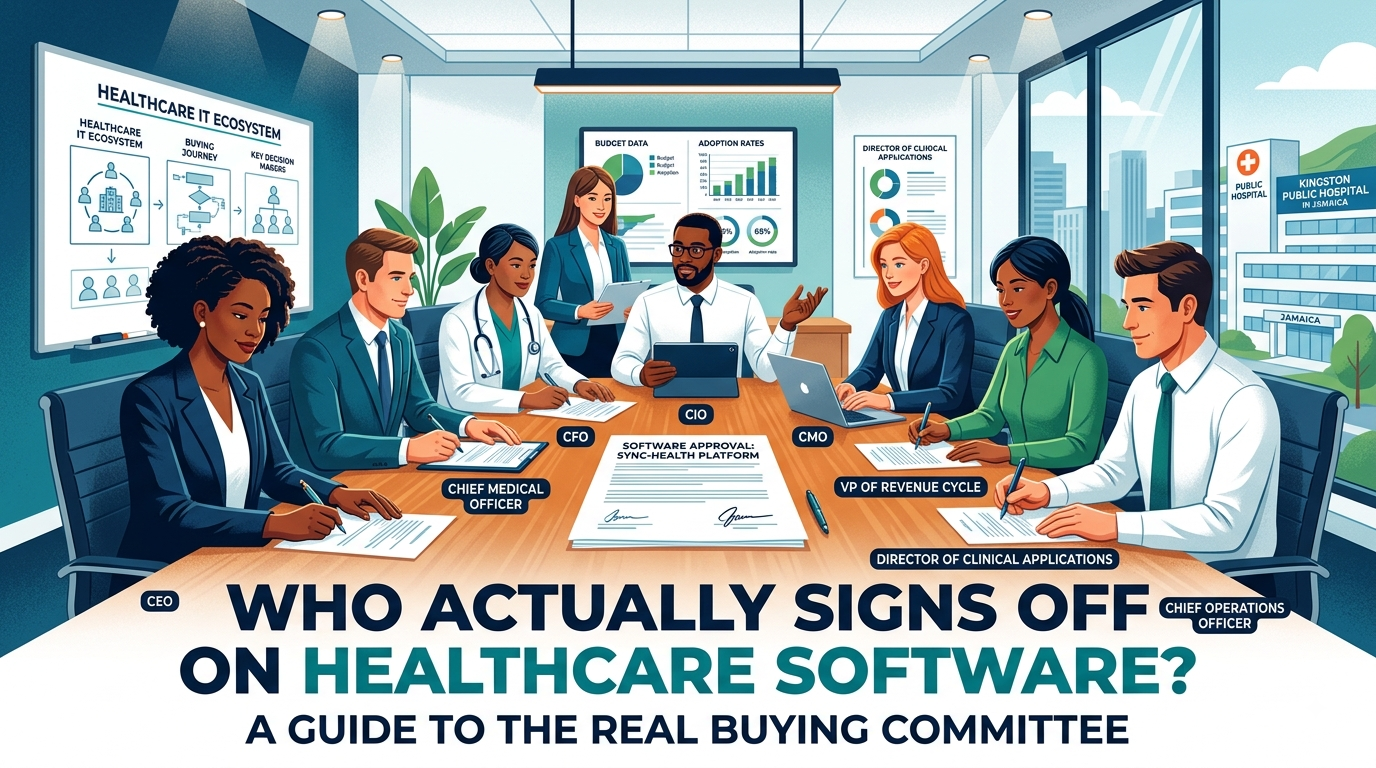
Ask a healthcare SaaS marketing team who their buyer is, and you’ll often get a single job title back. VP of Clinical Operations, maybe, or Director of IT. That answer isn’t wrong, exactly, but it’s dangerously incomplete. Healthcare software is rarely purchased by one person. It’s approved by a committee, and every member of that committee is evaluating the product against a different set of fears, and if your marketing only speaks to one of them, you’re relying on a single champion to translate your pitch to everyone else in the room, which is a fragile way to close a deal.
The Champion Is Not the Decision-Maker
In most healthcare organizations, the person who finds your product and gets excited about it is not the person with final authority to sign the contract. A department director might discover your tool, sit through the demo, and become genuinely convinced it solves a real problem. But that enthusiasm has to survive contact with procurement, compliance, IT security, and often finance, none of whom were in the room for the demo and none of whom share the department director’s sense of urgency. Marketing that only equips the champion with excitement, and not with the specific answers those other stakeholders will demand, puts the entire deal on that one person’s shoulders.
This is why the most effective healthcare SaaS content doesn’t just sell the product. It arms the champion. A one-pager that anticipates the security questionnaire, a technical brief that answers the interoperability question before IT has to ask it, a plain-language summary of the compliance posture that a department director can forward without having to translate it themselves. The champion’s job gets dramatically easier when your marketing has already done the work of speaking to people who aren’t in the room yet.
The Compliance Officer Is Reading for What You Didn’t Say
Compliance and privacy officers approach vendor marketing differently than almost anyone else in the buying process. They aren’t looking for reasons to be impressed. They’re looking for gaps, vague language, and claims that don’t hold up under a security questionnaire. A confident, specific description of your data handling practices reads as competence to this stakeholder. A page full of adjectives like “secure” and “trusted” without any specifics reads as a red flag, because it suggests either the vendor doesn’t understand the regulatory environment or is hoping nobody looks closely.
The practical implication is that content aimed at this stakeholder needs to exist somewhere, even if it’s not on the main landing page. A security and compliance overview, written plainly enough that a non-technical department head can still follow it, does double duty: it satisfies the compliance officer’s scrutiny and gives the internal champion something concrete to hand off when the question inevitably comes up.
Clinicians Are Evaluating a Completely Different Question
Somewhere in the process, usually after the demo but before the contract, the software reaches the people who will actually use it every day, and their evaluation has almost nothing to do with the criteria everyone else applied. A nurse or physician isn’t weighing security architecture or total cost of ownership. They’re asking whether this tool will make their next twelve-hour shift easier or harder, and they’ve likely been burned before by software that was sold to administration as transformative and turned out to add clicks instead of removing them.
This is often the stage where deals quietly die, not because the contract fell through, but because adoption never happened and the renewal conversation a year later reflects that. Marketing rarely reaches this stakeholder directly, since they’re not the ones reading landing pages, but the language used earlier in the sales process shapes how the tool gets introduced to them. A rollout framed around administrative metrics alone tends to land as one more mandate from people who don’t do the actual clinical work. A rollout that can point to a specific, credible claim about time saved or friction removed gives the internal champion something to say in the room that isn’t just “corporate wants us to use this.”
Finance and Procurement Want a Different Kind of Proof
By the time a deal reaches finance and procurement, the emotional case has usually already been made elsewhere. What these stakeholders want is a defensible number: total cost of ownership over a multi-year period, a clear picture of implementation costs beyond the subscription price, and ideally a benchmark against whatever the organization is currently doing, whether that’s a competitor’s tool or a manual process. Marketing content aimed at this audience benefits from being unusually plain and quantitative, resisting the temptation to lean on the same persuasive language used for clinical or executive audiences.
Why This Changes How Content Should Be Built
Once it’s clear that a single sale involves this many distinct evaluators, the flaw in a one-size-fits-all marketing approach becomes obvious. A single landing page cannot simultaneously excite a department head, satisfy a compliance officer, reassure a clinician, and justify a budget line to finance, at least not without becoming so generic that it fails to fully convince any of them. The stronger approach treats the buying committee as an actual audience map, producing distinct pieces of content, even short ones, that speak directly to each stakeholder’s real question, and trusting the internal champion to assemble those pieces into the case they need to make internally.
That’s ultimately what strong healthcare SaaS marketing does that generic SaaS marketing often doesn’t. It acknowledges that the sale isn’t won in a single conversation with a single buyer, but in a series of quieter conversations happening across a committee, most of which the vendor will never be present for.