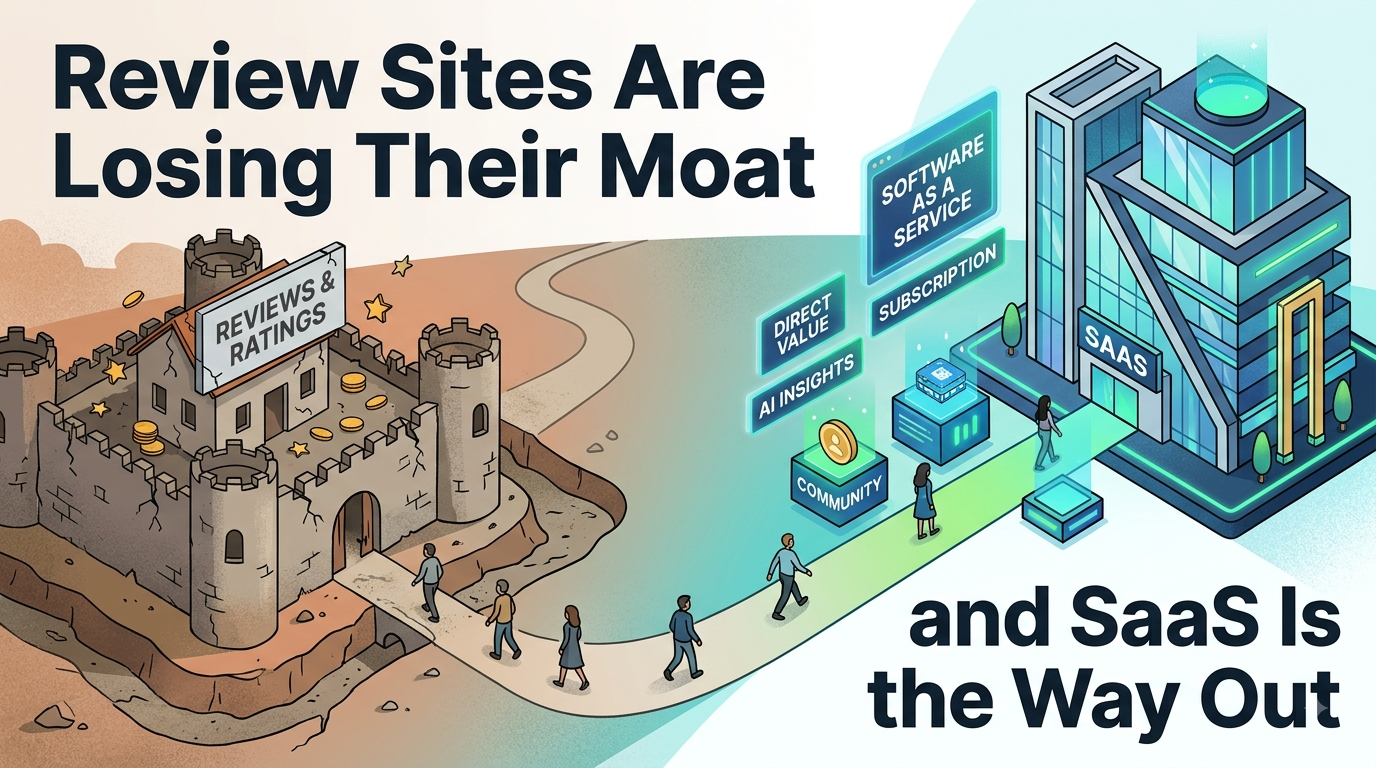
For nearly two decades, review sites built some of the most durable moats in consumer internet. Yelp, TripAdvisor, G2, Capterra, Trustpilot, and dozens of category-specific spinoffs all followed the same playbook. Accumulate enough user-generated reviews that you become the default source of truth for a category, rank at the top of search results because Google rewards fresh, structured, crowd-sourced content, and let network effects do the rest. More users meant more reviews, more reviews meant better rankings, and better rankings meant more users. It was a flywheel that took years to spin up and was almost impossible for a newcomer to interrupt.
Generative AI is quietly dismantling that flywheel, and it is doing so from two directions at once.The first is on the discovery side. People used to type “best noise cancelling headphones” into Google, click through to a review site, and read a ranked list. Increasingly, they ask an AI assistant instead, and the assistant synthesizes an answer directly, often without sending the person to any single source. The click-through that review sites depended on for ad revenue and affiliate commissions is disappearing, not because the content got worse, but because the interface people use to get answers has changed. When the answer is delivered in the chat window itself, the review site becomes an input to a model rather than a destination for a human.
The second is on the content side, and it is more corrosive. The entire value proposition of a review site rested on the assumption that reviews were written by real people with real experiences, and that aggregating enough of them produced a trustworthy signal. Generative AI makes it cheap to produce large volumes of plausible, detailed, seemingly authentic reviews that never happened. As fake reviews scale, the signal-to-noise ratio on these platforms degrades, and the thing that made them valuable in the first place, a trustworthy aggregate of human opinion, becomes harder to guarantee. Once users suspect that a meaningful share of the content might be synthetic, the platform’s core asset loses value even if most of the content is still genuine.
Put those two forces together and the moat that took years to build starts looking thin. The content is easier to fake, and the traffic that used to reward having the most content is being rerouted through AI intermediaries that don’t need to send anyone anywhere. A moat built on aggregated user content and search traffic was a great business when both of those things were scarce and hard to replicate. Neither is scarce anymore.
So where does that leave companies whose entire identity was built around being a review site? The honest answer is that being a review site, on its own, is no longer a durable business. But most review sites are not actually just review sites. They sit on top of something more valuable: relationships with the businesses being reviewed. That is where the way out lives.
The businesses listed on these platforms don’t just want to be reviewed, they want to manage their reputation, respond to feedback quickly, benchmark themselves against competitors, understand sentiment trends over time, and route review data into their own CRM or support systems. That is a software problem, not a content problem, and it is exactly the kind of problem that generative AI does not commoditize in the same way. A SaaS layer built on top of the review corpus, sold to the businesses themselves rather than monetized through consumer ad traffic, turns a fragile content moat into a much stickier one built on workflow integration and switching costs. Once a business has connected its support ticketing system, trained its response templates, and built dashboards on top of a platform’s data, moving away is expensive in a way that clicking a different link in a search results page never was.
This is a familiar pattern in software history. Businesses that win on aggregation eventually get squeezed by whatever technology makes aggregation easy to replicate, and the ones that survive are usually the ones that convert their position into a tool people depend on operationally, not just a destination people visit occasionally. Review platforms have an unusually good starting position for this pivot, because they already have the data, the business relationships, and the domain credibility. What they lack, in most cases, is the product muscle to turn a listings page into a genuine software product with recurring revenue tied to utility rather than traffic.The sites that make this shift will look less like directories and more like vertical SaaS companies that happen to have review data as a proprietary input. The sites that don’t will keep fighting a losing battle against a discovery layer that no longer needs them and a content layer that no longer trusts them.