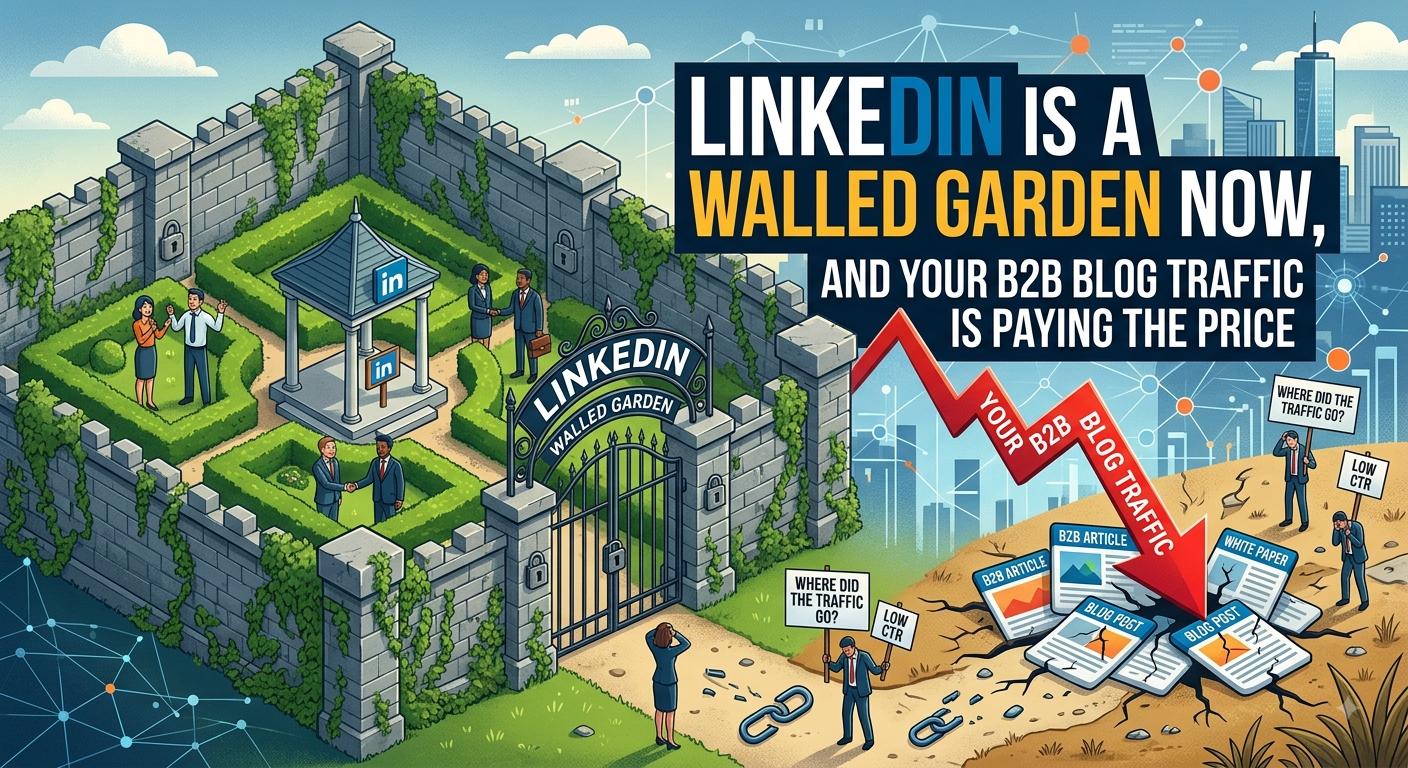
If you’ve been publishing on LinkedIn hoping it would feed traffic back to your website the way a good blog post does, it’s time for an honest look at what’s actually happening. LinkedIn has quietly become a closed ecosystem. Almost everything of substance on the platform now sits behind a login wall, which means Google and other search engines can’t see it, can’t index it, and can’t send anyone to it. For B2B marketers and bloggers who treated LinkedIn as a distribution channel with SEO upside, that upside has largely evaporated.
What “closed ecosystem” actually means here
A few years ago, you could stumble onto a LinkedIn post or article through a Google search without ever creating an account. That’s no longer the default experience. Try clicking through to most posts today while logged out, and you’ll hit a login or signup prompt before you can read more than the first couple of lines. The feed itself, where the vast majority of day-to-day content lives, is essentially invisible to search engines because it requires authentication to view.
This isn’t an accident or a bug. It’s a deliberate product decision. LinkedIn makes money by keeping people inside the app, engaging, connecting, and eventually paying for premium features or ads. Every person who reads your insightful post without logging in is a person LinkedIn isn’t converting into an active account. Gating content behind a login is a logical business move for LinkedIn. It’s just a bad one for anyone hoping to use the platform as a top-of-funnel SEO play.Why this matters specifically for posts, not everythingIt’s worth being precise here, because LinkedIn isn’t uniformly closed. LinkedIn controls what’s crawlable through its robots file, and it draws a clear line: public profiles, company pages, and published Articles remain crawlable and do show up in Google search results. The regular feed of status updates and posts, on the other hand, sits behind the authentication wall, so search engines see almost none of it.
That distinction explains a lot of confusion in the B2B marketing world right now. Someone will point to their LinkedIn Article ranking on Google as proof the platform still has SEO value, while someone else swears their daily posting habit has done nothing for their website traffic. Both people are right. They’re just talking about two different products wearing the same LinkedIn logo.
The practical effect on B2B bloggers
If your content strategy has leaned on writing something valuable, posting it as a LinkedIn update, and hoping it compounds into search visibility over time, that strategy no longer works the way it used to. A logged-out visitor arriving from Google will not find your post, no matter how good it is or how much engagement it got inside the platform. The post can go semi-viral among your network and still contribute zero long-term SEO equity to your domain, because Google was never able to see it in the first place.
This creates a strange incentive problem. LinkedIn’s own algorithm rewards frequent posting and fast engagement in the first hour after publishing, which pulls marketers toward producing more short-form feed content. But that’s precisely the content type sealed off from search. The platform is nudging creators toward the format that generates the least durable, least discoverable value outside its own walls.
Where the real SEO value still lives on LinkedInNone of this means LinkedIn is useless for a B2B content strategy, only that the value has moved to a narrower set of formats. LinkedIn Articles, unlike regular posts, are indexed by Google and can appear in both LinkedIn’s internal search and external search results, which gives them a genuine second life outside the app. A well-optimized company page or personal profile can also surface in Google results, functioning more like a landing page than a piece of content marketing.
The practical implication is that if search traffic is actually your goal, the feed post is best treated as a promotional signal, not the destination. It can drive engagement, build relationships, and put your name in front of the right people inside LinkedIn’s ecosystem. But the substantive, evergreen thinking that you want strangers to find via Google belongs somewhere search engines can actually reach: your own blog, a published LinkedIn Article, or another crawlable format. Anything you publish only as a status update is, from an SEO standpoint, effectively whispered into a closed room.
LinkedIn hasn’t stopped being valuable. It’s just stopped being an SEO channel for most of what gets posted there. Treat the feed as a relationship and visibility tool for the people already inside the platform, and keep your actual search-driving content on assets that Google can crawl. Confusing the two is how a lot of B2B marketing budgets are quietly being spent on content that nobody outside LinkedIn will ever find.