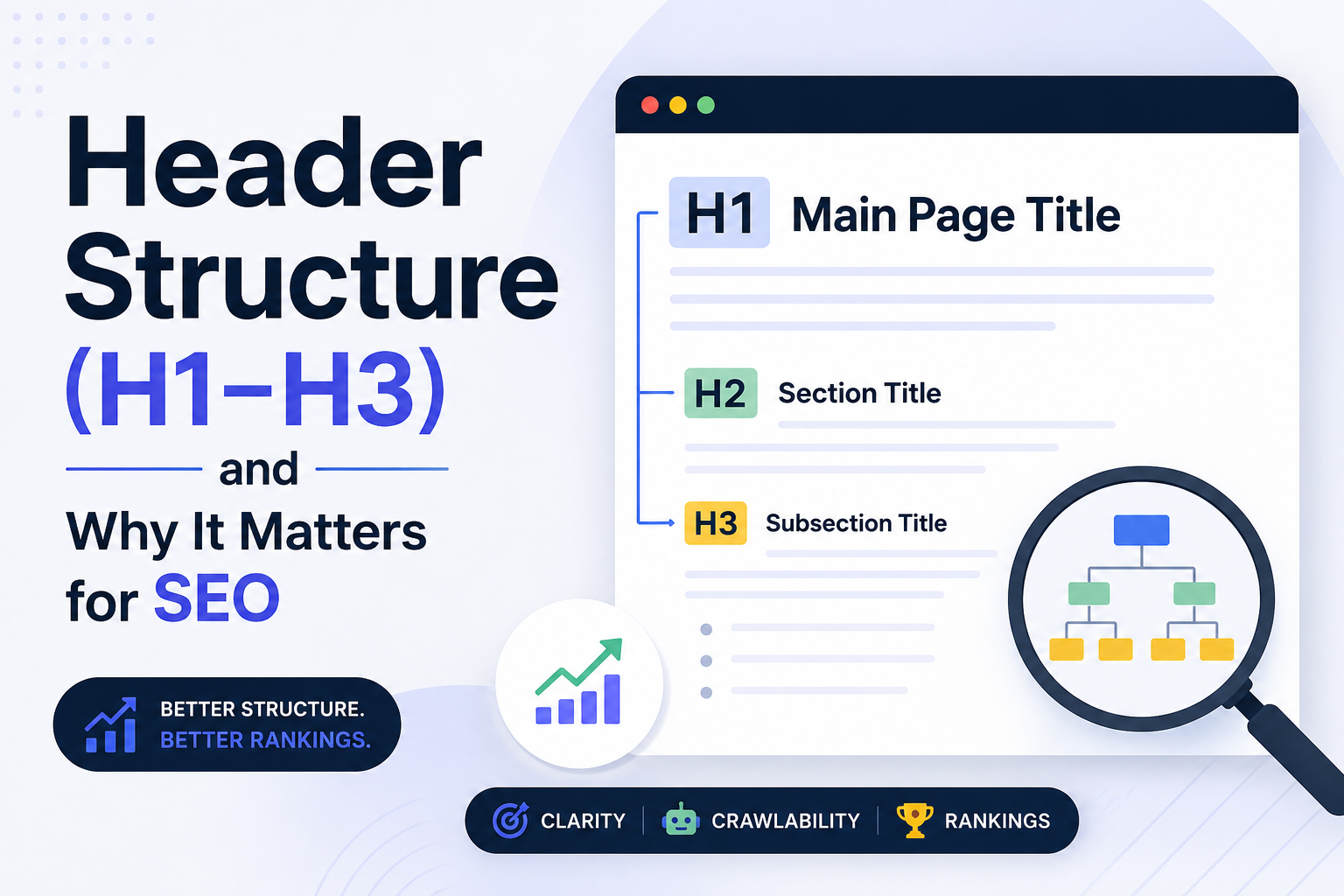
Search engines do not read content the way humans do. They crawl. They parse. They look for signals that tell them what a page is about and how its ideas connect to one another. Header tags are among the most important of those signals, yet they are often treated as an afterthought, used only to make text bigger or bolder. That is a mistake. When used with intention, headers form the backbone of your content architecture, guiding both search engine crawlers and human readers through your material with clarity and purpose.
The Hierarchy of Meaning
An H1 tag is not simply a title. It is the single most definitive statement of what a page contains. Every page should have exactly one H1, and that H1 should encapsulate the primary topic with precision. Think of it as the headline of a newspaper article. It tells the reader, at a glance, what they are about to learn. For search engines, the H1 carries significant weight in determining relevance. It sits at the top of the semantic hierarchy, and the keywords it contains help algorithms categorize the page correctly. A vague or missing H1 forces search engines to guess your intent, and guessing rarely leads to strong rankings.
Beneath the H1, H2 tags divide the content into its major thematic sections. If the H1 is the book title, the H2s are the chapter headings. Each H2 should introduce a distinct subtopic that supports the central theme established by the H1. This structure allows search engines to understand the relationship between ideas on the page. An H2 about keyword research, for example, signals to a crawler that this section contributes to the broader topic of SEO strategy outlined in the H1. Without H2s, a long piece of content becomes an undifferentiated block of text, and search engines struggle to identify which parts are most important.
H3 tags operate one level deeper. They break H2 sections into smaller, more specific components. If an H2 covers on-page optimization, an H3 might address meta descriptions, image alt text, or internal linking. These tags add granularity. They help readers scan for the precise information they need, and they give search engines additional context about the depth and specificity of your coverage. A page rich in well-structured H3s demonstrates thoroughness, and thoroughness is a quality signal that search engines increasingly value.
Why Structure Influences Rankings
Search engines have evolved far beyond simple keyword matching. Modern algorithms employ natural language processing to understand context, intent, and the relationships between concepts. A clear header hierarchy feeds directly into this capability. When headers cascade logically from broad to specific, algorithms can construct a semantic map of your content. This map helps them match your page to complex, long-tail queries that might not contain your exact keywords but relate closely to your topic. A page about healthy eating that uses H2s for meal planning, nutrient balance, and dietary restrictions, with corresponding H3s beneath each, is far more likely to rank for varied queries than a page that simply repeats the phrase healthy eating in paragraph after paragraph.
User behavior reinforces this structural importance. When visitors land on a page and encounter a wall of text, they tend to leave quickly. High bounce rates and short dwell times send negative signals to search engines, suggesting that the content did not satisfy the user’s need. Headers combat this by making content scannable. A reader can glance at your H2s and immediately know whether the page contains the answer they seek. If it does, they scroll to the relevant H3, find the detail they need, and stay longer. That engagement is measurable, and search engines measure it.
Accessibility adds another dimension to the argument. Screen readers rely heavily on header tags to navigate content for visually impaired users. A logical H1 through H3 structure allows assistive technologies to present information in a meaningful order. Search engines consider accessibility a component of user experience, and pages that serve all users well tend to perform better in search results. Neglecting header hierarchy does not just hurt your rankings, it excludes a portion of your audience.
Common Mistakes That Undermine Structure
One of the most frequent errors is using headers for styling rather than semantics. A writer might choose an H2 because the text looks better at that size, even though the content does not represent a new section. This practice confuses crawlers. If an H2 appears in the middle of a paragraph without introducing a new idea, the algorithm cannot determine where one topic ends and another begins. Always select header levels based on the role the text plays in your argument, not on how it appears on the screen. CSS should handle appearance, headers should handle meaning.
Another mistake is skipping levels. Jumping from an H1 directly to an H3, or using multiple H1s on a single page, breaks the logical flow. It is the equivalent of handing someone a book with two title pages and no chapter headings. The reader, human or algorithmic, loses the thread. Maintain a strict hierarchy. If you need more than three levels of depth, use H4s and beyond, but do so consistently and only when the content genuinely requires that level of subdivision.
Keyword stuffing within headers is equally damaging. Early SEO tactics encouraged loading H1s and H2s with as many keywords as possible, but modern algorithms penalize this behavior. A header that reads unnaturally, packed with variants of the same phrase, reads as manipulation rather than information. Write headers for people first. If your H1 accurately describes the page and your H2s naturally incorporate relevant terms, the SEO value will follow without forced optimization.
Building Content That Earns Authority
Header structure is not merely a technical checkbox. It is a reflection of how well you understand your subject. When you sit down to write, the process of outlining your H1, H2s, and H3s forces you to organize your thoughts. It reveals gaps in your knowledge and highlights where your argument might be weak. A page that flows logically from H1 to H3 is usually a page that has been thought through carefully, and that depth of thought translates into content that other sites want to reference.
Backlinks remain one of the strongest ranking factors, and authoritative sites link to content that demonstrates expertise. A well-structured article is easier to cite because other writers can point directly to a specific H2 or H3 section that supports their own argument. Your headers become anchor points for the broader conversation happening across the web. In this way, strong header architecture does not just help you rank, it helps you become a recognized voice in your field.
The Practical Path Forward
Start every piece of content with an outline. Define your H1 by asking what single question this page answers. Then list the major components of that answer as your H2s. Under each H2, note the specific points that require explanation and assign them as H3s. Only after this skeleton is complete should you begin writing the body text. This discipline ensures that your headers guide the content rather than being retrofitted after the fact.
Review existing pages with an eye toward header hierarchy. Look for pages where the H1 is missing or where multiple H2s could be consolidated or split. Check whether H3s genuinely introduce new ideas or merely restate what the H2 already covered. These audits often reveal quick wins, pages that can climb in rankings with nothing more than structural refinement.
Remember that headers are promises. An H2 promises that the following section will deliver on the idea it names. An H3 promises specificity. When you keep those promises with high-quality, relevant content, you build trust with both your readers and the algorithms that send them your way. That trust compounds over time, turning individual pages into a cohesive, authoritative presence that dominates search results for your niche.
The difference between content that ranks and content that disappears often comes down to the invisible architecture beneath the words. Master your H1 through H3 structure, and you master one of the most powerful, yet most overlooked, tools in modern SEO.