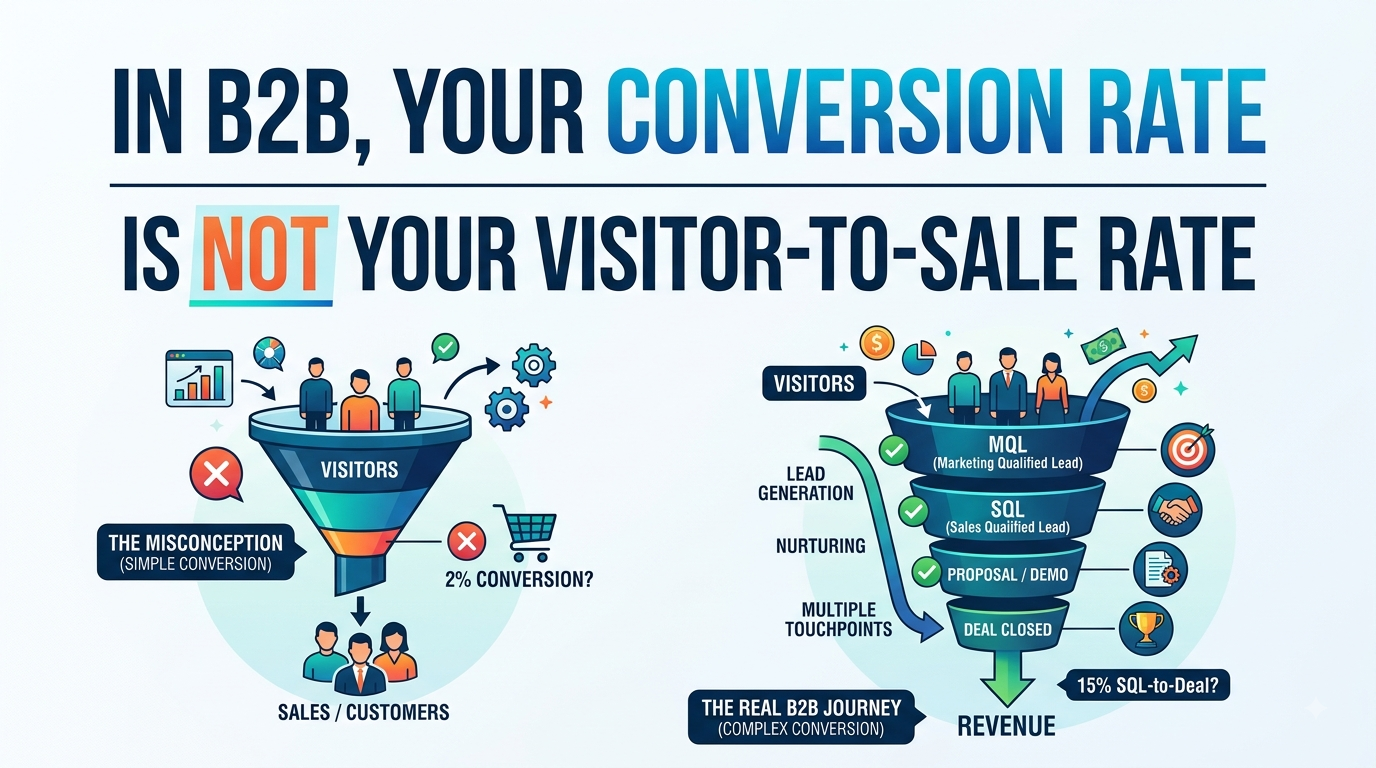
A lot of B2B marketing teams report on conversion rate as if it’s a single, self-explanatory number, and a lot of leadership teams read it the same way. Someone says the website converts at three percent, and everyone in the room quietly translates that into “three percent of visitors become customers.” In B2C, that translation is often roughly true, because the purchase happens on the site. In B2B, that translation is almost always wrong, and treating it as true leads to bad decisions about where marketing dollars go and who gets credit or blame when revenue moves.
The reason for the gap is structural. A B2B purchase is rarely a single-session decision made by a single person. It typically involves multiple stakeholders, a procurement or budgeting process, and a sales cycle that can run for weeks or months, made up of a series of intermediate steps like a discovery call, a demo, a proposal, a security review, and a signed contract. Your website’s job in that process is not to produce a sale. Its job is to produce the first qualified step in a much longer chain, most commonly a form fill, a demo request, or a content download that gets someone into a nurture sequence. That first step is what your on-site conversion rate is actually measuring. It tells you how well your site turns a visitor into a lead. It says nothing on its own about how well your sales team turns that lead into revenue.
This is why two companies can report identical conversion rates and have wildly different businesses. One company converts three percent of visitors into demo requests and closes forty percent of those demos into paying customers. Another company also converts three percent of visitors into demo requests but closes five percent of those demos. The marketing numbers look identical. The revenue outcomes are not remotely comparable. If you only look at visitor-to-lead conversion rate, you’d conclude both marketing engines are performing the same. The real story is downstream, in a part of the funnel that on-site analytics never touches.
The practical consequence is that marketing teams who optimize purely for on-site conversion rate can end up optimizing against the business. It’s straightforward to raise a conversion rate by loosening the ask: shorten the form, remove qualifying questions, offer something low-commitment instead of a real sales conversation. All of that can lift the percentage of visitors who convert while quietly filling the sales pipeline with people who were never going to buy. The visitor-to-lead number goes up. The visitor-to-sale number, which is the one that actually funds the company, goes down or stays flat because sales is now spending more time disqualifying people who shouldn’t have been in the funnel in the first place.
The fix isn’t complicated, but it does require tracking a longer chain than most dashboards default to. Conversion rate deserves to be tracked as its own metric, because it tells you something real about your site and your offer’s initial appeal. But it needs a companion number that follows the lead all the way through the sales process to closed revenue, and that number needs its own name so nobody confuses the two. Some teams call it close rate, some call it lead-to-customer rate, some just report pipeline conversion by stage so the whole journey stays visible. Whatever the label, the important discipline is keeping the two ideas separate in every report and every conversation about performance. A high conversion rate paired with a low close rate is a sign that marketing is attracting volume without quality. A modest conversion rate paired with a high close rate can be a sign that marketing is doing exactly the right job of pre-qualifying traffic before it ever reaches sales.
Once a company starts tracking both numbers side by side, marketing and sales stop arguing past each other. Marketing can show they’re moving the top of the funnel even in a quarter where deals were slow to close, and sales can show they’re closing well even in a quarter where traffic was soft. Revenue, the number everyone actually cares about, is the product of both rates multiplied together across the whole journey, not a single number any one team can claim credit for or take the blame for on its own.