Posted on

The Best YouTubers to Watch on Design Principles for Entrepreneurs

Design is one of the most underrated competitive advantages in business. A well-designed brand communicates trust before a single word is read. A thoughtful user experience can be the difference between a customer who converts and one who bounces. Yet for most entrepreneurs, formal design education feels out of reach — too expensive, too time-consuming, or too narrowly focused on craft rather than business outcomes. Fortunately, a generation of educators has built entire schools on YouTube, and the best of them speak directly to the entrepreneurial mind.

The Futur with Chris Do

If you only ever watch one design channel as an entrepreneur, make it The Futur. Chris Do is an Emmy Award-winning designer and the founder of Blind, a brand strategy consultancy whose clients have included Nike, Microsoft, Sony, and Starbucks. But what makes The Futur remarkable isn’t the client roster — it’s the mission: to teach one billion people how to make a living doing what they love.

Chris Do bridges the gap between design craft and business strategy better than almost anyone working today. His content spans branding, pricing philosophy, client psychology, and the deep connection between how something looks and how much people believe it’s worth. For entrepreneurs, his videos on perceived value are particularly powerful — he has a gift for demonstrating that the price someone will pay for your product or service is inseparable from the design signals your brand sends. The channel has built a serious community around the idea that creativity and commerce are not opposites, and his conversations with founders, designers, and business thinkers are some of the most intellectually honest content available for free anywhere online.

Roberto BlakeRoberto Blake started his YouTube channel in 2013 after leaving the corporate world to become a full-time freelance designer and creator, and he has since built a following of over 600,000 subscribers with more than 40 million views. His channel sits at a fascinating intersection: part personal branding tutorial, part creative business coaching, part design education.

What sets Roberto apart for entrepreneurs is his unflinching practicality. He doesn’t just teach you what good design looks like — he teaches you how to turn design fluency into revenue, reputation, and reach. As the founder of Awesome Creator Academy, a coaching platform that has helped hundreds of creators build sustainable businesses, Roberto understands that design decisions don’t happen in a vacuum. They happen inside a business model, a content strategy, and a personal brand. His writing credits in Print Magazine and HOW Design give him deep design credibility, but his entrepreneurial instincts make that knowledge immediately actionable for founders.

Flux Academy (Ran Segall)Ran Segall is a former freelance designer who built Flux Academy into one of the most respected design education platforms on YouTube. His content covers branding, UX design, and the business of running a creative practice — and it does so with a clarity that rewards viewers who are design-curious but not design-trained.For entrepreneurs, Segall’s most valuable content is his work on branding strategy and user experience. He approaches both as problem-solving disciplines rather than aesthetic ones, which makes his lessons immediately transferable to product and business decisions. If you’re building a startup and need to understand why certain design choices build trust while others erode it, Flux Academy is one of the clearest teachers you’ll find. He also regularly covers what it actually takes to run a sustainable design business, making his channel doubly useful if you’re thinking about hiring designers or building a creative team.

Will Paterson

Will Paterson has built an audience of nearly a million subscribers around one deceptively narrow subject: logo and brand design. But within that focus, he covers an enormous amount of ground that matters enormously to entrepreneurs — visual identity, typographic decisions, color psychology, brand style guides, and the strategic thinking behind how great brands communicate who they are before they say a word.What makes Paterson valuable for non-designers is his willingness to deconstruct real client work. He shows the thinking behind the choices, not just the finished result. For entrepreneurs who need to brief a designer, evaluate a logo proposal, or understand why a rebrand isn’t landing the way they hoped, his channel provides a practical vocabulary and a trained eye by proxy. He regularly recommends foundational books on brand identity, including classics like Marty Neumeier’s The Brand Gap, which gives his channel an educational depth that outlasts any single trend.

Fast Company on YouTubeFast Company’s YouTube channel takes a different approach than the channels above — it is journalistic rather than instructional, focused on how design shapes business at scale. The channel features brand evolution case studies for companies like Apple, McDonald’s, and Coca-Cola, alongside interviews with designers and executives about how creative decisions get made inside major organizations.For entrepreneurs, this is essential context. Understanding how design functions inside a larger business strategy — how it responds to market shifts, serves as a competitive moat, or reinvents a brand’s relationship with its audience — is knowledge that most design tutorials never provide. Fast Company’s content asks a different question than most channels: not “how do you make this look good?” but “why did this visual decision succeed or fail in the market?” That question is the one entrepreneurs need to be asking.

A Note on How to WatchThe temptation with educational YouTube is to consume passively — to watch videos the way you’d watch television, absorbing atmosphere without extracting action. The channels above are worth more than that. The most effective approach is to watch with a specific problem in mind. If you’re preparing for a rebrand, spend a week with The Futur and Will Paterson. If you’re trying to understand what your website is communicating about your business, start with Flux Academy. If you want to understand how design creates competitive advantage at scale, Fast Company and Roberto Blake deserve your full attention.

Design is not decoration. It is the language your business speaks before it opens its mouth. These channels will help you learn to speak it fluently — and more importantly, to understand what it’s saying about you.

Posted on

How To Launch a WordPress Website, For B2B Entrepreneurs

Launching a professional website is one of the most consequential early decisions a B2B entrepreneur makes. It is not merely a digital brochure but the central hub where credibility is established, expertise is demonstrated, and relationships with potential clients begin. WordPress remains the most versatile platform for this purpose, offering the depth and scalability that serious business builders require without demanding that they become professional developers overnight.

The first consideration is hosting. A B2B website must load quickly and remain available without interruption, because a prospect who encounters a slow or broken site will not assume technical difficulties. They will assume unprofessionalism. Managed WordPress hosting is worth the investment for entrepreneurs who would rather focus on their business than on server maintenance. These services handle security updates, backups, and performance optimization automatically, which means the site remains fast and secure without constant attention. The small premium over basic shared hosting pays for itself in reliability and peace of mind.

Once hosting is secured, the foundation of the site is the theme. For B2B purposes, the visual design should communicate competence and clarity rather than creativity for its own sake. A clean, modern theme with generous white space, readable typography, and a logical structure will outperform a flashy, cluttered alternative every time. The goal is to guide visitors toward understanding what the business does and why it matters to them. Many premium themes designed specifically for corporate or service-based businesses include pre-built layouts for home pages, about sections, and service descriptions that can be adapted without starting from scratch. The best themes are also responsive, ensuring that the experience remains polished whether a prospect is browsing on a desktop in their office or a phone between meetings.

Content is where the B2B website truly earns its keep. Every page should answer a question that a potential client is likely asking. The homepage must immediately clarify what the business offers and who it serves. The about page should build trust by conveying the founder’s expertise and the company’s mission in human terms. Service or product pages need to speak directly to the outcomes that clients care about, not just the features being sold. Case studies are particularly powerful in B2B contexts because they transform abstract claims into concrete proof. A well-written case study describes the client’s situation before engaging with the business, the specific actions taken, and the measurable results achieved. This narrative structure allows prospects to imagine themselves in the success story.Search engine optimization should be woven into the site from the beginning rather than added as an afterthought. WordPress makes this manageable through plugins that handle technical fundamentals like sitemap generation, meta description editing, and schema markup. But the real work of SEO is in the content strategy. B2B buyers search with specific intent. They look for solutions to operational problems, comparisons between approaches, and insights that help them make informed decisions. Creating content that aligns with these search behaviors, whether through detailed service pages or a regularly maintained blog, draws qualified traffic that is already interested in what the business offers.

Lead generation is the ultimate purpose of most B2B websites, and WordPress supports this through forms, pop-ups, and integration with customer relationship management systems. The key is to offer something of genuine value in exchange for contact information. A white paper, an industry benchmark report, or a consultation booking can all serve this function. The exchange must feel fair to the prospect. If the content or offer behind the form is thin or generic, trust is damaged and the lead is unlikely to convert into a client. Every form field should be justified by the value being offered, and the follow-up process must be prompt and professional.

Security deserves explicit attention because B2B websites often handle sensitive information. An SSL certificate is non-negotiable, not only for encryption but because browsers now flag unencrypted sites as unsafe, which destroys credibility instantly. Regular updates to WordPress core, themes, and plugins close vulnerabilities before they can be exploited. Strong passwords and two-factor authentication for administrative access are simple measures that prevent the vast majority of unauthorized intrusions. For businesses in regulated industries, additional compliance measures may be necessary, and WordPress can accommodate these through appropriate plugins and hosting configurations.

As the business grows, the website must grow with it. WordPress excels here because its ecosystem of plugins and integrations allows the site to evolve without rebuilding from the ground up. A company that begins with simple contact forms may later need a client portal, a membership area, or e-commerce functionality for digital products. These capabilities can be added incrementally, preserving the investment in the existing site structure and content. This scalability means that the website launched in the early days of the business can still serve it well years later, even as operations become more sophisticated.

The process of building a WordPress site for B2B entrepreneurship is ultimately an exercise in strategic communication. Every choice, from hosting to theme to content, should reflect an understanding of who the ideal client is and what they need to see in order to take the next step. WordPress provides the tools, but the entrepreneur must supply the clarity of purpose. When both are present, the result is a website that works continuously to attract, educate, and convert the right kind of prospects, becoming one of the most valuable assets the business owns.

Posted on

Facebook Is Central to Online Business

Every web master who isn’t posting to Facebook is leaving traffic, trust, and revenue on the table. It is not because Facebook is the newest platform or the most exciting one. It is because Facebook remains one of the largest collections of human attention ever assembled, and ignoring it means ignoring the very people you built your website to serve.When you publish content and never syndicate it to Facebook, you are assuming that your audience will find you on their own. That assumption is costly. Search engines are competitive, and organic discovery takes months or years to build. Meanwhile, billions of people open Facebook every day not because they are looking for your website, but because they are looking for something interesting. Your content could be that interesting thing. A single share from the right person can introduce your work to an audience you would never reach through search alone. Without a Facebook presence, that share never happens.

The missed opportunity is not just about reach. It is about repetition. People rarely buy, subscribe, or trust a website on their first visit. They need to encounter your brand multiple times before they remember it. Facebook gives you a way to stay visible without requiring someone to return to your site directly. Each post is another touchpoint, another reminder that you exist and that you have something worth reading. Web masters who skip this channel are forcing their audience to do all the work of remembering them. Most audiences will not do that work.

There is also a credibility cost. When someone discovers your website and considers whether to trust it, one of the first things they do is look for social proof. A Facebook page with regular posts, comments, and engagement signals that you are active, responsive, and real. An empty page or no page at all signals the opposite. It suggests abandonment, obscurity, or even suspicion. You may have the best content on the internet, but if your only digital footprint is a static website, you are asking visitors to take a leap of faith. A maintained Facebook presence bridges that gap.

Some web masters avoid Facebook because they believe their audience is not there. This is almost always wrong. Facebook’s user base spans every age group, profession, and interest category. Even highly technical or niche audiences use Facebook for groups, events, and community discussion. The question is not whether your audience uses Facebook. The question is whether you are showing up where they already spend their time. If you are not, someone else is.Another common excuse is that Facebook’s algorithm suppresses organic reach, making it pointless to post without paying for ads. It is true that organic reach has declined. It is not true that it is zero. A post that earns genuine engagement still travels. More importantly, even modest reach is better than none. A Facebook post that reaches two hundred people is two hundred people who might not have seen your latest article otherwise. Over time, those numbers compound. The web masters who benefit from Facebook are not the ones who went viral once. They are the ones who showed up consistently, built a small following, and turned casual scrollers into regular readers.

The biggest loss, however, is data and feedback. When you post to Facebook, you learn what resonates. You see which headlines get clicks, which topics spark comments, and which formats people share. That feedback loop is invaluable for improving your website itself. Without it, you are creating in a vacuum, guessing at what your audience wants based on analytics alone. Facebook turns your content into a conversation, and conversations teach you more than page views ever will.

Ultimately, every web master wants the same thing: for their work to matter to someone. Facebook is not a distraction from that goal. It is a direct path to it. The platform is not perfect, and it is not the only place you should be. But it is a place where attention already lives, where trust can be built, and where your next reader is probably scrolling right now. Choosing not to post there is not a principled stand. It is a quiet decision to make your website harder to find, harder to trust, and harder to grow. That is a choice no serious web master can afford to keep making.

Posted on

The Best Social Media Platforms for B2B Direct Outreach

There is no shortage of advice telling B2B marketers to “be everywhere.” Post on every platform, build every audience, stay active on every feed. In practice, that approach spreads resources thin and produces mediocre results across the board. When it comes to direct outreach — the kind where a real person sends a message to another real person with a specific business goal in mind — only a handful of platforms are actually worth your time. Knowing which ones to prioritize, and why, can be the difference between a thriving pipeline and a lot of unanswered messages.

LinkedIn: The Undisputed Starting Point

If you do B2B outreach on only one platform, it has to be LinkedIn. The professional context is baked into the experience from the moment someone creates a profile. People list their job titles, their companies, their career histories, and their professional interests not because they have to, but because that is the entire point of being there. When you reach out to someone on LinkedIn, they already know it is likely a professional matter, which significantly lowers the friction of an unsolicited message.

LinkedIn’s real power for direct outreach lies in how precisely you can identify and reach the right people. The platform lets you filter by industry, company size, seniority level, geography, and even the specific skills someone has listed. Sales Navigator, LinkedIn’s paid research tool, takes that further by surfacing decision-makers, tracking job changes, and flagging accounts showing buying signals. For any B2B seller or business developer, it functions less like a social network and more like a living directory of professional contacts.

The etiquette matters enormously here. The worst outreach on LinkedIn is a copy-paste pitch fired off the moment a connection request is accepted. The best outreach is a short, specific message that demonstrates genuine familiarity with the recipient’s work or company, makes a clear and relevant ask, and respects their time. The platform rewards patience and personalization. A sequence of three or four thoughtful messages, spaced out over a few weeks, consistently outperforms a single wall of text.Twitter/X: Niche, But Powerful in the Right Industries

Twitter — or X, depending on your loyalties — is a less obvious choice, but it earns a place on this list for specific sectors. Technology, venture capital, marketing, media, SaaS, and the startup ecosystem have historically been unusually active there, with founders and executives often posting openly and engaging publicly in ways they never would on more formal channels.

The opportunity this creates for outreach is subtle but real. Following a prospect’s account, engaging thoughtfully with their posts over a few weeks, and eventually sliding into their direct messages with a well-timed message is a soft and relationship-first approach that works well when someone has been visibly active on the platform. The key word is “visibly” — this strategy only holds up if the person you are targeting is actually posting regularly and engaging with replies. Cold messaging someone who logs in twice a year will go nowhere.

The character limit and the informal nature of the platform also means your outreach has to be exceptionally concise. There is no room for a lengthy preamble. You have a sentence or two to make your point before someone decides whether to respond or ignore you, which forces a useful discipline on your messaging.

YouTube: An Unconventional Channel Worth Considering

YouTube rarely appears on lists of B2B outreach platforms, but it deserves more attention than it gets. A significant number of B2B decision-makers and subject matter experts run their own channels or appear regularly in video content. Engaging with that content, leaving substantive comments, and then reaching out directly through YouTube’s messaging features or by finding contact information in a channel’s about section can be a surprisingly effective way to stand out.

The reason it works is simple: almost nobody thinks to do it. Your LinkedIn inbox might look a lot like every other professional’s — a steady stream of semi-personalized sales messages that blur together after a while. A thoughtful comment on someone’s video, followed by a direct message, arrives in a much less crowded space. It also signals that you have actually consumed their work, which is a form of flattery that costs nothing but carries genuine weight.

This approach works best when paired with legitimate interest in the content. If you are reaching out to someone who produces thought leadership videos in your industry, actually watching and engaging with the material will make your outreach more credible and more natural. People can tell the difference between someone who is performing interest and someone who is genuinely engaged.

Reddit: A Long Game with Specific Use Cases

Reddit is perhaps the most counterintuitive platform on this list, and direct messaging there is rarely a first move. But certain subreddits function as remarkably concentrated communities of professionals in specific fields — software engineering, product management, cybersecurity, finance, and many others. Becoming a legitimate, valued member of one of those communities over time creates a level of credibility that is very difficult to manufacture on other platforms.

The direct outreach opportunity on Reddit comes after community participation, not instead of it. Once you have contributed genuinely to discussions, answered questions helpfully, and built a recognizable presence, reaching out privately to another active member feels natural rather than intrusive. Attempting to skip that step and cold-message someone on Reddit without an established presence tends to land badly. The culture of the platform has very little tolerance for unsolicited sales pitches, and being called out publicly is a real risk.

That said, for certain types of B2B business — developer tools, technical services, niche consulting, and anything serving a community that is well-represented on the platform — the investment in building a Reddit presence can pay off in ways that other channels cannot replicate.

The Principle That Holds Across All of Them

Whatever platform you choose, the single most important variable in B2B direct outreach is not the channel. It is the quality of the message itself. The best platform in the world cannot rescue a pitch that is too long, too generic, or too transparently self-interested. The outreach that actually works treats the recipient as a professional with limited time and real goals, demonstrates that you understand their specific situation, and makes an ask that is proportionate to the relationship you have built.

Social media has made it easier than ever to reach decision-makers directly. It has not made it easier to say something worth their time. The platforms are the door. The message is the knock. Getting that knock right is still the hardest and most important part of the whole endeavor.

Posted on

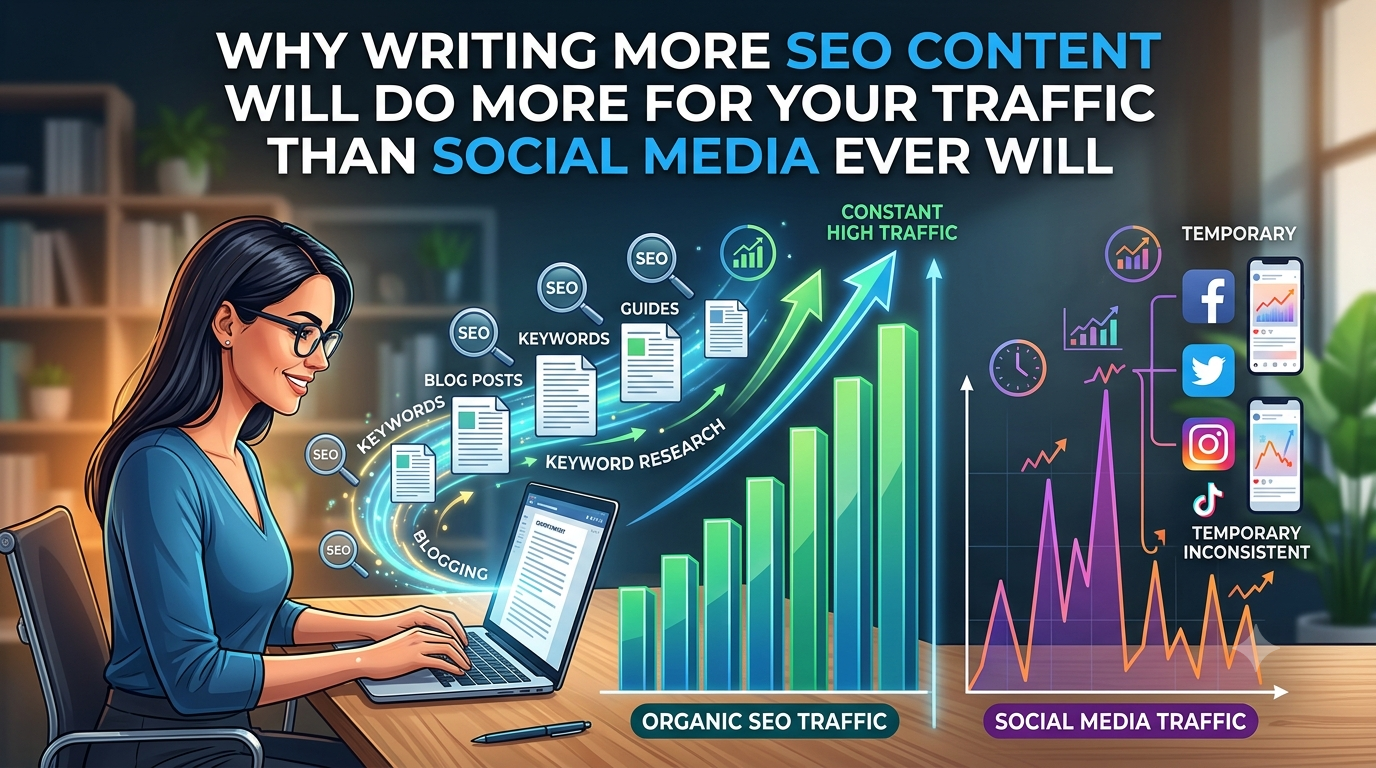
Why Writing More SEO Content Will Do More for Your Traffic Than Social Media Ever Will

There is a temptation, especially for newer webmasters, to pour energy into social media. The feedback is immediate, the audience feels tangible, and the platforms are designed to make you feel like you are making progress. But if your goal is sustainable, compounding traffic to your website, the hard truth is that most social media activity is closer to running on a treadmill than building a road. SEO content, on the other hand, is infrastructure. And infrastructure lasts.

The Fundamental Difference: Rented Attention vs. Owned Traffic

When you post on Instagram, X, or LinkedIn, you are borrowing an audience. The platform owns the relationship, controls the algorithm, and can change the rules at any time — and they do, constantly. Organic reach on most major platforms has been declining for years as they push creators toward paid promotion. Even when a post performs well, the traffic spike is sharp and brief. Within 24 to 48 hours, most social posts are effectively dead, buried under the avalanche of new content from the millions of other accounts competing for the same eyeballs.

An SEO article is different in kind, not just degree. Once a well-optimized piece of content earns its ranking, it can generate consistent traffic every single day — for months or even years — without you touching it again. The effort you put in today does not expire next Tuesday. It compounds.

Search Intent Is the Most Valuable Traffic on the Internet

People who find your site through a Google search are not passively scrolling. They typed something into a search bar because they wanted an answer, a product, or a solution. That intent makes them vastly more likely to engage, subscribe, or buy compared to someone who saw your post in a social feed while they were killing time. Organic search visitors consistently outperform social visitors on almost every metric that actually matters: time on page, bounce rate, conversion rate, and return visits.

When you write a thorough, well-researched article targeting a specific search query, you are essentially setting a trap in exactly the right place for the exact right person at exactly the right moment in their decision-making process. No social post can replicate that precision.

The Compounding Effect That Social Media Cannot Match

The most powerful argument for investing in SEO content is mathematical. Imagine you write two articles a week for a year. Some will rank well, some won’t, but the ones that do will keep earning traffic indefinitely. By the end of that year, you might have 50, 60, or 80 pages working for you around the clock. Each one is a separate entry point into your website, a separate trap laid for a separate audience.

Social media does not work this way. Two posts a week for a year gives you 104 posts that are essentially all dead. The cumulative value of past social posts trends toward zero over time. The cumulative value of past SEO content trends upward. That asymmetry becomes enormous over a three to five year horizon, and it is the reason why sites with serious SEO strategies eventually start to feel unstoppable — they have hundreds of pages generating small but steady streams of traffic that add up to something huge.

Social Media Has a Role, But It Is a Supporting One

None of this means you should abandon social media entirely. It serves real purposes: building brand awareness, warming up audiences, distributing content to people who already follow you, and occasionally earning the kind of social shares that generate backlinks, which in turn help your SEO. But the key word there is “supporting.” Social media works best as a distribution channel for your SEO content, not as a traffic strategy in its own right.The mistake most webmasters make is treating social posting as a substitute for content creation rather than a complement to it. They spend three hours a week crafting tweets and reels, and one hour writing articles, when the return on investment strongly argues for the opposite ratio.

The Long Game Almost Always Wins

SEO is not fast. It requires patience, consistency, and a tolerance for delayed gratification that social media has trained people out of. You may write excellent content for six months before you see significant results, and that lag can feel discouraging when your Instagram post got 200 likes yesterday.

But those 200 likes did not send 200 people to your website, did not put 200 email addresses on your list, and will not send anyone to your website six months from now. The SEO article you published in January that finally hits page one in July will still be sending you traffic in the following year and beyond. That is the trade-off, and once you truly internalize it, the choice of where to spend your time becomes much clearer.Build the asset. Write the content. The traffic will follow — and unlike social traffic, it will stay.

Posted on

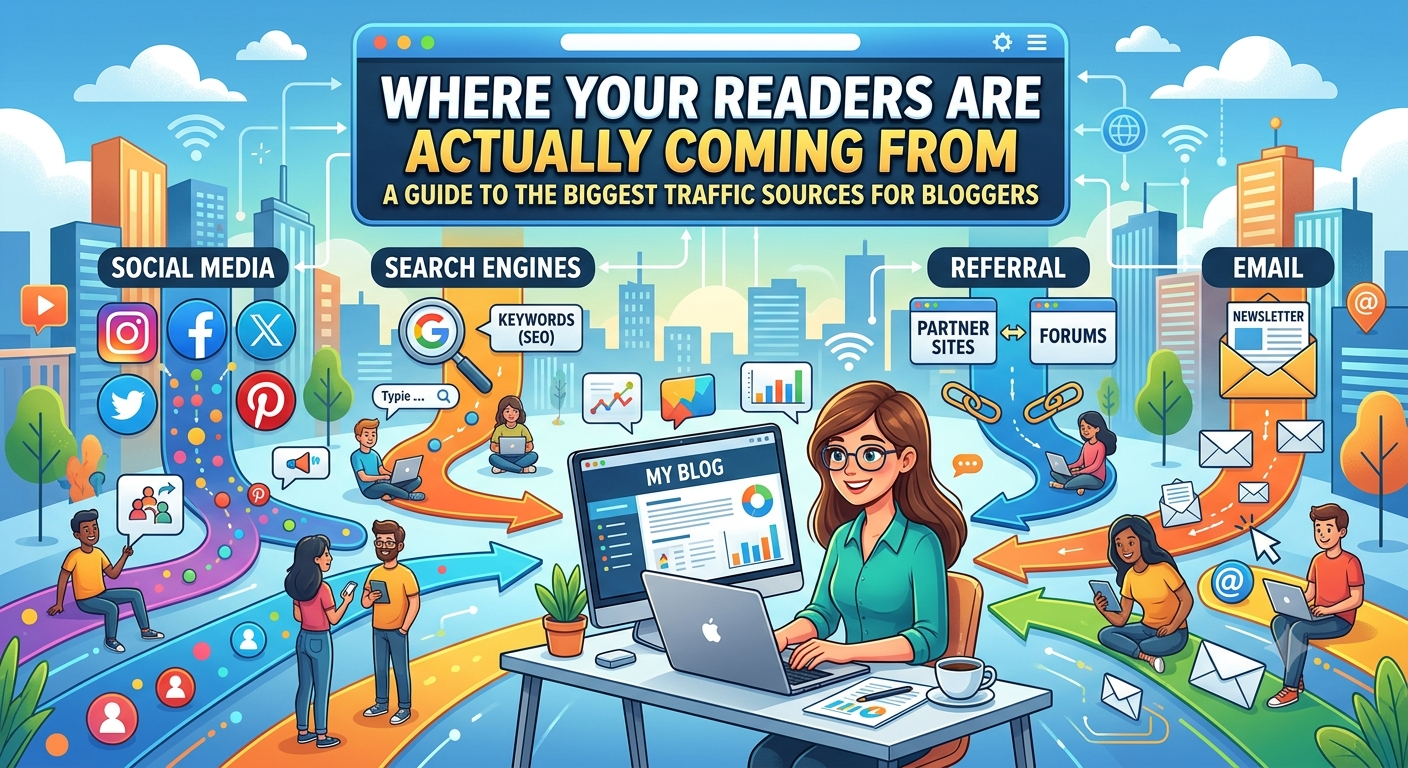
Where Your Readers Are Actually Coming From: A Guide to the Biggest Traffic Sources for Bloggers

Starting a blog or website is the easy part. Getting people to actually show up? That’s where most aspiring creators get stuck. The internet is vast, and the path from publishing your first post to building a real, consistent audience can feel overwhelming. But here’s the truth: the majority of meaningful web traffic flows from a small number of well-established channels. Understanding where those channels are — and how they work — is the most important strategic advantage a new blogger can have.

Search Engines: The Long Game That Pays ForeverOrganic search traffic from Google, Bing, and other search engines is the holy grail for most website owners, and for good reason. When someone types a question into a search engine and your article appears in the results, that click costs you nothing. Unlike paid advertising, it doesn’t stop the moment you run out of budget. Unlike social media, it doesn’t disappear into a feed within hours. A well-optimized post can continue driving traffic for months or even years after it’s published.

The discipline behind earning this traffic is called Search Engine Optimization, or SEO, and it revolves around understanding what your target audience is searching for and creating content that genuinely answers those questions better than anyone else. This means researching the exact phrases and questions people type into search bars — known as keywords — and structuring your content around them. It also means earning credibility in the eyes of search engines by accumulating backlinks, which are links from other reputable websites pointing to yours.

The catch, and it’s an important one, is that organic search traffic takes time to build. A new website has no authority in the eyes of Google. It can take anywhere from three to twelve months before you begin seeing meaningful search traffic. This is why so many new bloggers get discouraged and quit before they ever see results. But for those who stay patient and keep publishing quality content, organic search becomes the most scalable and sustainable traffic source available.

Social Media: Fast Reach, Short MemorySocial media platforms represent a very different kind of traffic engine. Where search is slow and durable, social is fast and fleeting. A post on Instagram, X (formerly Twitter), Pinterest, Facebook, or LinkedIn can drive a spike of visitors to your site within hours — but that traffic often fades just as quickly as the post moves down the feed.

That said, social media is far from irrelevant for bloggers. Pinterest in particular functions more like a visual search engine than a traditional social platform, and content on Pinterest can continue circulating and driving clicks for years, making it unusually valuable for bloggers in lifestyle, food, home decor, and travel niches. Facebook Groups remain a powerful way to connect with highly specific communities and share your work with people who are genuinely interested in your topic. And Instagram and TikTok, while they don’t always drive direct clicks, build brand awareness and audience loyalty that can translate into long-term readership.

The key to making social media work for your blog is to choose one or two platforms where your audience actually spends time, rather than trying to maintain a presence everywhere at once. Spreading yourself thin across every platform is a recipe for burnout and mediocre results on all of them.

Email: The Traffic Source You Own

Of all the traffic sources available to bloggers, email is the only one that truly belongs to you. Your social media following can be decimated overnight by an algorithm change. Your search rankings can drop after a Google update. But your email list is yours — a direct line to readers who have explicitly said they want to hear from you.When you send a newsletter, you’re not competing with an algorithm or hoping that a platform decides to show your content to your followers. You’re landing directly in someone’s inbox. The click-through rates from email newsletters consistently outperform social media by a significant margin, and email subscribers tend to be a blogger’s most engaged, most loyal readers.

Building an email list should be a priority from day one, not something you think about after you’ve already grown an audience. Offering a lead magnet — a free resource, checklist, or mini-course in exchange for an email address — is one of the most effective ways to accelerate list growth. Even a small, engaged email list of a few hundred subscribers can be more valuable than tens of thousands of social media followers who scroll past your posts without clicking.

Referral Traffic: The Power of Other People’s Audiences

Referral traffic comes from other websites linking to yours. This could be a blogger in your niche mentioning your article, a journalist citing your research, or a popular forum thread where someone shared your post. Each of these links sends readers your way and, as a bonus, also signals to search engines that your content is worth paying attention to — which helps your SEO at the same time.

Building referral traffic requires you to step outside the walls of your own website and become part of a broader conversation. Guest posting on established blogs in your niche is one of the most reliable strategies. By contributing a high-quality article to a site that already has an audience, you get your name and your work in front of new readers who might then follow you back to your own site. Podcast appearances, collaborations with other creators, and simply being mentioned in relevant roundup posts all contribute to this stream of incoming readers.

The relationships you build with other bloggers and content creators in your space are often what make the difference between a site that slowly gains momentum and one that stays invisible for years.

Direct Traffic: The Mark of a Real Brand

Direct traffic — people who type your URL directly into their browser or who click a bookmark — is the purest signal that you’ve built something people genuinely value. These are your true fans, the readers who don’t need a search engine or a social media algorithm to remind them you exist.

Direct traffic tends to grow slowly in the early days, but it compounds over time. Every reader who has a memorable experience on your site, who saves your URL, who tells a friend about your work — each of them becomes a small, self-renewing traffic source. Nurturing this kind of loyalty requires consistent quality, a distinctive voice, and a site that’s genuinely worth returning to.

Putting It All Together

The bloggers and website owners who build lasting audiences don’t usually bet everything on a single traffic source. They play the long game with SEO while using social media to create immediate visibility. They build an email list from the start and nurture it carefully. They invest in relationships with other creators and look for opportunities to reach new audiences through referrals and collaborations.

No single channel will grow your site on its own. But together, these sources create a diversified traffic foundation that’s resilient, compounding, and ultimately — over time — unstoppable.

Posted on

The Social Media Landscape for B2B Promotion

When you think about promoting a business-to-business offer, the instinctive reach is often toward LinkedIn. That instinct is not wrong, but it is incomplete. The reality of B2B social media promotion is that different platforms serve different purposes within the same buyer journey, and the most effective strategies treat them as complementary channels rather than interchangeable billboards.

LinkedIn remains the undisputed heavyweight for direct B2B engagement. Its user base is explicitly professional, and the platform’s algorithm favors content that sparks industry-relevant conversation. What makes LinkedIn particularly valuable is not just the audience composition but the context in which people use it. A decision-maker scrolling through LinkedIn during a coffee break is already in a work-oriented mindset, which means your offer lands in a mental space where business purchasing decisions feel natural rather than intrusive. The key to success here is not posting your offer directly but building authority through insight-driven content that makes your offer the logical next step for interested readers.

Twitter, now known as X, occupies a different but equally important niche in the B2B ecosystem. Its real-time nature makes it invaluable for participating in industry conversations as they happen. For B2B promotion, Twitter excels at thought leadership and rapid response to market developments. A well-timed thread explaining how current industry trends relate to your offer can generate significant engagement from exactly the right people. The platform rewards conciseness and clarity, which forces B2B marketers to distill their value propositions into their most essential form. This discipline often improves messaging across all channels.

YouTube serves a longer-term, deeper-engagement function that other platforms cannot replicate. B2B purchases typically involve research and deliberation, and YouTube content remains discoverable long after publication. A detailed case study, a product demonstration, or an educational series addressing your target industry’s pain points can continue generating qualified leads for months or even years. The investment in production is higher, but the shelf life of the content justifies it. Prospects who find your YouTube content are often further along in their decision-making process, having actively searched for solutions rather than passively encountered your message.

Reddit represents a more nuanced opportunity that many B2B marketers overlook or misuse. The platform’s community-driven structure means that overt promotion is typically met with hostility, but genuine participation in relevant subreddits can build credibility that translates into business interest. The key is understanding that Reddit users have highly tuned detectors for inauthenticity. Success requires actual expertise and a willingness to help without immediate expectation of return. When done correctly, Reddit can become a source of highly qualified inbound interest from people who trust your judgment because they have seen it demonstrated repeatedly in public conversation.

Instagram and TikTok might seem like odd choices for B2B promotion, and for many industries they are. However, for B2B offers targeting creative industries, lifestyle brands, or younger decision-makers, these platforms offer access to audiences that are increasingly difficult to reach through traditional professional channels. The visual nature of these platforms demands that you translate your offer into compelling imagery or short-form video, which is a creative challenge but also an opportunity to differentiate from competitors who have not ventured there. The informal tone of these platforms can humanize a B2B brand in ways that resonate with modern buyers who value authenticity over corporate polish.

Facebook maintains relevance in B2B promotion primarily through its advertising infrastructure and group functionality. While organic reach for business pages has declined dramatically, Facebook’s targeting capabilities remain exceptionally precise. For B2B offers, this means you can reach specific job titles, industries, and company sizes with sponsored content. Facebook Groups also host numerous industry-specific communities where professionals gather to discuss challenges and share solutions. Participation in these groups, when done with genuine helpfulness rather than sales aggression, can establish presence in communities where your ideal customers already congregate.

The strategic consideration that ties these platforms together is not which one is best in isolation, but how they work together to support a complete buyer journey. A prospect might first encounter your brand through a Twitter thread, deepen their understanding through your YouTube content, see social proof through LinkedIn recommendations, and finally convert after encountering a precisely targeted Facebook ad. Each platform plays a role, and the B2B marketer’s task is to understand which role each platform plays for their specific offer and audience.

The most common mistake in B2B social media promotion is treating every platform as a direct response channel. Not every post needs to generate an immediate click or conversion. Some content exists to build awareness, some to establish expertise, some to nurture consideration, and only a subset to drive immediate action. Recognizing this distribution of purpose across platforms and content types is what separates effective B2B social media strategies from those that burn budget and patience without producing results.

Ultimately, the best platform for your B2B offer depends on where your specific audience spends their attention, what format best communicates your value, and what stage of the buyer journey you are trying to influence. The answer is rarely a single platform, and the question itself is better reframed from which platform to how platforms in combination can guide a prospect from first awareness to confident purchase.

Posted on

Create Valuable Content, Not Just What You Enjoy

There is a particular kind of loneliness that comes with working alone, and it has a way of distorting every decision a solopreneur makes. When you are the only person in the room, the line between what the business needs and what you need becomes easy to blur. You start a blog post not because your customer asked for it but because you have been thinking about a topic and you want to get your thoughts out. You record a video not because it addresses a specific pain point in your market but because you feel strongly about an issue and you want to be heard. You redesign your website not because the data shows it is underperforming but because you are tired of looking at the old version and you want something that feels more like you. Each of these decisions feels productive in the moment. Each of them is a trap.

The solopreneur does not have the luxury of a team to absorb bad decisions. There is no marketing department to compensate for a self-indulgent content strategy. There is no sales team to convert the few leads that wander in despite the messaging. There is only you, your time, and the direct connection between how you spend that time and whether the business survives. This is why the emotional content creator is the most dangerous version of the solopreneur. They are burning their most limited resource on work that serves their own psychology rather than their customer’s problem, and because they are working alone, there is no one to stop them.

The mistake is understandable. Most solopreneurs started their business because they cared about something. They were experts in a field, or enthusiasts about a craft, or frustrated by a problem they wanted to solve. The business was born from passion, and passion is an emotional force. It is natural to assume that communicating that passion is the path to connection, that customers will be drawn to the authenticity of someone who genuinely cares. This is true in a narrow sense and catastrophically false in a broad one. Customers do not buy your passion. They buy the resolution of their own problem. Your passion is only relevant to the extent that it produces a better solution, a clearer explanation, or a more reliable outcome. If your content expresses your passion without addressing their need, you are performing for an audience of one.

The difference between emotional content and valuable content is not about tone. It is not that emotional content is warm and personal while valuable content is cold and clinical. Some of the most valuable content ever created is deeply personal, told through stories that reveal vulnerability and struggle. The difference is the direction of the arrow. Emotional content points inward. It asks the audience to understand the creator, to validate their perspective, to appreciate their journey. Valuable content points outward. It asks what the audience is struggling with, what they need to know, what decision they are trying to make, and what information would make that decision easier or that struggle lighter. The creator’s personal story is only present to the extent that it illuminates the audience’s situation. It is a tool, not a subject.This is harder than it sounds because the solopreneur’s identity is often wrapped tightly around the business. When someone criticizes the content, it feels like a criticism of the self. When a post performs poorly, it feels like a rejection of the person who wrote it. This fusion of ego and enterprise makes it nearly impossible to evaluate content objectively. The solopreneur looks at engagement metrics and does not see data. They see a referendum on their worth. A post that gets three likes and no comments is not just a failed experiment in messaging. It is a wound. And the natural response to a wound is to create something that feels better, something that expresses what the creator wants to express, something that restores their sense of competence and voice. The result is a spiral of increasingly self-referential content that speaks to the creator’s emotional needs while the audience drifts away, unaddressed and unmoved.

The antidote is not to suppress emotion or to write like a robot. It is to install a filter between the impulse to create and the act of creation, and that filter is a single question that must be answered with brutal honesty before any piece of content is published. Who is this for, and what specific problem or question does it solve for them? Not what do I want to say. Not what have I been thinking about. Not what would feel good to express. What does the person on the other side of this screen need from me right now, and would they be willing to pay for this information if it were not free? If the answer is unclear, or if the answer is that this content primarily serves the creator’s need to be seen, the content should not be made. The time should be spent on research, on customer conversations, on studying what the market is actually asking for, until a clear answer emerges.

This discipline is especially important because the solopreneur has no buffer. A large company can afford to publish content that misses the mark. They have a content calendar, a team of writers, a budget for promotion, and the statistical certainty that some percentage of their output will land even if much of it does not. The solopreneur has none of this. Each piece of content represents a significant fraction of their total output for the week or the month. A single self-indulgent post is not a minor misstep. It is a substantial diversion of resources away from the work that actually builds the business. The solopreneur who publishes once a week and wastes one of those weeks on content that serves their own emotional needs has just sacrificed four percent of their annual content output to vanity. Compound that over a year and the cost is not just lost time. It is lost momentum, lost trust, and lost opportunity to establish authority in the minds of the people who might have become customers.

The value-first approach requires a shift in how the solopreneur thinks about their own expertise. Many solopreneurs are genuinely knowledgeable. They have spent years in their field, solving problems, making mistakes, developing intuitions that are hard to articulate. The temptation is to share that expertise in the form it exists in their own mind, as a stream of insights and observations that feel profound to them because they carry the weight of lived experience. But the customer does not live in that experience. They live in their own confusion, their own urgency, their own limited frame of reference. The expert who speaks from the center of their knowledge is speaking a language the beginner cannot understand. The value-first creator must translate. They must find the entry point where the customer’s current understanding meets the expert’s deeper knowledge, and they must build a bridge between those two points one step at a time. This is harder than simply expressing what you know. It requires empathy, patience, and the willingness to slow down your own thinking to match the pace of someone who is still learning.

It also requires the willingness to be boring. The solopreneur who creates for emotional gratification often gravitates toward topics that feel exciting, controversial, or personally meaningful. The value-first creator must sometimes address topics that are mundane but urgent. How to file a specific form. How to troubleshoot a common error. How to compare two similar products. How to prepare for a meeting. These are not the posts that win awards or generate passionate comment threads. They are the posts that someone searches for at eleven at night when they are stuck and anxious and need an answer. They are the posts that build trust through usefulness rather than admiration. They are the posts that turn a stranger into a customer because the customer remembers who helped them when they needed help, not who impressed them when they were scrolling.

The emotional creator often resists this work because it does not feel like self-expression. It feels like manual labor, like translation, like service. This is exactly what it is, and this is exactly why it is valuable. The solopreneur is not an artist working for a patron. They are a service provider working for a market. Their content is not a portfolio of their inner life. It is a product, and like any product, it must be designed for the user, not the maker. The sooner the solopreneur internalizes this, the sooner they stop wasting their limited resources on content that feeds their ego and start building a body of work that feeds their business.

There is a deeper cost to emotional content creation that goes beyond wasted time. It is the erosion of the solopreneur’s ability to hear the market. When you create primarily to express yourself, you train yourself to look inward for validation. You judge the success of a piece by how it made you feel, by whether it captured what you wanted to say, by the elegance of your own phrasing. This habit makes you deaf to the signals that actually matter. Did the right people read it? Did they act on it? Did they return for more? Did it move them closer to a purchase? These are the questions that build a business, and they require the creator to step outside their own experience and inhabit the perspective of the customer. The emotional creator never develops this muscle because they are always looking back at themselves.

The value-first creator, by contrast, develops a feedback loop that is grounded in reality. They publish something useful, they watch how the audience responds, they adjust the next piece based on what they learned, and they gradually build a model of their customer that is more accurate than any persona document could be. This loop is the engine of growth for a solopreneur, and it only works when the content is designed to elicit a measurable response. Emotional content elicits feelings, which are hard to measure and easy to misinterpret. Useful content elicits actions, which are clear and which compound over time into a reliable understanding of what the market actually wants.

This does not mean the solopreneur should be cynical or manipulative. Providing genuine value is not a trick. It is an act of respect. It is the recognition that the customer’s time and attention are scarce, that they have chosen to spend some of that time with you, and that your obligation is to leave them better off than they were before they arrived. The emotional creator often mistakes their own need for connection with the customer’s need for value, and in doing so they disrespect the very people they are trying to reach. They make the interaction about themselves, and the customer senses it, even if they cannot articulate why they feel uneasy. The value-first creator makes the interaction about the customer, and the customer feels it as relief, as clarity, as the sense that someone finally understands what they are going through.

The practical implementation of this philosophy is straightforward but uncomfortable. Before creating any piece of content, the solopreneur should write down the intended audience member as a specific person with a specific problem. Not a demographic. Not a persona. A human being in a moment of need. What are they trying to accomplish? What have they already tried? What is confusing them? What would they search for on Google if they knew the right term? The content should answer that search, that confusion, that need, as directly and completely as possible. The creator’s opinions, experiences, and feelings should only appear if they serve that answer. If they do not, they should be cut, no matter how eloquent or heartfelt they are.

After publishing, the solopreneur should measure what matters. Not likes. Not compliments from peers. Not the warm feeling of having expressed themselves. They should measure whether the right people found it, whether they stayed to read it, whether they took the next step, whether they returned, whether they eventually bought. These metrics are harder to face because they are less flattering than vanity metrics, but they are the only metrics that pay the bills. Over time, the solopreneur who focuses on these numbers will build a content library that functions as a sales force, working while they sleep, answering questions before they are asked, and building trust at scale. The emotional creator will build a diary that is occasionally admired but rarely purchased from.

The hardest part of this shift is the grief it requires. The solopreneur must mourn the idea that their business is a vehicle for their self-expression. It is not. It is a vehicle for solving problems in exchange for money, and the content is a tool in that exchange. This is not a tragedy. It is a liberation. The moment you stop trying to be understood through your business and start trying to be useful, the business becomes lighter. The content becomes easier to produce because you are not mining your own emotions for material. You are simply observing your customer and reporting what you see. The connection you build with your audience becomes deeper because it is grounded in respect rather than need. They do not follow you because they find you interesting. They follow you because you make their life better, and that is a far more durable bond than admiration.

The solopreneur who masters this discipline gains an unfair advantage. While competitors are creating content that impresses their friends, they are creating content that converts strangers. While others are building an audience of spectators, they are building a pipeline of customers. While others are seeking validation, they are seeking revenue. The emotional creator might feel more fulfilled in the short term, but the value-first creator builds a business that lasts, and in the end, a business that lasts is the only kind of fulfillment that sustains a solopreneur through the inevitable hard years.

Create for the customer. The rest will follow.

Posted on

The Invisible Engine: Why Referrals Run Most Businesses and Why You Cannot Afford to Ignore Them

There is a number that sits quietly in the financial records of nearly every successful business, rarely discussed in marketing meetings, rarely celebrated in quarterly reports, rarely optimized with the same urgency as ad spend or content calendars. That number is the percentage of revenue that comes from referrals. It is often higher than the founder expects, sometimes higher than the founder even knows, and in many cases it is the single largest source of new business the company has. Yet it is treated as an afterthought, a happy accident, a byproduct of good work rather than a system to be engineered. This is a costly mistake, because referrals are not a bonus. They are the foundation, and the businesses that understand this build differently from the ones that do not.

The data on this is consistent across industries and decades. Studies by Wharton, the Harvard Business Review, and various market research firms have found that referrals account for somewhere between twenty and fifty percent of new customer acquisition for most established businesses, with some professional service firms seeing numbers as high as seventy or eighty percent. The exact figure varies by industry, by business age, by price point, and by the strength of the referral system itself, but the pattern is universal. Word of mouth is not a marginal channel. It is the dominant channel for businesses that have been around long enough to earn it, and it is often the most profitable channel by a wide margin.

A customer who arrives through a referral is different from a customer who arrives through an advertisement. They come pre-qualified, pre-trusted, and pre-disposed to buy. The cost of acquisition is effectively zero, or close to it, because the marketing work was done by someone the prospect already trusts. The sales cycle is shorter because the objection of whether you are legitimate has already been handled by the referrer. The lifetime value is higher because referred customers tend to be more loyal, less price-sensitive, and more likely to refer others in turn. The churn rate is lower because the relationship begins with social proof embedded in it, not with a transaction between strangers.

This is why the referral percentage matters so much. It is not just a measure of how nice your customers are. It is a measure of how efficiently your business converts trust into revenue, and how much of your growth is funded by goodwill rather than capital. A business that grows primarily through paid acquisition is a machine that requires constant fuel. Every new customer costs money, and the cost typically rises over time as the easy prospects are exhausted and the platforms increase their prices. A business that grows primarily through referrals is a self-sustaining system. The customers bring the customers, and the marginal cost of each new acquisition approaches zero while the trust compounds.

The problem is that most businesses do not know their referral percentage with any precision. They might track it loosely, through a question on an intake form or a casual conversation at checkout, but they rarely build rigorous systems to measure it, to attribute revenue accurately, or to distinguish between a true referral and a customer who happened to hear about them from multiple sources. The result is a blind spot. The founder knows that word of mouth is important, but they do not know how important, and they do not know whether it is growing or shrinking, and they do not know which customers or which experiences are driving it. They are flying a plane with a fogged windshield, guessing at altitude based on how the engine sounds.

This blindness leads to underinvestment. The business that does not know that forty percent of its revenue comes from referrals will not allocate resources to making that forty percent into sixty percent. It will not train its team to ask for referrals at the right moment. It will not build a formal referral program with incentives that reward the behavior it wants. It will not design the customer experience to create moments so remarkable that talking about them becomes natural. It will spend its marketing budget chasing new channels while its most powerful channel atrophies from neglect.

The businesses that treat referrals as a system rather than a surprise do the opposite. They measure obsessively. They know not just how many customers came from referrals, but which customers referred them, what triggered the referral, how long after the purchase it happened, and what the referred customer went on to buy. They map the customer journey looking for peak moments of delight, the moments when the customer is most likely to feel gratitude and most likely to mention the business to a friend. They engineer those moments intentionally, knowing that a referral is not a random event but the predictable outcome of a specific emotional state.

They also ask. This is the part that makes many founders uncomfortable. The idea of directly requesting a referral feels pushy, desperate, or transactional. But the data shows that customers who are satisfied are often willing to refer and simply do not think to do so unless prompted. The prompt does not need to be aggressive. It can be a simple question at the end of a successful project, a note in a follow-up email, a small incentive that feels like a thank-you rather than a bribe. The businesses that master this do not ambush their customers. They create a context where the request feels natural, and they make the act of referring as easy as possible. A referral link, a pre-written email, a social media post ready to share. Friction is the enemy of word of mouth, and the best referral systems remove it at every step.

The importance of this becomes acute when a business is being sold or valued. A buyer looking at a company with a high referral percentage sees a business that is not dependent on the founder’s personal network or on advertising platforms that could change their rules tomorrow. They see a business with a moat made of trust, with customer relationships that produce new customer relationships without additional cost. This is a premium asset. It commands a higher multiple because the risk is lower and the future revenue is more predictable. Conversely, a business with a low referral percentage is a business that must constantly buy its customers, and the buyer knows that the cost of that purchase may rise and the yield may fall. The valuation reflects this uncertainty.For the founder who is not planning to sell, the referral percentage is still the most honest scorecard of the business’s health. Revenue can be manipulated with discounts and promotions. Follower counts can be purchased. Ad metrics can be gamed. But a referral is a vote that costs the voter something. It costs their social capital, their reputation, their implicit endorsement. A customer who refers you is staking their relationship with their friend on your performance. That is a high bar, and clearing it repeatedly is the truest sign that your product or service is genuinely good, not just well-marketed.This is why the obsession with viral marketing, growth hacking, and influencer partnerships often misses the point. Those tactics can spike awareness, but they rarely build the sustained trust that produces referrals at scale. A viral tweet might bring ten thousand visitors, but if the experience does not match the hype, those visitors will not return and they will not recommend. An influencer might drive a burst of sales, but if the product disappoints, the influencer’s audience will blame the influencer for the recommendation, and the trust is damaged on both sides. Referrals are slower than virality, but they are deeper, more durable, and more valuable over time. They are the tortoise that wins the race while the hare is chasing the next trend.The businesses that understand this invest in the long game of trust. They overdeliver on the promise they made in their marketing. They follow up after the sale not to sell again but to ensure satisfaction. They fix problems with a speed and generosity that turns complainers into advocates. They stay in touch with past customers, not with constant sales pitches but with genuine value, reminders, education, or community. They know that a customer who bought once and forgot about them is a wasted asset, while a customer who bought once and remains engaged is a potential referral engine for years.They also understand that not all customers are equally likely to refer. Some are natural connectors, people with large networks and a habit of making introductions. Some are quiet and satisfied but unlikely to mention the business unless directly asked. Some are unhappy but silent, and their silence is a warning sign that the referral percentage could be higher if the underlying issues were addressed. The sophisticated business segments its customers by referral potential and treats the segments differently. The connectors get special attention, early access, and explicit invitations to spread the word. The quiet satisfied customers get the nudge and the tools to make referring easy. The unhappy customers get outreach and resolution before their dissatisfaction becomes invisible churn.The referral percentage is also a diagnostic tool for the broader business. If it is low, the problem might be the product, the pricing, the customer service, the onboarding, or the simple fact that the business has not been around long enough to earn trust. If it is high but declining, the problem might be growth at the expense of quality, a new team member who does not understand the culture, or a change in the competitive landscape that makes the experience less remarkable. If it is high and stable, the business has likely found its rhythm and should protect it fiercely while looking for ways to compound it. The number tells a story, and the founder who learns to read it gains a perspective that no marketing dashboard can replicate.In the end, the reason referrals matter is not because they are cheap or because they are easy. They are neither. They are expensive in the sense that they require a level of quality and consistency that most businesses cannot sustain, and they are difficult in the sense that they cannot be manufactured through sheer effort or spending. They must be earned, and earning them is the work of the entire business, from the first touchpoint to the last follow-up. But once earned, they become the most powerful force in commerce. They are the proof that the business is real, that the promise was kept, that the customer was seen and served rather than merely sold to. They are the invisible engine that turns a transaction into a relationship, a customer into an advocate, and a business into an institution.If you do not know what percentage of your revenue comes from referrals, that is the first thing you should fix. Not because the number itself is the goal, but because the act of finding it forces you to look at your business through the lens of trust rather than the lens of traffic. And once you see it that way, you cannot unsee it. You begin to measure everything by whether it earns a referral or merely makes a sale. You begin to design for the long term rather than the quarterly report. You begin to build something that grows not because you spent more, but because you became worth talking about. That is the difference between a business that survives and a business that lasts.

Posted on

The Valuation You Can’t Fake: Why Knowing Your Business’s Worth Is Key

Most entrepreneurs start with the wrong question. They ask how to get customers, how to build a product, how to run ads, how to grow a team. These are tactical questions, and tactics are seductive because they feel like progress. But the real question is this: what is this thing worth to someone who might want to buy it?

If you cannot answer that question with a number that would hold up under scrutiny, you are not building a business. You are building an income stream attached to your personality, your time, and your stress. And that is fine if that is what you want. But most people do not want that. Most people want an asset. Something they can sell, step away from, or scale without their daily presence becoming the bottleneck. The path to that outcome does not begin with a logo or a landing page. It begins with an honest valuation.

The Honesty Nobody Wants

Valuation is not a number you pull from ambition or hope. It is a number derived from what the market has actually paid for businesses like yours, adjusted for your specific risks, growth trajectory, and dependency on you as the founder. If you are doing ten thousand dollars a month in revenue but you are the only person who can deliver the service, talk to the clients, and close the deals, your business is not worth a multiple of that revenue. It might be worth close to nothing. A buyer is not purchasing your past effort. A buyer is purchasing future cash flows they can extract without you in the building. If the cash flows disappear when you do, there is nothing to buy.

This is the honesty that stings. Most founders discover, when they run the numbers properly, that their business is worth far less than they imagined. Not because they have failed, but because they have optimized for the wrong thing. They optimized for revenue, for social media followers, for vanity metrics that feel impressive at dinner parties but do not translate to transferable value. A business with two hundred thousand dollars in revenue and a full-time operator who is not the founder is worth more than a business with five hundred thousand dollars in revenue and a founder who works eighty hours a week and holds every client relationship personally.

The market does not care about your hustle. The market cares about risk-adjusted future earnings. And the biggest risk in most small online businesses is the founder.

How Valuation Actually Works

The standard approach for valuing a small online business is to apply a multiple to seller discretionary earnings, or SDE. SDE is essentially your profit plus your salary plus any personal expenses you have run through the business. The multiple typically ranges from two to five times SDE for most online businesses, though it can go higher for SaaS companies with recurring revenue, strong margins, and low churn, or lower for agencies with high client concentration and no recurring contracts.But the multiple is not the whole story. It is adjusted by a series of risk factors. Is the revenue concentrated in one or two clients? That lowers the multiple. Is the traffic dependent on a single Google algorithm or one influencer partnership? That lowers the multiple. Is the technology proprietary or easily replicated? That lowers the multiple. Are the financials clean, with three years of tax returns that match the profit and loss statements? That raises the multiple. Is there a management team in place that can run the business without the founder? That raises the multiple significantly. Is the growth rate accelerating, flat, or declining? That changes everything.

A business doing three hundred thousand dollars in SDE with clean books, diversified traffic, a small team, and a founder who works ten hours a week might sell for four to five times SDE, or one point two to one point five million dollars. The same business with all revenue coming from one client, no team, and a founder working sixty hours a week might struggle to sell at all, or might go for one to two times SDE if the buyer is betting they can diversify quickly. The difference is not the revenue. The difference is the structure.

Why Starting with Valuation Changes Everything

When you know what buyers are actually paying for, your priorities invert. Instead of asking how do I get more revenue, you start asking how do I make this business less dependent on me. Instead of chasing every client, you start asking which clients can be served by a system, not a person. Instead of building a personal brand, you start building a brand that can be operated by someone else. The goal shifts from making money today to building an asset that produces money tomorrow, with or without you.This is not about selling. Most founders who build sellable businesses never actually sell. They hold them, they collect the cash flow, they step back into an advisory role, and they start something else. The option to sell is what creates the freedom. A business that cannot be sold is a prison with good cash flow. A business that can be sold is a choice.

Knowing your valuation also changes how you think about investment. If you are considering spending fifty thousand dollars on a new marketing campaign, the question is not will this generate revenue. The question is will this increase the sellable value of the business by more than fifty thousand dollars. Sometimes the answer is yes. Sometimes the answer is no, because the campaign creates revenue that is tied to your personal involvement in closing deals, which does not transfer. A marketing campaign that builds a brand and a lead generation system is an asset. A marketing campaign that requires you to personally demo and close every sale is a treadmill.

The Trap of Founder Dependency

The most common reason online businesses fail to sell, or sell for disappointing multiples, is founder dependency. This manifests in ways that are easy to rationalize and hard to fix. You are the only one who understands the product. You are the only one the clients trust. You are the only one who knows how to run the ads. You are the only one who can write the content. You are the only one who understands the software stack. Each of these is a comfort in the early days and a liability in the later days.

The fix is not to hire a team and hope for the best. The fix is to document everything, systematize everything, and gradually transfer ownership of each function to someone else while you are still there to supervise. This takes longer than most founders want it to take. It requires you to slow down revenue growth in the short term to build infrastructure that enables faster growth later. It requires you to let people make mistakes that you would have avoided. It requires you to accept that in the short term, things will get worse before they get better. Most founders skip this step because it is uncomfortable and because the revenue numbers look better when they do everything themselves.

But the revenue numbers are a lie if they cannot exist without you. And buyers see through that lie immediately. They will dig into your client relationships, your traffic sources, your team structure, and your personal calendar. If they find that removing you from the equation removes half the revenue, they will either walk away or cut their offer in half. Sometimes both.

The Emotional Cost of Honesty

There is a psychological barrier here that most business advice ignores. Telling a founder that their business is worth less than they thought is not just a financial conversation. It is an identity conversation. The business is their creation, their proof of competence, their answer to the question of whether they could make it on their own. To learn that the market values that creation at a fraction of their emotional investment is a blow to the ego that many people avoid by simply never looking.

They do not get a valuation. They do not talk to brokers. They do not look at comparable sales. They keep their head down, keep grinding, and tell themselves they will figure it out later. But later is when the burnout hits, or the market shifts, or a competitor eats their lunch, and they are forced to sell from a position of weakness. The founders who get the best outcomes are the ones who looked at the number early, absorbed the disappointment, and spent the next two to four years fixing the gaps.

Honesty is not just about knowing the number. It is about accepting what the number implies about your current strategy, your current structure, and your current self. It is about looking at a valuation of two hundred thousand dollars for a business you have spent five years building and deciding whether that is enough, or whether you are willing to do the hard work of making it worth a million. The decision is yours. But you cannot make it if you do not know the number.

How to Start

If you are at the beginning of your online business journey, the best time to think about valuation is now. Not because you are going to sell next year, but because every decision you make from day one either builds transferable value or erodes it. Choose a business model that can scale without your daily presence. SaaS, marketplaces, subscription content, and productized services are all structurally more sellable than custom consulting or personal coaching. If you are in a service business, productize it. Create packages, create systems, create delivery teams, and remove yourself from the one-to-one client work as quickly as possible.

If you are already running a business and have never done a proper valuation, do it this month. Find a business broker who specializes in online businesses. Look at marketplaces like Empire Flippers, FE International, or Quiet Light to see what businesses like yours are actually selling for. Calculate your SDE. Apply the multiples you see in comparable sales. Be conservative. Then look at the gap between that number and what you think your business is worth, and ask yourself what would have to change to close that gap.The list of changes is your real business plan. Not the marketing strategy. Not the product roadmap. The list of structural changes that make your business worth more to a stranger than it is to you right now. That is the work that matters.

The Long Game

Building a sellable business is slower than building a personal income machine. It requires patience, systems thinking, and the willingness to sacrifice short-term revenue for long-term structure. It requires you to hire before you are comfortable, to delegate before you are ready, and to document before you feel like you have time. It requires you to look at your business as an object separate from yourself, with its own value, its own risks, and its own potential future without you.

That separation is the goal. Not because you want to leave, but because you want the option. The most successful entrepreneurs I know are not the ones who sold for the highest price. They are the ones who built something so structurally sound that they could have sold at any time, chose not to, and collected the cash flow while living the life they wanted. The valuation was not the endgame. The valuation was the proof that they had built something real.

Know your number. Be honest about it. Fix what it tells you to fix. That is the only path to a business that is truly yours, in the sense that you can choose to keep it, sell it, or step back from it without the whole thing collapsing. Everything else is just a job with extra steps.