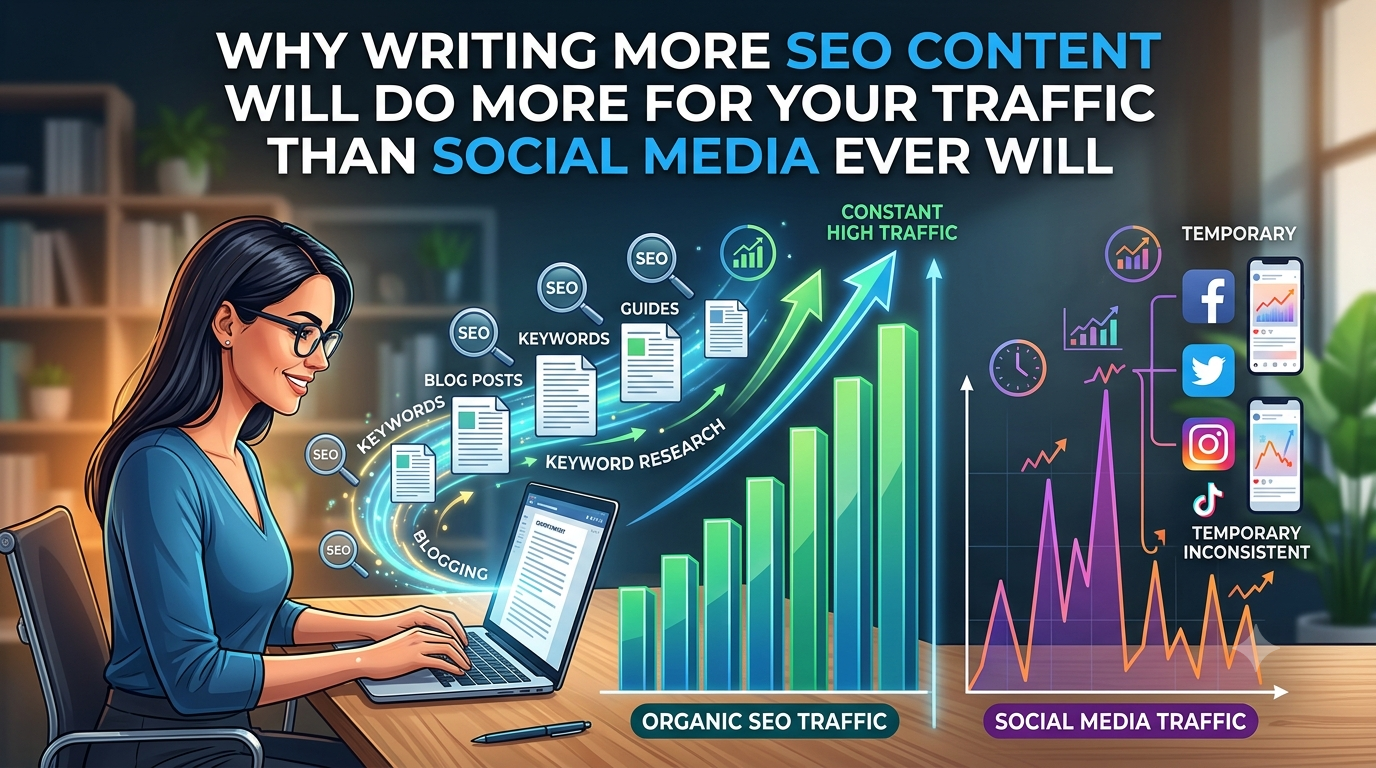
There is a temptation, especially for newer webmasters, to pour energy into social media. The feedback is immediate, the audience feels tangible, and the platforms are designed to make you feel like you are making progress. But if your goal is sustainable traffic to your website, the hard truth is that most social media activity is closer to running on a treadmill than building a road. SEO content, on the other hand, is infrastructure. And infrastructure lasts.
Rented Attention vs. Owned Traffic
When you post on Instagram, X, or LinkedIn, you are borrowing an audience. The platform owns the relationship, controls the algorithm, and can change the rules at any time. And they do. Organic reach on most major platforms has been declining for years as they push creators toward paid promotion. Even when a post performs well, the traffic spike is sharp and brief. Within 24 to 48 hours, most social posts are effectively dead, buried under the avalanche of new content from the millions of other accounts competing for the same eyeballs.
An SEO article is different in kind, not just degree. Once a well-optimized piece of content earns its ranking, it can generate consistent traffic every single day without you touching it again. The effort you put in today does not expire next Tuesday. It compounds.
Search Intent Is the Most Valuable Traffic on the Internet
People who find your site through a Google search are not passively scrolling. They typed something into a search bar because they wanted an answer, a product, or a solution. That intent makes them vastly more likely to engage, subscribe, or buy compared to someone who saw your post in a social feed while they were killing time. Organic search visitors consistently outperform social visitors on almost every metric that actually matters: time on page, bounce rate, conversion rate, and return visits.
When you write a thorough, well-researched article targeting a specific search query, you are essentially setting a trap in exactly the right place for the exact right person at exactly the right moment in their decision-making process. No social post can replicate that precision.
The Compounding Effect That Social Media Cannot Match
The most powerful argument for investing in SEO content is mathematical. Imagine you write two articles a week for a year. Some will rank well, some won’t, but the ones that do will keep earning traffic indefinitely. By the end of that year, you might have 50, 60, or 80 pages working for you around the clock. Each one is a separate entry point into your website, a separate trap laid for a separate audience.
Social media does not work this way. Two posts a week for a year gives you 104 posts that are essentially all dead. The cumulative value of past social posts trends toward zero over time. The cumulative value of past SEO content trends upward. That asymmetry becomes enormous over a three to five year horizon, and it is the reason why sites with serious SEO strategies eventually start to feel unstoppable. They have hundreds of pages generating small but steady streams of traffic that add up to something huge.
Social Media Has a Role, But It Is a Supporting One
None of this means you should abandon social media entirely. It serves real purposes: building brand awareness, warming up audiences, distributing content to people who already follow you, and earning the kind of social shares that generate backlinks, which in turn help your SEO. But the key word there is “supporting.” Social media works best as a distribution channel for your SEO content, not as a traffic strategy in its own right.
The mistake most webmasters make is treating social posting as a substitute for content creation rather than a complement to it. They spend three hours a week crafting tweets and reels, and one hour writing articles, when the return on investment strongly argues for the opposite ratio.
The Long Game Almost Always Wins
SEO is not fast. It requires patience, consistency, and a tolerance for delayed gratification that social media has trained people out of. You may write excellent content for six months before you see significant results, and that lag can feel discouraging when your Instagram post got 200 likes yesterday.
But those 200 likes did not send 200 people to your website, did not put 200 email addresses on your list, and will not send anyone to your website six months from now. The SEO article you published in January that finally hits page one in July will still be sending you traffic in the following year and beyond. That is the trade-off, and once you truly internalize it, the choice of where to spend your time becomes much clearer.
Build the asset. Write the content. The traffic will follow and unlike social traffic, it will stay.