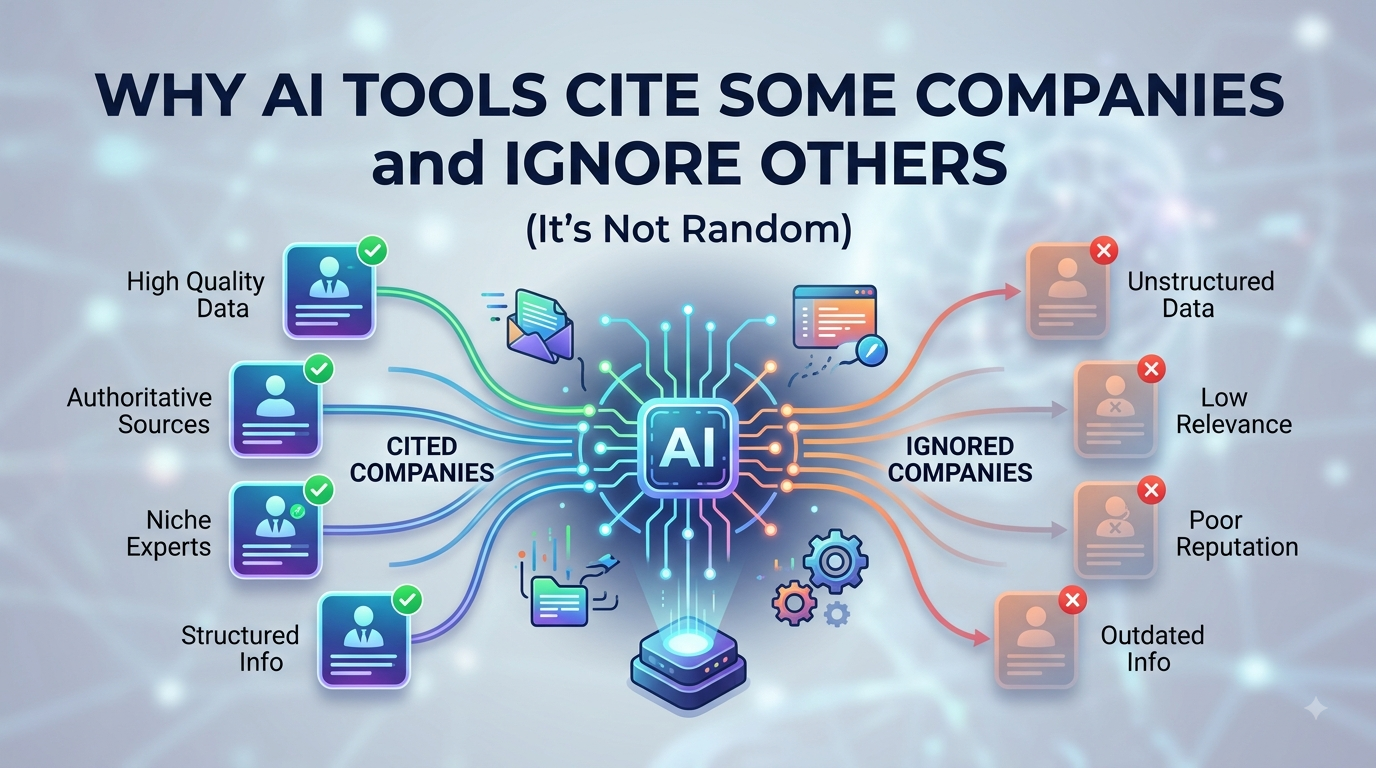
Ask enough business owners about their experience with AI search and you’ll hear a version of the same complaint: a direct competitor gets mentioned by name when someone asks ChatGPT or Perplexity a question in their industry, and their own company, despite being just as established, doesn’t come up at all. It can feel arbitrary, almost like a coin flip decided by whatever the model happened to have seen. It isn’t arbitrary. There’s a fairly consistent pattern in what gets cited and what gets skipped, and once you see the pattern, it stops looking like luck and starts looking like a set of choices some companies have made and others haven’t.
The first pattern is that AI systems tend to cite content that answers a specific question clearly and directly, rather than content that talks around a topic in general terms. When a generative model is constructing an answer, it’s pulling from sources that let it state something concrete with confidence. A page that says plainly what a service costs, how a process works, or what a specific technical specification is gives the model something it can restate accurately. A page that speaks only in broad, general language, the kind built more for brand impression than for answering a real question, doesn’t give the model much to work with. It’s not that the vague company is being penalized. It’s that there’s nothing extractable there for the model to use, so it reaches for a competitor whose content actually answered the question being asked.
The second pattern is that structure matters more than most companies expect. Content organized with clear headers, direct statements near the top of a section, and information broken into distinct, well-labeled pieces is easier for a model to parse and pull an accurate citation from than a dense, unstructured wall of text where the useful detail is buried in the middle of a paragraph. This isn’t about writing for robots instead of humans. Well-structured content tends to be more genuinely useful to a human reader too. But companies that haven’t thought about structure at all, and have pages built primarily around narrative or marketing flow rather than clarity, are inadvertently making themselves harder for these systems to cite even when their underlying information is perfectly good.
The third pattern, and probably the least intuitive one, is that AI systems appear to weigh third-party validation heavily, not just what a company says about itself. A claim that only appears on a company’s own website carries less weight in a model’s synthesis than the same claim corroborated by an independent source, a review site, a press mention, an industry publication, or a case study referenced elsewhere. This mirrors how a careful human researcher would behave: trusting a company’s self-description less than an outside source saying the same thing. Businesses that have only ever invested in their own website, without any presence in the broader ecosystem of press, reviews, and industry content that discusses them, are working with a thinner evidence base than a competitor whose claims show up corroborated in multiple places across the web.
The fourth pattern is consistency across sources. When a model encounters the same fact about a company, whether that’s a specific certification, a service area, or a specialty, stated the same way across the company’s own site, its listings, and any third-party mentions, that consistency reinforces confidence in the fact. When the same detail is stated differently in different places, or contradicts itself across a company’s own pages, that inconsistency creates exactly the kind of uncertainty a model is inclined to route around by choosing a source that doesn’t require reconciling conflicting information.
Put together, these patterns describe something closer to a competence and clarity filter than a lottery. Companies getting cited tend to have done a handful of unglamorous things well: answered real questions directly instead of vaguely, organized their content so it’s easy to extract information from, built up genuine third-party presence rather than relying only on their own site, and kept their facts consistent everywhere they appear. None of that is mysterious or reserved for large companies with big budgets. It’s closer to a checklist than a secret, which is good news for any company currently on the wrong side of that gap, because it means the gap is closeable.