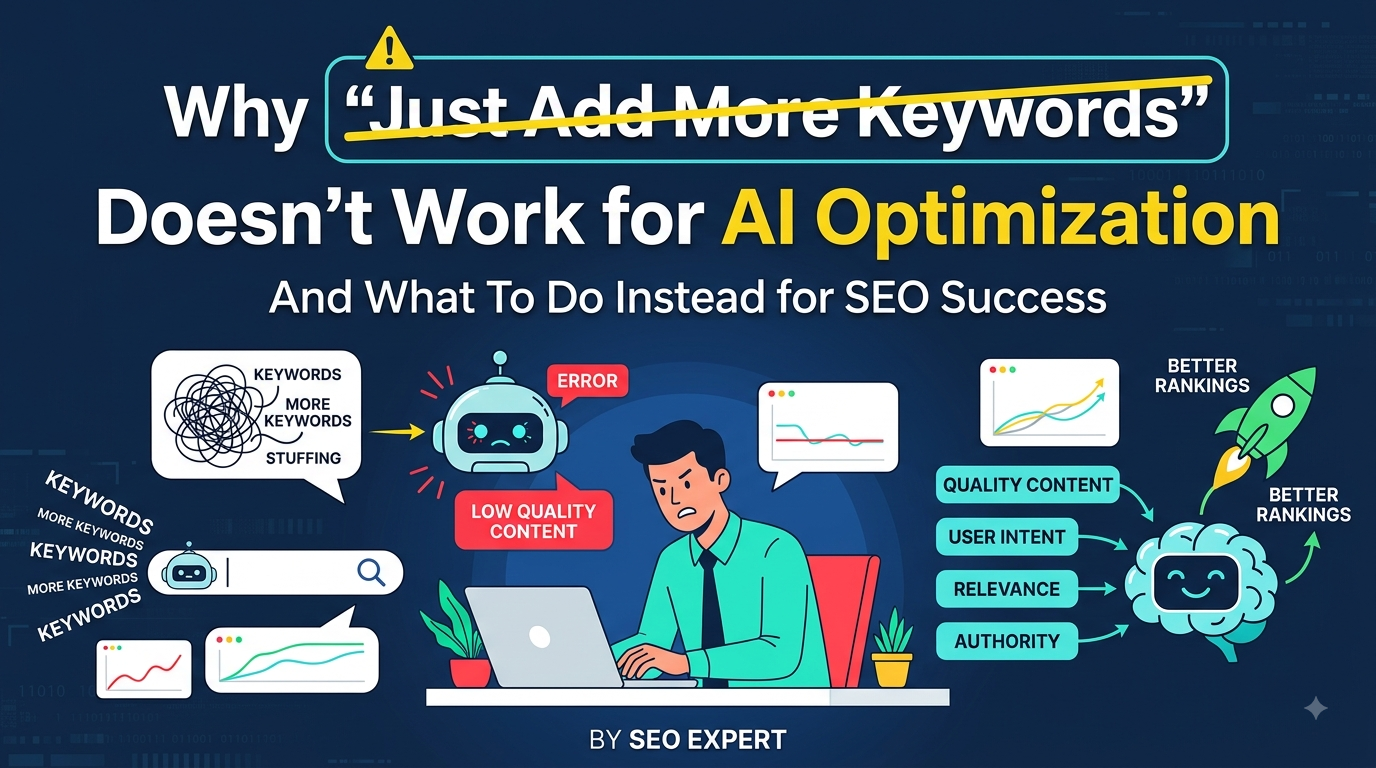
A lot of businesses approaching AI optimization for the first time bring the same mental model they built up over years of doing traditional SEO, and the most common version of that model is some variation of “make sure the important terms show up enough times on the page.” That instinct made sense for a long time, because early search engines really did rely heavily on keyword matching to figure out what a page was about. The assumption transfers naturally to AI search because it feels like the same problem: get your terms in front of the system enough times and it will notice you. The trouble is that generative AI tools aren’t solving the same problem traditional search engines were solving, and a tactic built for pattern matching doesn’t translate well to a system built for understanding and synthesis.
Traditional search engines built their early rankings around counting and matching. A page that repeated a target phrase a certain number of times, in the right places, signaled relevance in a way the algorithm could measure directly. Modern AI systems generating an answer aren’t counting keyword occurrences on a page at all. They’re synthesizing an answer from the underlying meaning of the content across many sources, then generating language that best reflects what those sources actually say. A page stuffed with a repeated phrase but thin on real explanation doesn’t rank higher in that process. If anything, it tends to get skipped entirely, because there’s nothing substantive there for the system to draw on when constructing its answer. The keyword density that used to be a subtle signal has become mostly irrelevant noise to a model that’s reading for meaning, not pattern-matching for occurrence counts.
What actually seems to influence whether an AI tool cites or references a company is much closer to what would convince a genuinely well-informed human reader. Content that clearly and specifically answers a real question, in language that resolves ambiguity rather than dancing around it, gives a generative system something concrete to draw from and paraphrase accurately. Content that’s vague, repetitive, or written primarily to satisfy a keyword target rather than to actually inform someone tends to contain very little the model can confidently extract and restate. Because these systems are trying to produce an accurate, useful answer for the person asking, they gravitate toward sources that make that job easy, and a page optimized around repetition rather than clarity makes that job harder, not easier.
There’s also a structural dimension that keyword-focused strategies tend to ignore entirely. AI systems often favor content that’s cleanly organized, with clear headers, direct answers near the top, and a logical structure that separates distinct ideas instead of blending them into a single dense block optimized to hit a word count and a keyword quota. A page built around repeating a target phrase as many times as felt tolerable often produces exactly the kind of muddy, repetitive writing that’s hardest for a system to cleanly extract a citable statement from. Clarity and structure end up mattering more than frequency, which is close to the opposite of what old-school keyword optimization prioritized.
None of this means keywords are irrelevant. Understanding the language real people use when they’re trying to solve a problem is still valuable, because it tells you what questions to actually answer and what terminology to use naturally while answering them. The mistake isn’t paying attention to language at all. It’s treating that language as something to insert repeatedly rather than something to genuinely address. A business that keeps applying a repetition-based mindset to AI optimization is optimizing for a measurement that generative systems mostly aren’t taking, while missing the actual signals, clarity, structure, and substantive answers, that these systems are built to reward.