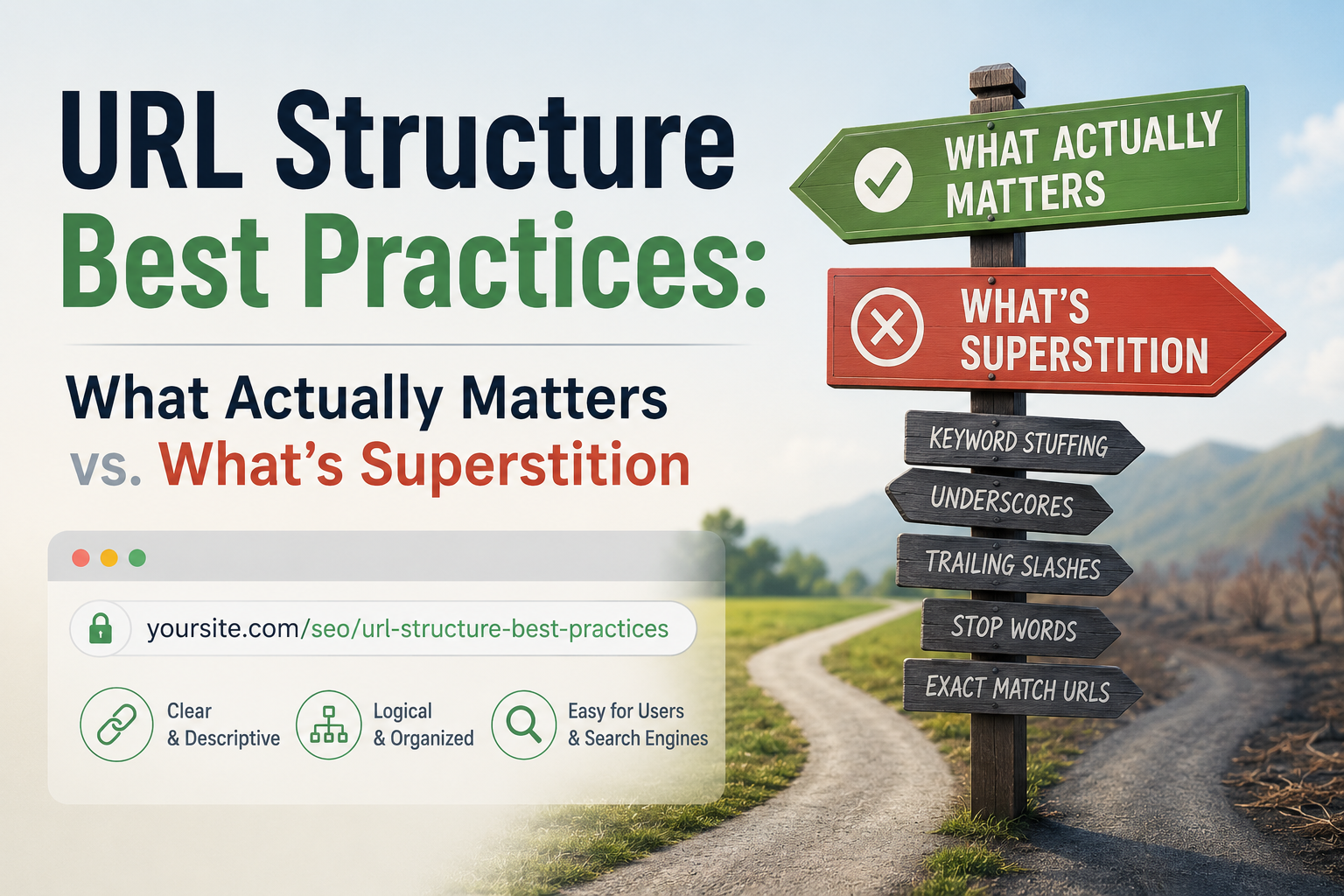
Open ten different SEO guides and you’ll find ten confident, sometimes contradictory rules about URLs: stay under a certain character count, always include your exact keyword, never use dates, never nest more than three folders deep. Some of this is genuinely useful. A lot of it is superstition repeated so often it’s mistaken for settled fact. Here’s a breakdown of what’s actually confirmed, what’s a minor signal, and what’s a myth worth retiring.
What Actually Matters
Readability, for humans. This is the strongest, least debatable reason to care about URL structure at all. A URL like yoursite.com/blog/how-to-choose-running-shoes tells someone exactly what they’re about to click. A URL like yoursite.com/?p=4821&cat=12 tells them nothing. That affects trust and click-through behavior directly, regardless of what any algorithm does with the string.
A logical, consistent structure. Pick a pattern — flat (/post-name) or categorized (/category/post-name) — and stick with it. Consistency helps both visitors navigating the site and your own ability to manage it as it grows. Switching patterns partway through a site’s life is what creates a tangle of legacy redirects down the road.HTTPS. Google confirmed HTTPS as a ranking signal back in 2014, and it remains a baseline trust factor — a security requirement, not a stylistic preference.
Avoiding duplicate URLs for the same content. If one page is reachable through multiple URLs — with and without a trailing slash, different capitalization, tracking parameters — that’s a genuine technical issue. Canonical tags tell Google which version is the real one, and settling on one consistent format going forward prevents the problem from recurring.
One real keyword in the slug, used naturally. This is confirmed, but genuinely minor. Google’s own public guidance consistently frames it as a lightweight, tie-breaker-level signal — a small hint during initial crawling, before Google has fully processed the page’s actual content. Once a page is indexed, this effect fades almost entirely, since the title, headers, and body copy become far stronger indicators of what the page is about.
What’s Mostly Superstition
URL length as a direct ranking factor. This is the biggest myth still in circulation. Google’s Search Advocate John Mueller has said outright that URL length doesn’t affect rankings, and that URLs function as identifiers rather than something scored on length. The “shorter URLs rank better” idea traces back to older correlation studies that noticed shorter URLs tend to show up on well-established, well-organized sites — a correlation with solid site architecture in general, not a causal length effect. If your CMS produces a longer URL because of a genuinely deep, logical folder structure, that’s a site-architecture question, not an SEO penalty.
URL length affecting click-through rate. This carried some truth back when search results displayed the full URL path prominently. Today, on both mobile and desktop, Google typically shows the site name, a favicon, and a breadcrumb-style path instead of the raw URL string. Your title tag and meta description now do far more of the work in earning a click than URL length ever will.Keyword-stuffed URLs. Cramming several keyword variations into one slug (/best-cheap-running-shoes-for-beginners-2026-review) adds nothing beyond one clean, natural phrase, and it actively damages readability and click appeal. Since the underlying keyword signal is already minor, the returns diminish almost immediately after the first clear mention.
Dates in URLs, as a blanket rule. The common advice — “never put a date in a URL, it makes content look stale” — is situational rather than universal. For genuinely evergreen content, skipping the date makes sense, since a 2019 timestamp next to otherwise current advice undercuts it. But for content that’s inherently tied to a moment in time — news coverage, an annual roundup, an event recap — a date is honest and appropriate. The real mistake is applying a blanket “no dates” rule to content that actually benefits from being dated.
The Middle Ground: Things That Matter a Little
URL depth (how many folders deep a page sits). Extremely deep nesting (/category/subcategory/subcategory/subcategory/post-name) can create real crawl inefficiency on very large sites, and pages positioned further from the homepage in a site’s internal link structure sometimes receive a weaker authority signal as a result. For a small or mid-sized site, this rarely becomes a practical problem. For a large e-commerce site with thousands of pages, it’s worth deliberate planning.
Category or folder naming. Google does read the category names in a URL path as a mild thematic hint. Worth getting right when a site’s structure is first being built, but not worth a full restructure of an already-established site.
A Simple, Durable Rule of Thumb
Given how much of this list turns out to be either minor-but-confirmed or outright myth, the practical takeaway is simple: build URLs for the person clicking on them, not for an imagined algorithm scoring them keyword by keyword. A clean, readable, natural-language slug with one clear keyword, served over HTTPS, with no duplicate versions floating around, covers essentially everything actually confirmed to matter. Anything beyond that is optimizing for a rule that either doesn’t exist or barely moves the needle, at the cost of readability that genuinely does.
Don’t Retroactively Chase This
One important caution: if your existing URLs don’t perfectly follow every practice above, resist the urge to rush in and fix them. Changing a URL means implementing a redirect, and while a well-executed 301 preserves most of a page’s ranking value, it isn’t risk-free — doing it purely to shorten a URL or squeeze in a keyword that’s already a minor signal rarely justifies the disruption. Save URL structure decisions for new content and genuine restructuring projects, not as a retroactive fix for pages that are already performing fine.
URL structure is one of those SEO areas where the gap between “widely repeated” and “actually confirmed” is unusually wide. Getting the fundamentals right once, at the outset, matters far more than chasing incremental rules that mostly turn out to be folklore.