Schema markup has always been one of those SEO tasks that sounds more important than it usually turns out to be for a typical blog. It’s also a topic that’s shifted meaningfully in 2026, after Google quietly retired two of the schema types bloggers relied on most. This post covers what schema markup actually is, what’s genuinely worth implementing right now, and what to leave alone despite years of advice telling you otherwise.
What Schema Markup Actually Does
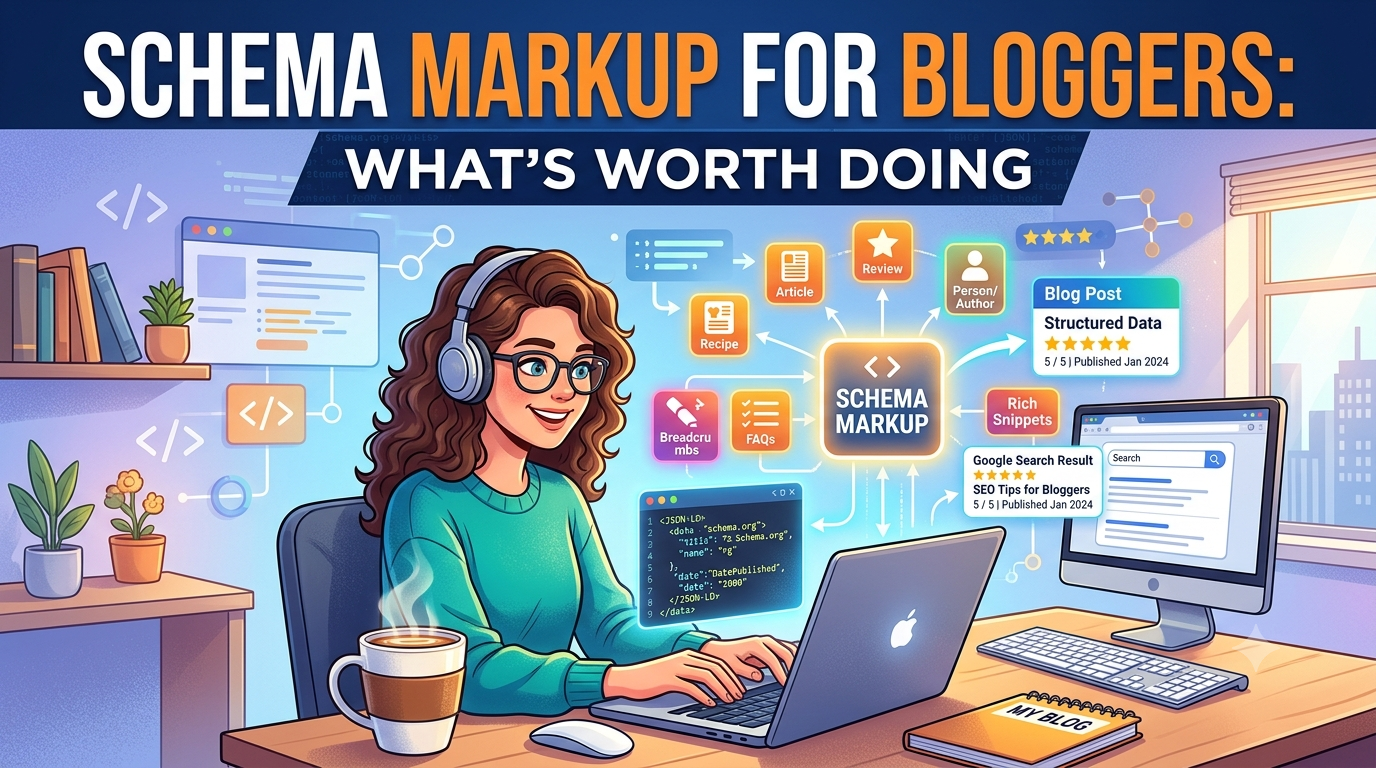
Schema markup is structured code, usually written as JSON-LD, added to a page to explicitly tell search engines what a piece of content represents: this is a recipe, this is a product with a price, this is an article by a specific author published on a specific date. Search engines can often infer a lot of this from the visible page content alone, but explicit markup removes ambiguity and, for certain types, unlocks specific visual treatments in search results known as rich results.
It’s worth separating these two functions clearly, because the events of the past few years have made that distinction matter a great deal. Schema markup as a machine-readable description of your content is one thing. Rich results, the visual dropdowns, star ratings, and expandable panels that markup can sometimes trigger, are a separate thing that Google controls entirely and can remove at will, independent of whether the underlying markup remains valid.
The Big Change: FAQ and HowTo Rich Results Are Gone
For years, FAQ schema was one of the most commonly recommended tactics for bloggers, since it could trigger an expandable question-and-answer dropdown directly under a search listing, giving a result significantly more visual space on the page. As of May 2026, that’s over. Google has fully retired FAQ rich results in search, following a multi-year narrowing that had already restricted the feature to a small set of government and health sites back in 2023. Google is also removing the related Search Console reporting and Rich Results Test support in stages through mid-2026.
This follows the same path rich results took years earlier, when that format was pulled from desktop search entirely back in 2023 and largely lost its remaining relevance since. If you’ve been adding FAQ or HowTo schema to win extra visual space in search results, that payoff no longer exists, regardless of how well-implemented the markup is.
Importantly, Google has been clear that this is a change to what displays in search, not a penalty against the markup itself. FAQPage remains a valid schema.org type, existing markup won’t cause errors or ranking harm, and other search engines and AI crawlers still parse it. There’s simply no visual reward left for adding it purely for that purpose.
What This Means Practically for a Blogger
If your blog has FAQ schema sitting on pages where the FAQ content is genuinely useful to readers, there’s no urgency to rip it out. Google has said explicitly that unused structured data doesn’t harm a site, so leaving accurate, still-relevant markup in place is a reasonable, low-effort choice. What’s worth reconsidering is adding new FAQ schema purely as an SEO tactic going forward, since the primary reason bloggers adopted it, the SERP dropdown, no longer exists.
The takeaway, echoed across most current coverage of this change, is that the value was always in having clear, well-organized question-and-answer content on the page itself, something a reader benefits from and something AI systems can still parse and cite regardless of whether formal schema markup wraps around it. Writing a genuinely useful FAQ section as part of a post’s content remains worthwhile. Adding the JSON-LD wrapper around it purely to chase a rich result that no longer exists is not.
What Still Works and Is Worth Doing
Several schema types continue to produce rich results and remain worth a blogger’s time. Article schema, describing a post’s headline, author, publish date, and last-updated date, remains supported and has taken on additional importance as a signal for AI-generated search summaries, which increasingly look for clear authorship and freshness signals when deciding what to cite.
Review and Aggregate
Rating schema, which can produce visible star ratings in search results, remains fully supported and is worth adding to any post that includes a genuine review or rating of a product, book, or service. BreadcrumbList schema, showing a page’s position within your site hierarchy directly in the search result, remains supported and reinforces the kind of site architecture discussed earlier in this series in a way that’s directly visible to searchers.For a blog that publishes recipes, Recipe schema also remains a strongly supported, high-value type, since it’s tied to a rich result format that continues to perform well and gives visible information, like cook time and ratings, that meaningfully influences click-through.
The Pattern Behind Google’s Recent Changes
It’s worth understanding why this happened, since it informs how much to trust any given schema type’s long-term value going forward. Google has been steadily narrowing the set of structured data types that produce visible rich results, retiring several underused or frequently-abused formats over the past few years alongside FAQ and HowTo. The consistent reasoning given is reducing visual clutter and removing formats that weren’t reliably adding value for searchers, rather than any broader retreat from structured data as a concept.
This suggests a reasonable working assumption for a blogger deciding where to invest schema effort: types tied to genuinely valuable, differentiated information, like a real product review with a real rating, or a real recipe with real cook times, are more durable bets than types that were mainly being used to win extra screen space regardless of whether the underlying content justified it. Rich results tied to a specific commercial or content value tend to survive these periodic prunings better than ones that became popular mainly as a visibility hack.
Schema and AI Search: A More Careful Claim Than It Sounds
A lot of current advice suggests schema markup, and complete Article schema in particular, helps content get cited in AI-generated search summaries like Google’s AI Overviews. This is worth treating carefully rather than as a settled fact. Google’s own guidance on AI features states there’s no special schema required for AI Overviews or AI Mode specifically, though structured data should still accurately match the page’s visible content. Independent research has also found no clear correlation between schema markup coverage and citation rates across AI platforms, suggesting that clear, well-organized visible content is doing more of the actual work than the markup layer itself.
The more defensible position is that structured data is a low-cost way to make already-good content more clearly machine-readable, not a shortcut that makes weak content perform better in AI-driven search. If a post’s actual content clearly answers a question in plain, well-organized prose, that clarity likely matters more to both traditional rankings and AI citation than whether a JSON-LD block sits alongside it.
A Practical Approach for a Solo Blogger
Given all this, a reasonable schema strategy for most blogs in 2026 is fairly narrow. Add Article schema consistently across posts, since it’s cheap to implement, remains supported, and plausibly helps with both traditional search presentation and AI-driven citation. Add Review schema on any post that includes a genuine product or service review, since the star-rating rich result remains a real, visible benefit. Add Recipe schema if your blog publishes recipes, for the same reason. Beyond that, don’t chase additional schema types purely because a guide recommends them, and don’t feel obligated to remove existing FAQ or HowTo markup that’s otherwise accurate and harmless, even though it no longer earns the visual placement it once did.
The Broader Lesson
This whole episode is a useful illustration of a theme that runs through this series more broadly: structural and technical fixes, schema markup included, support good content, they don’t substitute for it. The bloggers least affected by this change were the ones who built genuinely useful FAQ sections as real content in the first place, where the markup was simply a wrapper around something already worth having. The bloggers most affected were the ones who added FAQ schema purely as a tactic, wrapping thin or forced Q&A sections around content that didn’t need that structure, chasing a rich result that’s now gone.